



N.Y.'s Centro lends buses to TCAT to help prevent missed trips
In October alone, TCAT reported 90 missed trips due to bus shortages.

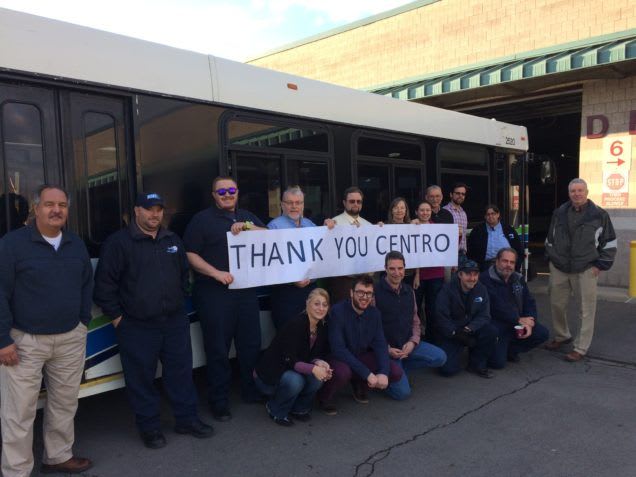
Upon the request of TCAT GM Scot Vanderpool, (shown above far right with TCAT staff) Centro CEO Rick Lee last week quickly agreed to lend two 40-foot 2005 New Flyer diesel buses, which TCAT bus operators and a mechanic transported back to Ithaca on Fri., Dec. 1. Photo: TCAT
Upon the request of TCAT GM Scot Vanderpool, (shown above far right with TCAT staff) Centro CEO Rick Lee last week quickly agreed to lend two 40-foot 2005 New Flyer diesel buses, which TCAT bus operators and a mechanic transported back to Ithaca on Fri., Dec. 1. Photo: TCAT
Syracuse-based Central New York Regional Transportation Authority (Centro) has come to TCAT’s rescue by lending two buses to the Ithaca-based transit agency to help it prevent missed trips due to bus shortages.
Upon the request of TCAT GM Scot Vanderpool, Centro CEO Rick Lee last week quickly agreed to lend two 40-foot 2005 New Flyer diesel buses, which TCAT bus operators and a mechanic transported back to Ithaca on Fri., Dec. 1. After they pass the required state inspections, the buses will be put into service.
TCAT has already ordered and expects to receive 11 brand new Gillig buses to replace older buses in February, but needs help in the meantime to get through “a rough patch” with equipment failure and bus shortages — both of which force TCAT dispatchers to make the difficult decision to pull trips, thus, inconveniencing riders, Vanderpool said. In October alone, TCAT reported 90 missed trips due to bus shortages. Though TCAT pulls trips on high-frequency routes so that passengers can catch the next bus within a relatively short time frame, any missed trip is unacceptable, Vanderpool said.
“TCAT is in a particularly bad place on weekdays due to our aging fleet,” Vanderpool said. “We certainly need the help that Centro is providing to assure that we meet our service demands and to provide the reliable service our customers expect and deserve. We are very appreciative of Rick Lee’s and Centro’s generosity, support and quick response in helping out a fellow transit agency.”
The head of the New York Public Transit Association (NYPTA), the trade association in Albany representing transit agencies across the state, said the arrangement is a prime example of the strong alliances forged by NYPTA’s members, all of whom have a “real interest in everyone succeeding.”
“The collaboration and sharing public transit systems have formed statewide are all about helping local communities thrive,” said NYPTA President Bill Carpenter, who is the CEO of Rochester’s Regional Transit Service (RTS). “As TCAT works to manage an aging fleet, Centro stepped in to help meet service demands. Community and public transit go hand in hand, it’s that simple.”
Larry Stackhouse, Centro’s Senior Director of Fleet Maintenance, has offered to schedule time to come to Ithaca to train TCAT’s maintenance crew and give an overview of the buses, as well as information about preventative maintenance. In addition, the New York Department of Transportation (NYSDOT) has agreed to expedite the inspections of the two buses as soon as possible.
“It’s nice to know we have a great team within the NYPTA organization made up of great transit agencies, such as Centro, that we can turn to,” said Vanderpool, who worked at Centro from 1996 before joining Syracuse University in 2003 where he was the university’s Parking and Transit Services manager. Vanderpool joined TCAT last winter, first as its operations manager, before being promoted to GM in August, and has since been looking for creative ways to deal with TCAT’s bus shortages.
Vanderpool said Centro’s buses will be used on TCAT’s Route 82 campus route. The buses are painted white with dark blue, light blue and green stripes and will place TCAT’s logo on them to help passengers identify them. TCAT will alert passengers via the Bus Tracker on its web site, the MyStop app and elsewhere when the buses will go into service.
Centro, which has a fleet size of approximately 235 buses, provides public transportation to Onondaga, Oswego, Cayuga, and Oneida counties.
More Bus

New York MTA Plans Largest Bus Fleet Upgrade in More Than a Decade
The agency is seeking manufacturers for 650 new CNG buses to replace aging vehicles, improve reliability, and advance its broader fleet modernization strategy.
Read More →
Building a Flexible Path to Transit Electrification
John Hroncich discusses BAE Systems’ modular and scalable approach, lessons learned from decades of real-world operations, and how agencies can identify electrification strategies that fit their fleets.
Read More →
Bus Tech Talk: Keeping Transit Technicians Ahead of the Technology Curve
LA Metro’s Obed Mejia discusses technician training, evolving maintenance technology, fleet replacement, and strategies for getting the most out of today’s transit fleets.
Read More →
Biz Briefs: RIPTA Unveils New Frontrunners, Clevland RTA Adds New Siemens, and More
In METRO's latest installment, we take a look at recent news from Siemens, Prevost, Dodge, and more partnerships making headlines across the transportation sector.
Read More →
People Movement: Holly Arnold Joins Transdev and More
In this edition, we also cover recent appointments and announcements at Pace, CamTran, MCI, and more, showcasing the individuals helping to shape the future of transportation.
Read More →
The High Cost of Transit Buses: Industry Leaders Look to Procurement Reform
Transit leaders and policymakers examine how standardized bus designs, streamlined procurement, and predictable funding could help agencies stretch budgets and deliver better service.
Read More →
The Business Voice Behind Public Transportation
As chair of APTA’s Business Members Board of Governors, Ray Melleady explains how more than 850 business members are partnering with transit agencies to advance funding, innovation, and industry-wide collaboration.
Read More →
From Surviving to Thriving: Building Stronger Transportation Organizations
Bus Business Consultants founder Brian Dickson shares lessons on leadership, organizational health, and creating options for long-term success in a changing transportation industry.
Read More →
Finding the ‘Happy Medium’: Optimizing Maintenance Without Sacrificing Reliability
The key to maintenance optimization isn’t doing less work—it’s doing the right work at the right time on the right assets.
Read More →
LA Metro, City of West Hollywood, and Partners Advance Smarter Bus Lane Enforcement
The award-winning partnership combines AI-powered detection with human oversight to improve bus reliability, accessibility, and enforcement efficiency.
Read More →