



Nearly 9 in 10 Americans see benefits of public transportation
Increased mobility for more people, jobs and cleaner air most frequently cited benefits, according to a new HNTB survey.

HNTB Corp.
Almost nine in 10 Americans (88 percent) recognize public transportation systems provide a wide array of benefits to the communities they serve, according to a new HNTB Corp. America THINKS public opinion survey.
The survey, Public Transportation-2017, found 83 percent of Americans have some type of public transportation option available where they live or work; 71 percent of those have used it at some point; and 51 percent have opted to use public transportation instead of driving in the past 12 months.
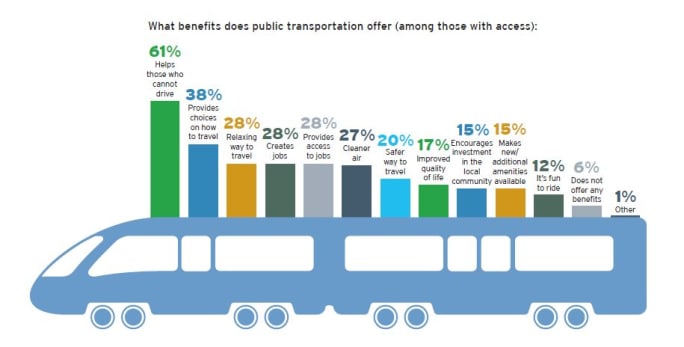
Americans identified an array of benefits provided by public transportation. Helping those who cannot drive was the benefit cited by more respondents (61 percent) than any other. Among others mentioned were providing travel choice (38 percent), offering a relaxing way to travel (28 percent), creating jobs (28 percent), access to jobs (28 percent) and contributing to cleaner air (27 percent).
HNTB Corp.
The survey’s respondents also said the most prevalent forms of public transportation currently available to them are buses/street cars (78 percent), followed by taxis and related services (64 percent), and railroads/subways (34 percent).
New transportation technologies
The HNTB survey found 48 percent of respondents with access to public transportation would be interested in using a driverless vehicle to go to and from public transportation stations, with interest strongest among millennials at 63 percent.
Access to public transportation using a ride-sharing service for travel from their homes to public transportation facilities is of interest to 42 percent of respondents, and rises to 58 percent for millennials.
“With the expanded use of ride-sharing — ranging from traditional car and van pooling to newer technology-based services such as ride-hailing — with smart phone apps and autonomous vehicle options in our not-too-distant future, people increasingly can have a lower-stress, modestly priced way to connect home to station. This is truly a game-changer for public transportation and more Americans who are considering using transit,” said Diana Mendes, AICP, HNTB senior vice president and national transit/rail practice leader.
How and where to invest
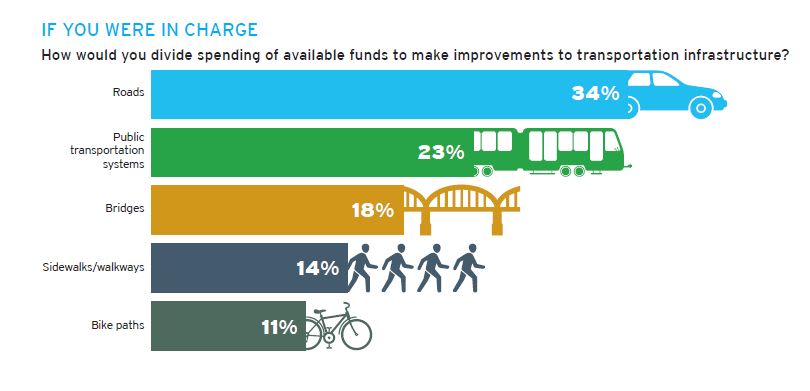
The survey asked Americans how they would divide available funding to make improvements to the transportation infrastructure — roads, public transportation, bridges, sidewalks and bike paths. Roads would receive the largest share (34 percent) and public transportation systems (23 percent), while bridges would be allocated 18 percent, sidewalks/walkways would get 14 percent and bike paths 11 percent.
Respondents also were asked how they would divide available funding among local transit system components of transit vehicles, safety systems and controls, parking facilities, track infrastructure, and station or stop facilities. They are most interested in seeing available dollars spent on transit vehicles (29 percent) and safety systems (21 percent). Parking facilities were cited by 18 percent of respondents, while track infrastructure was cited by 17 percent, and stations or stop facilities at 15 percent.
Why people use public transportation
While respondents identified many reasons for using public transportation, saving money was the most commonly identified reason by 33 percent of respondents. Avoiding traffic/congestion was cited by 24 percent; convenience, by 23 percent; and the ability to relax and/or be productive on the ride, by 21 percent of Americans surveyed.
When respondents also were asked to identify the one aspect they liked most about public transportation, cost was cited most frequently at 21 percent. Convenience was named by 17 percent of Americans, and being a passenger by 15 percent. Ease of use (11 percent) and availability (11 percent) were among those cited next.
More New Mobility

From Hardware to Digital Partner: Luminator Charts Its Next Chapter
CEO Magnus Friberg discusses Luminator’s shift toward becoming a digital partner, the growing importance of software and interoperability, and how AI can help agencies improve operations and passenger experience.
Read More →
Biz Briefs: Alstom Lands Canadian Contract, LYT to Supply California TSP, and More
In METRO's latest installment, we take a look at recent news from Complete Coach Works, Beep, FlixBus, and more partnerships making headlines across the transportation sector.
Read More →
CharterUP’s Armir Harris on Technology, AI, and the Future of Group Mobility
In a recent episode of METROspectives, CharterUP Founder/CEO Armir Harris discussed the company’s evolution from an online charter bus marketplace into a technology platform supporting public- and private-sector mobility and much more.
Read More →
Jacksonville’s NAVI Project Charts a New Course for Autonomous Public Transportation
Through its NAVI program, JTA is showing how autonomous vehicles, intelligent infrastructure, and coordinated operations can work together to deliver everyday public transportation.
Read More →
Biz Briefs: Luminator Marks Milestone and More
From manufacturers and suppliers to transit agencies and motorcoach operators, these updates offer a snapshot of the projects, partnerships and business moves driving the industry forward.
Read More →
New Tricks for Old Bureaucracies: Joshua Schank on Making Transit Innovation Stick
Former LA Metro Chief Innovation Officer Joshua Schank discusses why good ideas aren't enough, how transit agencies can overcome resistance to change, and why today's challenges demand more innovation.
Read More →
How DART's GoPass Is Redefining Regional Mobility
Serving 14 transit agencies, GoPass simplifies multimodal travel by allowing riders to plan, pay for, and manage an entire trip through one app.
Read More →
Biz Briefs: OCTA Taps Clean Energy for Hydrogen Station, Stadler to Supply Via Rail Vehicles, and More
From manufacturers and suppliers to transit agencies and motorcoach operators, these updates offer a snapshot of the projects, partnerships and business moves driving the industry forward.
Read More →CharterUP Expands Into New Mobility and Autonomous Transportation
Vice President of New Mobility Stephen Joos discusses how CharterUP is leveraging its nationwide transportation network, technology platform, and autonomous vehicle partnerships to expand into workforce mobility, campus shuttles, and transit solutions.
Read More →
METRO Magazine Announces 2026 Innovative Solutions Awards Winners
Projects Recognized for Advancing Mobility Through Technology, Accessibility, Workforce Innovation, and Operational Excellence
Read More →