



NTSB Calls for Railroads to Better Protect Rail Roadway Workers
The recommendation issued by the NTSB to the Federal Railroad Administration and Amtrak addressed several safety issues.
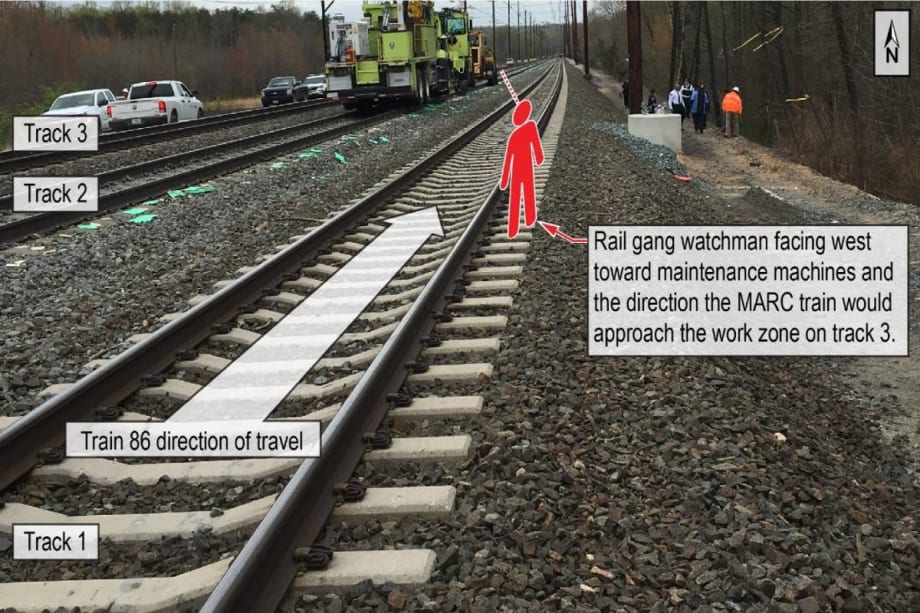
An illustration of the accident scene on April 24, 2018. The point where the roadway worker was struck by the train is marked with the red figure.
Photo: NTSB
The National Transportation Safety Board (NTSB) is urging the Federal Railroad Administration (FRA) and Amtrak to put an end to the use of “train approach warning” as the only method of on-track safety in areas covered by positive train control (PTC).
The NTSB said using TAW instead of available protections provided by advanced positive train control systems, Amtrak circumvented important PTC safety features that could help prevent rail worker deaths.
The safety recommendations issued in Railroad Accident Report 21/02, are based on an April 24, 2018, accident. An Amtrak rail watchman was killed in Bowie, Md.
The NTSB said that Amtrak’s insufficient site-specific safety work plan for the Bowie project did not adequately consider the challenges of multiple main tracks in a high-noise environment.
The watchman was focused on the movement of a southbound MARC commuter train when he was struck from behind by a high-speed northbound Amtrak train.
The NTSB said PTC could have been used to enforce speed restrictions. This would have automatically reduced the speed of trains in the work zone. The company also said PTC could have been used to prevent trains from even entering the work zone.
According to the latest FRA data, there have been 459 employee on-duty fatalities since 1997.
“More action needs to be taken to protect train crews, maintenance-of-way employees, and mechanical workers from getting killed or injured,” said Thomas Chapman, NTSB board member Thomas Chapman. “We have found from our investigations that many of these accidents are, tragically, preventable.”
The recommendation issued by the NTSB to the FRA and Amtrak address safety issues, including inadequate site safety risk assessment, unsafe train speeds in work zones, the failure to use PTC to protect roadway workers, and ineffective roadway worker protection.
In a letter sent to the leaders of the nation’s Class I Railroads and Amtrak, NTSB chair Jennifer L. Homendy said the continued use of TAW circumvents the protections that would be provided by PTC in controlled track territory.
“In short, the decades of funding, research, equipment, and training you have put into the implementation of PTC is being undone by the continued use of TAW,” Homendy said. “The continued use of TAW as a method of on-track safety is a deadly risk that your roadway workers cannot be asked to bear.”
More Rail
Amtrak, CN Reach Agreements to Strengthen Passenger Rail Service, Safety
The agreement resolves a more than decade-long proceeding before the Surface Transportation Board concerning the terms and conditions for Amtrak services, such as the City of New Orleans, Illini/Saluki, and Wolverine.
Read More →
New York MTA Advances Final Contract for Second Avenue Subway Expansion
Contract Four is the largest in the Second Avenue Subway Phase 2 project and includes construction of station infrastructure, tracks, and signals for the subway expansion, MTA officials said. Work on Contract Four will begin in 2027.
Read More →
San Diego MTS Breaks Monthly Trolley Ridership Record
Agency officials said July’s ridership indicates MTS’s continued recovery from the pandemic.
Read More →
Report Examines NJ TRANSIT Reliability, Funding Challenges
The Garden State Initiative analysis examines the roles of Amtrak infrastructure, fleet management, and agency operations while recommending a more performance-based approach to improving reliability.
Read More →
Stadler, CapMetro Sign Long-Term Rail Fleet Support Agreement
Beginning in 2027, Stadler will provide on-site technical expertise, spare parts support, training, and obsolescence management to help extend the reliability and longevity of CapMetro’s GTW fleet.
Read More →
Biz Briefs: Alstom Lands Canadian Contract, LYT to Supply California TSP, and More
In METRO's latest installment, we take a look at recent news from Complete Coach Works, Beep, FlixBus, and more partnerships making headlines across the transportation sector.
Read More →
CATS Gold Line Marks 5 Years of Service, 2.8M Passenger Trips
With a six-mile expansion planned, the Charlotte streetcar is positioned to connect more neighborhoods and major transit hubs across the region.
Read More →
Why Simulating Pedestrian Movement Has Become Essential for Modern Rail Stations
Pedestrian microsimulation is helping rail planners identify bottlenecks, test station designs, and prepare complex transit hubs for growing passenger volumes.
Read More →
Amtrak Begins Major Construction at New York’s Sunnyside Yard
The new maintenance facility will support Amtrak’s Airo trainsets while improving maintenance efficiency and turnaround times in New York.
Read More →
Chicago Leaders Unveil Plans for O’Hare Airport Express Train
The privately developed project would offer a 15-minute trip between downtown and O’Hare’s Terminal 2, with trains operating every 15 minutes on a dedicated track. The service would use battery-electric trains and three existing freight rail rights-of-way.
Read More →