



NTSB Issues 3 Safety Recs Following Utah Bus Crash
The crash happened when the medium-size bus was traveling east on Utah State Route 12, carrying 30 passengers during a trip from Los Angeles to Salt Lake City. At a recorded speed of 64 mph (in a posted 65 mph zone) the bus’s right wheels departed the right edge of the roadway.
The National Transportation Safety Board issued three safety recommendations, with its final report on the agency’s investigation of the fatal Sept. 20, 2019, rollover bus crash near Bryce Canyon City, Utah.
In its safety recommendations the NTSB asks the National Highway Traffic Safety Administration to:
Require lane departure prevention systems on new commercial motor vehicles with gross vehicle weight ratings above 10,000 pounds.
Require all new buses, other than school buses, with a gross vehicle weight rating above 10,000 pounds to meet a roof strength standard that provides maximum survival space for all seating positions.
Require all new buses, other than school buses, with a gross vehicle weight rating above 10,000 pounds to meet a window glazing standard that prevents occupant ejection.
In Highway Accident Report 21/01, the NTSB also reiterated five previously issued safety recommendations, including two concerning stability control systems for commercial vehicles, and classified five others as “Closed – Unacceptable Action/Superseded.”
The crash happened when the medium-size bus was traveling east on Utah State Route 12, carrying 30 passengers during a trip from Los Angeles to Salt Lake City. At a recorded speed of 64 mph (in a posted 65 mph zone) the bus’s right wheels departed the right edge of the roadway. The driver steered left, and the bus went into the westbound lane. The driver then steered sharply to the right, causing the bus to become unstable. The bus then rolled 90 degrees onto its left side, sliding for about 85 feet until its roof struck the guardrail, rolled over the guardrail, and came to rest on its wheels, straddling the damaged guardrail. The crash killed four passengers, 17 others suffered serious injuries, nine more suffered minor injuries, and a total of 13 of the 30 passengers were ejected from the bus. The driver was not injured.
The NTSB determined the probable cause of the crash was the driver’s failure, for undetermined reasons, to maintain the bus within its travel lane, and his subsequent steering overcorrections, which caused the bus to become unstable and roll over. Factors that contributed to the severity of the crash include:
The bus roof’s deformation and collapse, which created ejection portals and compromised passengers’ survival space.
The National Highway Traffic Safety Administration’s failure to develop and issue standards for bus roof strength and window glazing to enhance the protection of bus passengers.
The lack of passenger lap/shoulder belts on the bus contributed to the ejections and the severity of injuries.
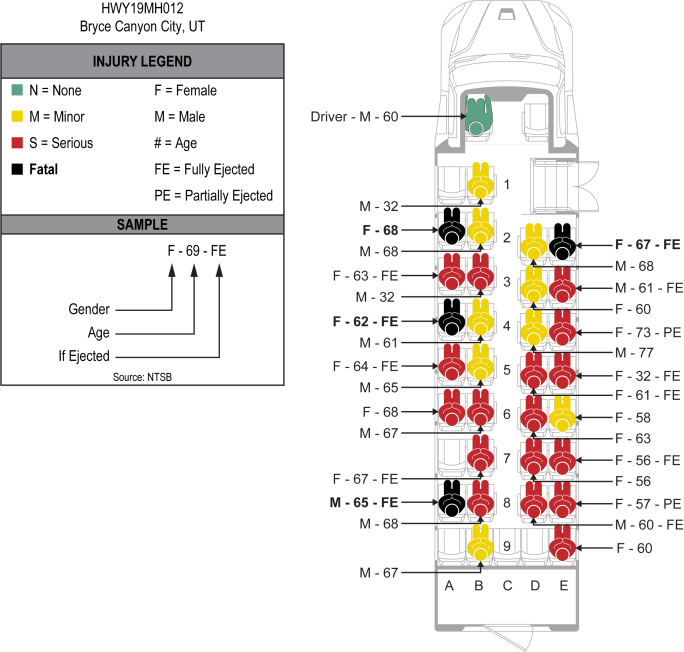
This seating chart of the medium-size bus involved in the fatal Sept. 20, 2019, crash near Bryce Canyon City, Utah, details the seating position and injury severity of the occupants. Of the 30 passengers aboard, 13 were ejected from the bus during the crash sequence.
NTSB graphic by Christy Spangler
NTSB investigators determined driver experience, licensing, alcohol or drug use, fatigue, distraction, and/or medical issues were not factors in the crash, nor was the mechanical operation of the bus. Similarly, highway design, markings, signage, and friction characteristics of the highway were not considered as factors in the crash. Motor carrier operations and state or federal oversight of the motor carrier, America Shengjia, were also ruled out as factors in the crash.
"This crash highlights the role that technology can play in preventing bus crashes,” said Rob Molloy, Director, Office of Highway Safety, at the NTSB. “A lane departure prevention system could have kept this crash from happening by keeping the bus in its travel lane. An electronic stability control system could have helped maintain the bus’s stability during the driver’s steering overcorrections, preventing the bus rollover.”
More Motorcoach

METRO Opens Submissions for 2026 Motorcoach Awards
Nominations are now being accepted for METRO Magazine’s Operator of the Year and Innovative Operator of the Year awards.
Read More →
Biz Briefs: Alstom Lands Canadian Contract, LYT to Supply California TSP, and More
In METRO's latest installment, we take a look at recent news from Complete Coach Works, Beep, FlixBus, and more partnerships making headlines across the transportation sector.
Read More →
Biz Briefs: RIPTA Unveils New Frontrunners, Clevland RTA Adds New Siemens, and More
In METRO's latest installment, we take a look at recent news from Siemens, Prevost, Dodge, and more partnerships making headlines across the transportation sector.
Read More →
People Movement: Holly Arnold Joins Transdev and More
In this edition, we also cover recent appointments and announcements at Pace, CamTran, MCI, and more, showcasing the individuals helping to shape the future of transportation.
Read More →
ABA Report: Motorcoach Travel Generates $161.6B Economic Impact
The 2025 analysis finds motorcoach travel supported nearly 900,000 jobs and generated $28 billion in federal, state, and local taxes.
Read More →
CharterUP’s Armir Harris on Technology, AI, and the Future of Group Mobility
In a recent episode of METROspectives, CharterUP Founder/CEO Armir Harris discussed the company’s evolution from an online charter bus marketplace into a technology platform supporting public- and private-sector mobility and much more.
Read More →
People Movement: ABC Names John Walsh as Chief Commercial Officer
In this edition, METRO also covers recent appointments and announcements at the DART, STV, and more, showcasing the individuals helping to shape the future of transportation.
Read More →
From Surviving to Thriving: Building Stronger Transportation Organizations
Bus Business Consultants founder Brian Dickson shares lessons on leadership, organizational health, and creating options for long-term success in a changing transportation industry.
Read More →
Biz Briefs: Luminator Marks Milestone and More
From manufacturers and suppliers to transit agencies and motorcoach operators, these updates offer a snapshot of the projects, partnerships and business moves driving the industry forward.
Read More →
ABAF Study Reveals Growing Insurance Crisis for Motorcoach Operators
Preliminary findings show 98% of operators faced premium increases over the past five years, while shrinking insurer participation is putting added pressure on businesses and customers.
Read More →