



NTSB releases motorcoach safety recs
Recommendations come in wake of January 2008 Mexican Hat, Utah motorcoach accident.

In the wake of January 2008's motorcoach accident in Mexican Hat, Utah, the National Transportation Safety Board made several safety recommendations to the coach operator - Arrow Stage Lines - as well as the United Motorcoach Association (UMA), American Bus Association (ABA), American Association of State Highway and Transportation Officials (AASHTO) and others.
The NTSB's recommendation for Arrow Stage Lines was to develop written contingency plans for each charter to ensure that trip planning is in place in the event of driver fatigue, incapacitation, or illness or in the event of trip delays necessitating replacement drivers to avoid hours-of-service violations and inform drivers of their trip's contingency plans.
The NTSB also urged the ABA and the UMA to inform its members through Websites, newsletters and conferences of the circumstances of the Mexican Hat accident. Further recommending that the prepared information should encourage charter operators to develop written contingency plans for each charter to ensure that trip planning is in place in the event of driver fatigue, incapacitation, or illness or in the event of trip delays necessitating replacement drivers to avoid hours-of-service violations and inform drivers of their trip's contingency plans. The NTSB also added that the prepared information should provide information about the risks of operating in rural areas without wireless telephone coverage and advise its members to carry mobile cellular amplifiers or satellite-based devices to communicate emergency events.
Meanwhile, the Federal Highway Administration was urged to develop and implement, in conjunction with AASHTO and the National Association of State Emergency Medical Services Officials, criteria based on traffic patterns, passenger volume and bus types that can be used to assess the risks of rural travel by large buses and to use the criteria as part of the SAFETEA-LU requirement to identify and select Highway Safety Improvement Program projects.
The NTSB also urged the Federal Interagency Committee on Emergency Medical Services to develop a plan that can be used by state and public safety answering points to pursue funding for enhancements of wireless communications coverage that can facilitate prompt accident notification and emergency response along high-risk rural roads, as identified under SAFETEA-LU criteria, and along rural roads having substantial large bus traffic, and evaluate the system of emergency care response to large- scale transportation-related rural accidents and, once that evaluation is completed, develop guidelines for emergency medical service response and provide those guidelines to the States.
The full list of recommendations may be viewed on NTSB's Website, www.ntsb.gov.
More Motorcoach

METRO Opens Submissions for 2026 Motorcoach Awards
Nominations are now being accepted for METRO Magazine’s Operator of the Year and Innovative Operator of the Year awards.
Read More →
Biz Briefs: Alstom Lands Canadian Contract, LYT to Supply California TSP, and More
In METRO's latest installment, we take a look at recent news from Complete Coach Works, Beep, FlixBus, and more partnerships making headlines across the transportation sector.
Read More →
Biz Briefs: RIPTA Unveils New Frontrunners, Clevland RTA Adds New Siemens, and More
In METRO's latest installment, we take a look at recent news from Siemens, Prevost, Dodge, and more partnerships making headlines across the transportation sector.
Read More →
People Movement: Holly Arnold Joins Transdev and More
In this edition, we also cover recent appointments and announcements at Pace, CamTran, MCI, and more, showcasing the individuals helping to shape the future of transportation.
Read More →
ABA Report: Motorcoach Travel Generates $161.6B Economic Impact
The 2025 analysis finds motorcoach travel supported nearly 900,000 jobs and generated $28 billion in federal, state, and local taxes.
Read More →
CharterUP’s Armir Harris on Technology, AI, and the Future of Group Mobility
In a recent episode of METROspectives, CharterUP Founder/CEO Armir Harris discussed the company’s evolution from an online charter bus marketplace into a technology platform supporting public- and private-sector mobility and much more.
Read More →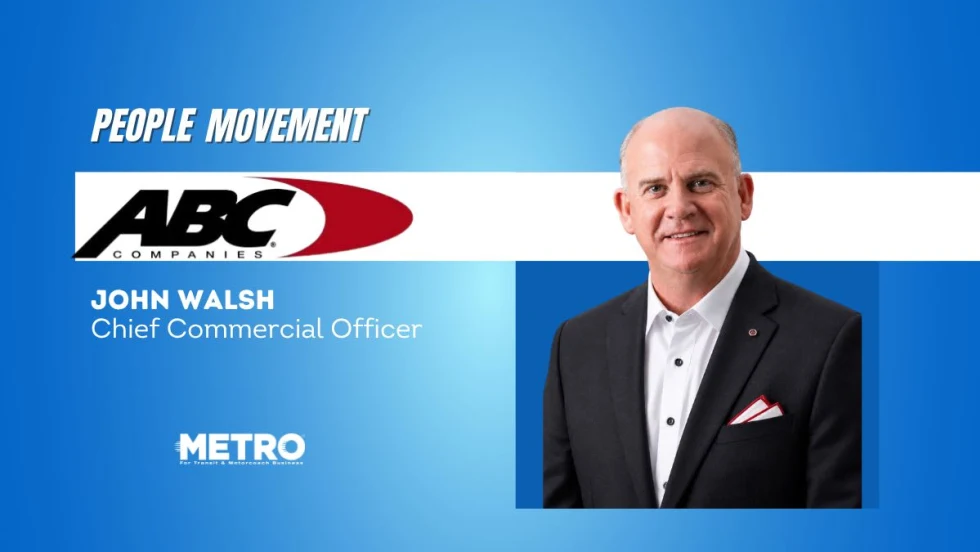
People Movement: ABC Names John Walsh as Chief Commercial Officer
In this edition, METRO also covers recent appointments and announcements at the DART, STV, and more, showcasing the individuals helping to shape the future of transportation.
Read More →
From Surviving to Thriving: Building Stronger Transportation Organizations
Bus Business Consultants founder Brian Dickson shares lessons on leadership, organizational health, and creating options for long-term success in a changing transportation industry.
Read More →
Biz Briefs: Luminator Marks Milestone and More
From manufacturers and suppliers to transit agencies and motorcoach operators, these updates offer a snapshot of the projects, partnerships and business moves driving the industry forward.
Read More →
ABAF Study Reveals Growing Insurance Crisis for Motorcoach Operators
Preliminary findings show 98% of operators faced premium increases over the past five years, while shrinking insurer participation is putting added pressure on businesses and customers.
Read More →