



Bipartisan BUSES Act Seeks Changes to New York City's Bus Idling Enforcement Program
Backed by motorcoach operators, the legislation seeks to balance emissions goals with passenger safety by allowing limited idling for inspections, accessibility needs and extreme weather conditions.

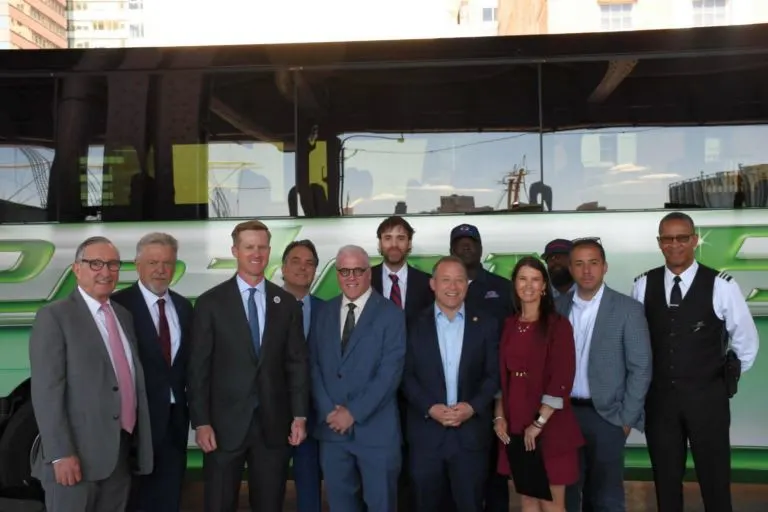
Rep. Gottheimer was joined by Fred Ferguson, CEO of the ABA; Glen Every, President of the Bus Association of New York State; Matthew Daus, City University of New York Region 2 Transportation Technology Chair, University Transportation Research Center; Michelle Petelicki, President, Panorama Tours Inc. & Representative of Greater Northeast Motorcoach Association; Steven Coyle, ABA Director of Government Relations; Howard Becker, Vice President of Membership, The Business Council of New York State; Patrick Condren, Bus4NYC Coalition Administrator; Aron Rush, Peter Pan Bus Driver; William Pelzer, Coach USA Bus Driver; Archim Hynes, Trailways Bus Driver; and Matt Costa, Yankee Lines.
Congressmen Gottheimer's Office
- U.S. Representatives Josh Gottheimer and Nick Langworthy introduced the bipartisan BUSES Act to establish federal standards for over-the-road bus idling.
- The legislation aims to address issues with New York City's private enforcement program, which impacts bus operators with fines for idling.
- The act seeks to simplify regulations for bus operators who travel across different state lines by creating a national standard.
*Summarized by AI
U.S. Rep. Josh Gottheimer (D-N.J.) joined bus industry leaders and small business owners to announce the bipartisan Buses Utilizing Safety and Environmental Standards (BUSES) Act, legislation created with Nick Langworthy (R-N.Y.), that would establish federal standards for over-the-road bus idling and address New York City's private enforcement program.
“This bus idling tax is not just bad policy. It is an offense to every principle of access and inclusion this country stands for. Operators are being put in an impossible position: do the job right and risk a fine, or cut corners on safety to beat an arbitrary clock. No one should ever have to make that choice,” said Rep. Gottheimer.
“Bus operators, who often travel across state lines and multiple jurisdictions, should not be forced to navigate a confusing maze of conflicting regulations just to do their jobs,” added Rep. Langworthy. “This legislation creates a commonsense national standard that protects transportation providers from excessive mandates while ensuring they have the flexibility needed to operate safely, especially in regions where safety, traffic, and weather conditions are a legitimate concern.”
The BUSES Act
Under New York City law, buses and trucks may not idle for more than three minutes in the city or for more than one minute adjacent to a school.
The city enforces these rules through the Citizens Air Complaint Program, which pays residents 25% of any fine collected when they report an idling vehicle; residents who file complaints directly with the Office of Administrative Trials and Hearings (OATH) can collect 50%. Fines range from $350 to $2,000 per violation, with companies subject to fines up to $15,000.
Some New Yorkers have turned bus bounty hunting into a full-time profession — the top five earners have collectively pocketed an estimated $3.6 million. Complaints under the program have skyrocketed from 49,000 in 2022 to 124,000 in 2024, with more than 62,000 already filed in 2026 alone — putting 2026 on track to be the biggest year yet for complaints, according to Rep. Gottheimer’s office.
The current NYC law makes no clear distinction between a bus sitting idle for no reason and a bus actively serving passengers, according to the bill’s sponsors. In practice, it penalizes operators for basic, legally required operations such as conducting federal safety inspections, loading passengers who are elderly or have disabilities, or keeping passengers at health risk cool during extreme heat.
Correcting Current Issues
Since 2020, more than 4,000 summonses have been issued against private bus carriers in New York City, resulting in hundreds of thousands of dollars in fines.
Academy Express, a well-regarded New Jersey bus operator, was hit with $120,000 in idling fines in a single day. ABA survey data shows the consequences: 35% of affected operators have reduced trips into New York City, 20% have turned down charters, and 10% have stopped operating in the city entirely.
The bipartisan BUSES Act will:
- Establish a 15-minute federal floor for idling restrictions on over-the-road buses — sufficient time to complete a federally required safety inspection, lower a wheelchair lift, and prevent dangerous heat buildup for passengers.
- End bounty-style enforcement mechanisms tied to bus idling violations.
- Prevent citizen suits from being weaponized against operators for basic operational necessities.
The bill does not eliminate anti-idling laws, authorize unlimited engine operation, or weaken national air quality goals, said officials. Instead, it establishes a narrow, reasonable federal standard that distinguishes between unnecessary idling and the limited engine operation required to transport passengers safely.
The Impact of the Motorcoach Industry
Motorcoaches are among the greenest passenger vehicles in operation — a single fully loaded coach produces up to 80% less CO₂ per passenger than private vehicles on the same route and takes up to 50 cars off the road, according to American Bus Association (ABA) data.
The industry supports nearly 30,000 jobs in New Jersey, with $130 million in wages in NJ-5. In 2024, the motorcoach sector generated a $4.2 billion economic impact in New Jersey and $336 million in output in NJ-5 alone.
“Professional bus operators deserve clear, consistent rules that allow them to focus on safety. The BUSES Act provides the certainty our industry needs while protecting the passengers who depend on motorcoach transportation every day,” said Fred Ferguson, president and CEO of the ABA. “Motorcoaches are already one of the most environmentally responsible group transportation options available. They deliver the lowest carbon emissions per passenger mile while helping relieve congestion by moving more people in fewer vehicles. As policymakers look for safe, efficient ways to expand mobility, buses belong at the center of the solution.”
“A policy intended to reduce emissions created more emissions. That is not good policy. It is not good for the environment,” said Michelle Petelicki, president, Panorama Tours Inc. & Representative of Greater Northeast Motorcoach Association. “That is exactly why the BUSES Act matters. It recognizes the operational realities of passenger transportation while continuing to support the environmental goals we all share.”
Quick Answers
The BUSES Act aims to establish federal standards for over-the-road bus idling and address conflicting regulations in New York City's private enforcement program, promoting consistency and fairness for bus operators.
*Summarized by AI
More Motorcoach

METRO Opens Submissions for 2026 Motorcoach Awards
Nominations are now being accepted for METRO Magazine’s Operator of the Year and Innovative Operator of the Year awards.
Read More →
Biz Briefs: Alstom Lands Canadian Contract, LYT to Supply California TSP, and More
In METRO's latest installment, we take a look at recent news from Complete Coach Works, Beep, FlixBus, and more partnerships making headlines across the transportation sector.
Read More →
Biz Briefs: RIPTA Unveils New Frontrunners, Clevland RTA Adds New Siemens, and More
In METRO's latest installment, we take a look at recent news from Siemens, Prevost, Dodge, and more partnerships making headlines across the transportation sector.
Read More →
People Movement: Holly Arnold Joins Transdev and More
In this edition, we also cover recent appointments and announcements at Pace, CamTran, MCI, and more, showcasing the individuals helping to shape the future of transportation.
Read More →
ABA Report: Motorcoach Travel Generates $161.6B Economic Impact
The 2025 analysis finds motorcoach travel supported nearly 900,000 jobs and generated $28 billion in federal, state, and local taxes.
Read More →
CharterUP’s Armir Harris on Technology, AI, and the Future of Group Mobility
In a recent episode of METROspectives, CharterUP Founder/CEO Armir Harris discussed the company’s evolution from an online charter bus marketplace into a technology platform supporting public- and private-sector mobility and much more.
Read More →
People Movement: ABC Names John Walsh as Chief Commercial Officer
In this edition, METRO also covers recent appointments and announcements at the DART, STV, and more, showcasing the individuals helping to shape the future of transportation.
Read More →
From Surviving to Thriving: Building Stronger Transportation Organizations
Bus Business Consultants founder Brian Dickson shares lessons on leadership, organizational health, and creating options for long-term success in a changing transportation industry.
Read More →
Biz Briefs: Luminator Marks Milestone and More
From manufacturers and suppliers to transit agencies and motorcoach operators, these updates offer a snapshot of the projects, partnerships and business moves driving the industry forward.
Read More →
ABAF Study Reveals Growing Insurance Crisis for Motorcoach Operators
Preliminary findings show 98% of operators faced premium increases over the past five years, while shrinking insurer participation is putting added pressure on businesses and customers.
Read More →