



NTVC Report Makes Short-, Long-Term WMATA Recommendations
The report makes near-term recommendations that can provide immediate relief to WMATA and the Virginia localities that provide funding to WMATA, as well as critical actions that must be taken in the coming months.

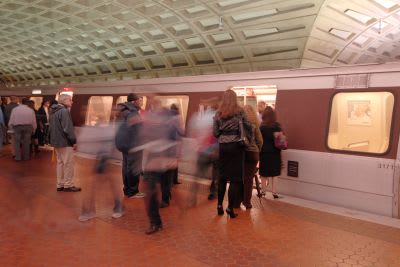
The NVTC's recommendations offer the region a framework to guide long-term regional funding and reform discussions.
Photo: WMATA
The Northern Virginia Transportation Commission (NVTC) makes recommendations to the Washington Metropolitan Area Transit Authority (WMATA) to help the transit agency solve its structural funding deficit as it faces the potential of devastating service and staff cuts.
NVTC published the recommendations today as part of its annual "Report on the Condition and Performance of WMATA."
“While this is the beginning of the process, NVTC recognizes that Metro's proposed budget clearly lays out the harsh service cuts the region will endure unless the District, Maryland, and Virginia jointly take action," said NVTC Chair Dalia Palchik. "The Northern Virginia cities and counties that pay for Metro are ready to work with Metro, its Board, and Richmond to close the gap, knowing that it will take all sources of funding — local, regional, state, and federal — as well as smart financial management at Metro to avoid these devastating service cuts that will affect our regional and statewide economy.”
NVTC Makes Near-Term Recommendations
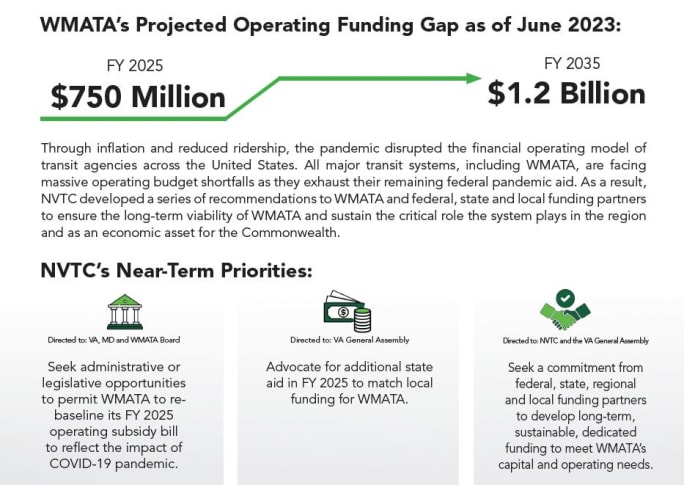
The report makes near-term recommendations that can provide immediate relief to WMATA and the Virginia localities that provide funding to WMATA, as well as critical actions that must be taken in the coming months.
Near-term recommendations include:
Seek administrative or legislative opportunities to permit WMATA to re-baseline its FY 2025 operating subsidy bill to reflect the impact of the COVID-19 pandemic.
Advocate for additional state aid in FY 2025 to match local funding for WMATA.
Seek a commitment from federal, state, regional, and local funding partners to develop long-term, sustainable, dedicated funding to meet WMATA’s capital and operating needs.
Return federal workers to the office and secure a replacement for the region’s losses in fares from riders using federal transit benefits.
While the Greater Washington region pursues temporary actions to stabilize WMATA, the region must develop longer term solutions.
Photo: NVTC
NVTC’s Long-Term Recommendations
While the Greater Washington region pursues temporary actions to stabilize WMATA, the region must develop longer term solutions. The recommendations offer the region a framework to guide long-term regional funding and reform discussions, and include:
Manage labor cost escalation through reforms to pension and other post-employment benefits (OPEB), including increased worker contributions to pensions and OPEB; limiting or prohibiting overtime earnings toward retirement pay; and implementing Office of the Inspector General (OIG) findings to improve controls and governance and explore alternative retirement plans.
Seek Amendments to the federal Wolf Act that would require consideration of WMATA’s fiscal condition and jurisdictions’ ability to pay in binding arbitration.
Establish a revised Virginia and Maryland legislative operating assistance growth cap that addresses the unintended consequences of the current cap.
Improve farebox recovery by raising fares for Metrorail and Metrobus.
Formalize the functions and scope of a WMATA board audit committee to enhance oversight via a coordinated jurisdictional audit.
Secure one or more sustainable and reliable sources of dedicated revenues to support additional operating funding.
Establish a rainy-day fund at WMATA.
Secure one or more sustainable and reliable sources of dedicated revenues to support additional dedicated capital funding
Sustain NVTC’s technical, policy, financial, and legislative efforts to support the implementation of recommendations
NVTC publishes the "Report on the Condition and Performance of WMATA" annually and submits it to the governor and General Assembly, as required by Virginia law.
More Management

Indian River Transit’s Community-Focused Approach Earns National Recognition
Named APTA’s 2026 Outstanding Public Transportation System in its size category, Florida’s Indian River County transit system continues to grow ridership through fare-free service and a focus on evolving community needs.
Read More →
ENC Lands MATA Contract and More in Biz Briefs
In this edition of Biz Briefs, we spotlight the latest developments shaping the future of mobility.
Read More →
From Surviving to Thriving: Building Stronger Transportation Organizations
Bus Business Consultants founder Brian Dickson shares lessons on leadership, organizational health, and creating options for long-term success in a changing transportation industry.
Read More →

Everett Transit, Community Transit Outline Consolidation Agreement
The proposed agreement calls for a 50% increase in bus service in Everett, a new microtransit zone, continued paratransit service, and the transfer of Everett Transit operations to Community Transit.
Read More →
Strada360’s Steve Lassey on Turning Transit Data Into Better Decisions
From breaking down data silos to preparing for AI, Strada360 CEO Steve Lassey discusses how transit agencies can use technology to improve operations, customer information, and long-term decision-making.
Read More →
People Movement: Phil Washington Joins HNTB, Denver RTD Launches CEO Search, and More
In this edition, we also spotlight recent personnel moves at STV, the Eno Center for Transportation, and more, highlighting the people taking on new roles across the transportation industry.
Read More →
SEPTA Details Accelerate Vision for Transit System
The plan outlines investments in trolley modernization, new Metro and Regional Rail vehicles, accessible stations, and more frequent bus and rail service.
Read More →
FTA Ends Direct Oversight of MBTA Safety Actions
The federal agency closed its remaining special directive to the Massachusetts Department of Public Utilities following a safety review that began in 2022.
Read More →
Report: Transit Bus Manufacturing Supports 34,100 Jobs, $5.1B in GDP
The “Buses Mean Business” report examines the transit bus manufacturing industry’s economic footprint, supply chain, and rising demand for vehicle replacements.
Read More →
LIT Marks 10-Year Milestone at Annual Summit
Hosted by the COTA from September 10 to 13, the Summit carried the theme “Celebrating 10 Years of Excellence, Leadership, and Impact,” with every part of the program honoring the people, agencies, and partners who built LIT over its first decade.
Read More →