



NY MTA mounted-camera program begins issuing bus lane violations
Since camera enforcement on the M15 began, there have been improvements in bus speeds on First and Second Avenues.

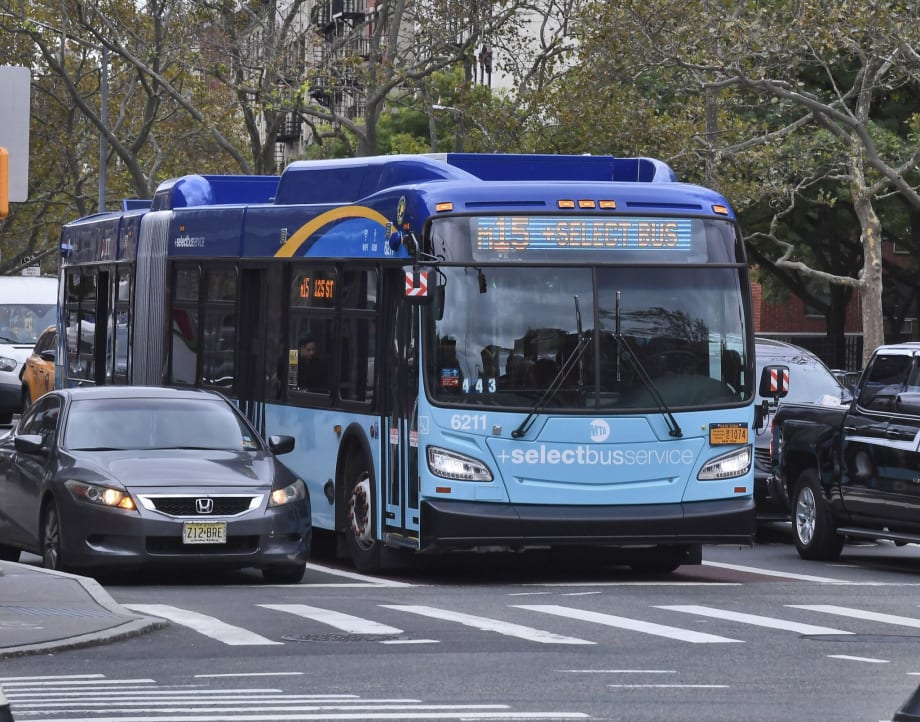
The bus-mounted ABLE systems are installed on 123 MTA buses across the three bus routes.
Marc A. Hermann
The bus-mounted ABLE systems are installed on 123 MTA buses across the three bus routes.
Marc A. Hermann
New York’s Metropolitan Transportation Authority (MTA) said its 60-day warning period for bus lane blockers on the M15 Select Bus Service route has now ended and motorists who are caught by the MTA’s new bus-mounted cameras will now receive violations with fines up to $250.
The forward-facing cameras on buses serving the M15 SBS route on First and Second Avenues in Manhattan were implemented on Oct. 7. State legislation mandated a 60-day grace period before violators are fined for standing or parking in the bus lanes. Since camera enforcement on the M15 began, there have been improvements in bus speeds on First and Second Avenues, with increases of up to 34% in some segments. The primary indicator of bus reliability, Wait Assessment, is at 76.7% on the route — the highest it’s been for the past 15 months.
Enforced bus lanes are key to improving bus service, and to heighten awareness of their use, NYC Transit is launching an awareness campaign targeted to motorists. The new campaign features “Are you a bus?” posters noting that “Bus lanes are for buses,” which will be posted on the backs of the buses equipped with ABLE camera systems. The posters will be installed on those buses this month, and the campaign will continue as NYC Transit expands the ABLE program. NYC Transit is working with the NYC DOT to implement transit priority across the city, including the recently announced City commitment to 50 miles of protected bus lanes annually for the next five years.
NYC Transit is currently using the Automated Bus Lane Enforcement (ABLE) system on buses serving the three popular routes. The B44 SBS travels on approximately 10 miles of dedicated bus lanes through Brooklyn, while the M14 SBS uses bus lanes on 14th Street as well as NYC DOT’s Truck and Transit Priority lanes. Motorists who remain in a bus lane without exiting at the first possible right turn, or are captured as blocking the bus lane at the same location by two successive buses, are considered to be violating traffic laws and will be ticketed.
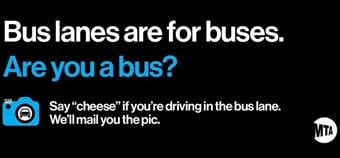
The new campaign features “Are you a bus?” posters noting that “Bus lanes are for buses,” which will be posted on the backs of the buses equipped with ABLE camera systems.
NY MTA
The ABLE camera systems capture evidence such as license plate information, photos, and videos, as well as location and timestamp information, of vehicles obstructing bus lanes to document clear cases of bus lane violation. The system collects multiple pieces of evidence to ensure that vehicles making permitted turns from bus lanes are not ticketed. The information is transmitted to NYC DOT for review and processing, and the program is administered in partnership with NYC DOT and the NYC Department of Finance. Beginning Dec. 6, motorists who are caught by the bus-mounting cameras blocking bus lanes on First and Second Avenues will be subject to a fine of $50 for the first violation. For additional violations within a 12-month period, fines are $100 for a second offense, $150 for a third offense, $200 for a fourth offense, and $250 for a fifth violation and each subsequent one within a 12-month period.
While NYC DOT has been using stationary fixed-position cameras on streets for years to capture vehicles that do not make the first available turn off a bus lane, the MTA’s bus-mounted cameras capture vehicles standing for long periods or parked in a bus lane. The two systems complement each other and work in tandem to ensure that violators are not fined twice for the same offense. NYPD provide additional enforcement through its Clear Lanes initiative, which uses traffic enforcement agents, tow trucks, and ride-alongs with NYCT Bus personnel to target bus-lane blocking hotspots.
The bus-mounted ABLE systems are installed on 123 MTA buses across the three bus routes. The proposed 2020-2024 MTA Capital Plan includes $85 million for further expansion of the program.
More Management

METRO Opens Submissions for 2026 Motorcoach Awards
Nominations are now being accepted for METRO Magazine’s Operator of the Year and Innovative Operator of the Year awards.
Read More →
New York MTA Advances Final Contract for Second Avenue Subway Expansion
Contract Four is the largest in the Second Avenue Subway Phase 2 project and includes construction of station infrastructure, tracks, and signals for the subway expansion, MTA officials said. Work on Contract Four will begin in 2027.
Read More →
Transit Agencies Highlight Safety Gains at National Summit
Leaders from 15 major transit systems shared crime-reduction results and safety initiatives while discussing the role of continued federal support.
Read More →

NITA Names New Leadership, Expands Reduced-Fare Program at First Board Meeting
The new regional transit authority appointed its first board chair and interim executive director while extending reduced fares across CTA, Metra, and Pace for eligible riders.
Read More →
Beyond the Checklist: A Structured Approach to Transit Maintenance
Reliability-Centered Maintenance helps transit agencies move beyond routine checklists to focus limited resources on the assets and failures that have the greatest impact on safety, reliability, and service.
Read More →
APTA 2026 Nominating Committee Selects Leadership Slate, Names Chair and Vice Chair Nominees
Leadership changes will help shape the association’s priorities and its representation of the transportation industry during the 2026–2027 term.
Read More →
DART Launches Major Security, Fare Enforcement Initiative
The 90-day demonstration will deploy coordinated security teams at five light rail stations while testing controlled access and gathering data to guide future investments.
Read More →
Advancing Fare Collection Through Technology and Innovation
Learn about delivering 1300 gates at 91 stations while managing fare evasion. Explore the large scale deployment, solution customization and real-world results that affect the region. Prepare for deployment in your region now.
Read More →
Game Day in Motion: Moving Millions During the 2026 World Cup
Between packed transit stations and team motorcoaches, see how agencies and operators across North America tackled the transportation demands of the 2026 FIFA World Cup.
Read More →
Surface Transportation Extension Averts Shutdown, Leaves Transit Funding Gap
The stopgap keeps federal transportation programs moving, but missing advance funding could complicate the transit and rail projects agencies are planning next.
Read More →