




RELATED: MTA unveils customer-focused subway performance dashboard
NYC to add 180 new articulated buses to fleet
Will award two contracts totaling $150 million to New Flyer and Nova Bus for the wheelchair-accessible, low-floor, 60-foot articulated buses that will feature visibility improvements for bus operators.
October 25, 2017
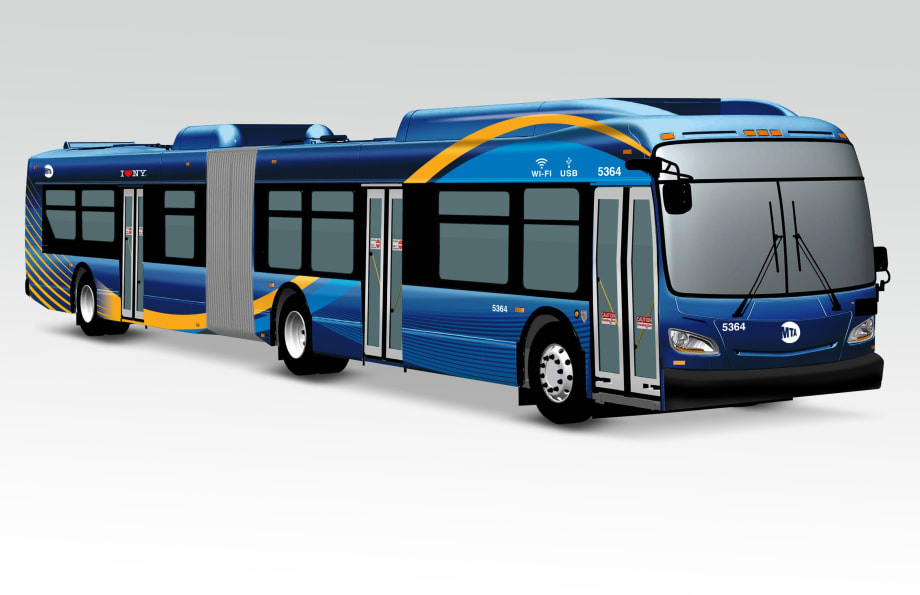
The new MTA buses will feature amenities such as Wi-Fi, digital screens, and USB charging ports. Rendering courtesy NY MTA
2 min to read
The new MTA buses will feature amenities such as Wi-Fi, digital screens, and USB charging ports. Rendering courtesy of NY MTA.
The Metropolitan Transportation Authority (MTA) Board voted to purchase 180 articulated buses equipped with pedestrian safety technology and modern customer amenities to increase the capacity of New York City Transit’s bus fleet as the agency works to improve bus service citywide and prepares for enhancing service during the Canarsie Tunnel repairs.
The MTA Board voted to award two contracts totaling $150 million to New Flyer and Nova Bus for the wheelchair-accessible, low-floor, 60-foot articulated buses that will feature visibility improvements for bus operators and safety technology such as pedestrian turn warning systems. These buses will also be equipped with technology to allow NYC Transit’s in-house crews to quickly install traffic signal priority (TSP) equipment once the buses are delivered, as part of NYC Transit’s goal to equip the entire bus fleet with the speed-enhancing technology.
Customer amenities include digital information screens, Wi-Fi capability and USB charging ports, which are consistent with other new MTA buses. The buses are expected to be delivered from September 2018 to September 2019, replacing older 40- and 60-foot buses that have reached the end of their 12-year life-cycles.
New Flyer will provide 108 buses for a total of $90.1 million, and Nova Bus will provide 72 buses at a cost of $60 million. The split contract allowed MTA New York City Transit to negotiate more competitive pricing for the buses and allowed both companies to deliver the buses at a faster rate rather than a single firm providing all 180 buses.
The expedited delivery schedule is vital to NYC Transit’s alternative service plans during the Canarsie Tunnel repairs, which are scheduled for 15 months beginning April 2019. Transit’s mitigation plans, which are in development with local communities and NYC DOT which is responsible for the building of dedicated bus lanes and other street enhancements necessary for faster bus service, will include robust bus service for line customers traveling between Manhattan and Brooklyn with options for customers traveling to the Lower East Side or 14th Street.
New buses are part of the MTA’s initiative to revitalize bus operations, with plans for adding a total of 2,042 new buses over five years. The new buses replace nearly 40% of the MTA’s current fleet and represent a $1.5 billion investment of Capital Program resources. The new buses included in the plan are already in service in all five boroughs, with new vehicles delivered continuously since 2016.
More Bus

New York MTA Plans Largest Bus Fleet Upgrade in More Than a Decade
The agency is seeking manufacturers for 650 new CNG buses to replace aging vehicles, improve reliability, and advance its broader fleet modernization strategy.
Read More →
Building a Flexible Path to Transit Electrification
John Hroncich discusses BAE Systems’ modular and scalable approach, lessons learned from decades of real-world operations, and how agencies can identify electrification strategies that fit their fleets.
Read More →
Bus Tech Talk: Keeping Transit Technicians Ahead of the Technology Curve
LA Metro’s Obed Mejia discusses technician training, evolving maintenance technology, fleet replacement, and strategies for getting the most out of today’s transit fleets.
Read More →
Biz Briefs: RIPTA Unveils New Frontrunners, Clevland RTA Adds New Siemens, and More
In METRO's latest installment, we take a look at recent news from Siemens, Prevost, Dodge, and more partnerships making headlines across the transportation sector.
Read More →
People Movement: Holly Arnold Joins Transdev and More
In this edition, we also cover recent appointments and announcements at Pace, CamTran, MCI, and more, showcasing the individuals helping to shape the future of transportation.
Read More →
The High Cost of Transit Buses: Industry Leaders Look to Procurement Reform
Transit leaders and policymakers examine how standardized bus designs, streamlined procurement, and predictable funding could help agencies stretch budgets and deliver better service.
Read More →
The Business Voice Behind Public Transportation
As chair of APTA’s Business Members Board of Governors, Ray Melleady explains how more than 850 business members are partnering with transit agencies to advance funding, innovation, and industry-wide collaboration.
Read More →
From Surviving to Thriving: Building Stronger Transportation Organizations
Bus Business Consultants founder Brian Dickson shares lessons on leadership, organizational health, and creating options for long-term success in a changing transportation industry.
Read More →
Finding the ‘Happy Medium’: Optimizing Maintenance Without Sacrificing Reliability
The key to maintenance optimization isn’t doing less work—it’s doing the right work at the right time on the right assets.
Read More →
LA Metro, City of West Hollywood, and Partners Advance Smarter Bus Lane Enforcement
The award-winning partnership combines AI-powered detection with human oversight to improve bus reliability, accessibility, and enforcement efficiency.
Read More →