




RELATED: How to Prevent Driver Assaults
PSTA fast tracks new safety barriers to protect bus drivers
Planned safety upgrades come less than three weeks after HART bus driver Thomas Dunn was murdered on the job by a passenger.
June 11, 2019
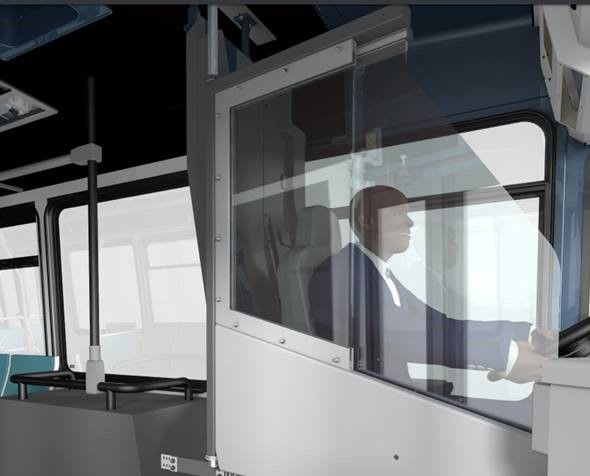
The new barriers (rendering shown) on all PSTA buses will have extended tempered glass to cover significantly more area than the pilot barrier PSTA has been testing for 6 months.
PSTA
2 min to read
The new barriers (rendering shown) on all PSTA buses will have extended tempered glass to cover significantly more area than the pilot barrier PSTA has been testing for 6 months.
PSTA
The Pinellas Suncoast Transit Authority (PSTA) is taking swift action to protect its bus drivers after the deadly attack on a HART driver in Tampa. PSTA leadership along with the support of the Service Employee International Union, has agreed upon safety barriers for all 210 PSTA buses.
“The safety of our drivers has been and always will be our top priority at the PSTA,” said PSTA CEO Brad Miller. “They are who we are, and we will do everything in our power to support them and make sure they feel safe while serving our community. After hearing from our drivers last week, that they felt scared to go to work and feared for their own lives, we knew we had to act as quickly possible. When it comes to keeping our drivers safe, we must move at lightning speed,” Miller added.
“The horrific murder of our fellow bus driver in Tampa was a shocking wake-up call for our drivers, and we want to make sure that this tragedy doesn’t happen again,” said April Murphy, a retired bus driver and representative for the Service Employee International Union. “We took a stand and voiced our concerns, and would like to thank our PSTA leadership for listening to us and taking immediate action to ensure that our drivers are safe and no longer have to live in fear.”
The planned safety upgrades come less than three weeks after HART bus driver Thomas Dunn was murdered on the job, randomly stabbed by a passenger on May 18. Dunn’s bus did not have a safety partition between himself and the passenger to protect him from the deadly attack.
PSTA leaders originally planned on today’s consensus-building meeting to be limited to Pinellas drivers but at the request of Hillsborough’s HART team, PSTA also included representatives of HART’s bus operator workforce and union the Amalgamated Transit Union.
The new barriers on all PSTA buses will have extended tempered glass to cover significantly more area than the pilot barrier PSTA has been testing for 6 months.
The investment is expected to cost $4,000 - $5,000 per installed shield. With 210 buses that would be a total of $840,000 - $1,050,000. An expedited approval process has the PSTA finance committee considering the purchase on June 19th with the full PSTA Board approval on June 26.
It will take 4 to 6 weeks for the company to manufacture the barriers, and crews are expected to begin installation of the enclosures in August with all PSTA buses equipped with these safety improvements by the end of October.
More Security and Safety

Transit Agencies Highlight Safety Gains at National Summit
Leaders from 15 major transit systems shared crime-reduction results and safety initiatives while discussing the role of continued federal support.
Read More →
DART Launches Major Security, Fare Enforcement Initiative
The 90-day demonstration will deploy coordinated security teams at five light rail stations while testing controlled access and gathering data to guide future investments.
Read More →
RTD Launches NextRide App to Consolidate Trip Planning, Fares, Security Reporting
The app expands on RTD’s existing NextRide web application and allows customers to view real-time vehicle locations and service alerts, purchase and store digital fares, and access customer support.
Read More →

TAPTCO Updates OSHA Compliance Training for Transit Maintenance Operations
The revamped program addresses 26 OSHA standards for maintenance facilities, with TAPTCO pointing to training, documentation, and everyday shop hazards as continuing challenges for transit operations.
Read More →
Sponsored•August 18, 2026
How VaporVision Adds Value to Transit Door Systems
Wabtec engineers explain how the system improves doorway detection, strengthens diagnostics and gives transit agencies and OEMs greater operating flexibility.
Read More →
FRA Announces $5.3B in Rail Investments, Including $2B for Amtrak
Funding will support grade-crossing improvements, infrastructure upgrades, and new Amtrak equipment in 23 states.
Read More →
Chicago, Maryland Expand Non-Law-Enforcement Safety, Rider Support
The CTA and MTA are launching new programs aimed at de-escalation, crisis response, rider assistance, and greater transparency.
Read More →
LA Metro, City of West Hollywood, and Partners Advance Smarter Bus Lane Enforcement
The award-winning partnership combines AI-powered detection with human oversight to improve bus reliability, accessibility, and enforcement efficiency.
Read More →
LA Metro Reports 57% Decline in Homelessness on Transit System Since 2024
The agency's latest homelessness count offers new data on how care-based services and cross-sector partnerships can complement traditional transit security strategies.
Read More →
FTA Launches 'Transit Moves America' Dashboard to Highlight Agency Safety and Performance
The online dashboard transforms National Transit Database information into a public-facing resource that allows users to compare transit agencies on key operational and safety metrics.
Read More →