




Keep Reading: Denver's RTD Boosts Rail Fare Inspections by More Than 500%
RTD Transit Police Use Virtual Reality Tech to Enhance Real-World Skills
The virtual scenarios allow officers to train in a safe environment and assess multiple options for addressing threats.
September 3, 2025
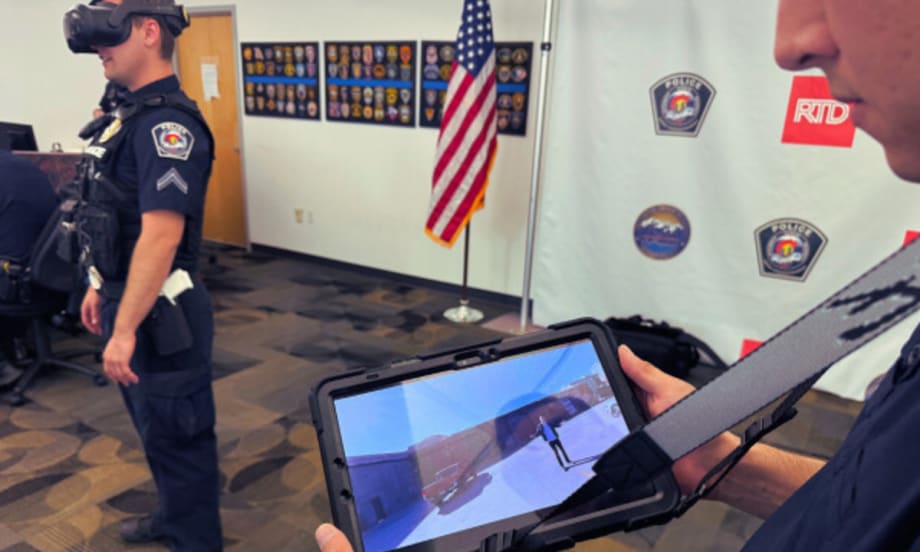
Through virtual reality technology, RTD transit police officers see and hear a simulated environment requiring them to take the best course of action.
Photo: Regional Transportation District
4 min to read
The Regional Transportation District (RTD) is using virtual reality technology to augment its training program for transit police officers to learn how to assess a multitude of situations and address threats safely. The virtual reality technology offers reality-based training scenarios for officers to hone skills safely and supports certification in using TASERs.
Almost half of the 100 sworn officers in the RTD Transit Police Department (RTD-PD) have completed the reality-based training since the program was implemented in June. The reality-based program is taught by two of RTD-PD's certified master taser instructors, Corporal Jacob Schubert and Corporal Chance Fitzgerald.
Through the technology, officers see and hear a simulated environment requiring them to take the best course of action and safely use TASERs. The technology manufacturer and service provider, Axon, currently provides 12 scenarios and continues to add more for officers to build upon their technical skills and refine in-the-moment decision-making.
The technology enables officers to progressively build skills, even accounting for factors such as the physical and mental state of the individual in the scenario, whether they're standing, sitting, or partially obscured, even offering the details of the clothing a person may be wearing and how that would impact the use of TASERs.
Why RTD Transit Police Chose Virtual Reality Training
The RTD-PD elected to implement the technology for various reasons, including training officers without the use of live rounds from TASERs. Plus, the system's headset and tablet device are portable, enabling training to be conducted in many locations. Transit police incorporate virtual reality training into almost every in-service training to maximize officers' ability to use the technology.
According to an agency release, the reality-based training is also cost-effective for its ability to take officers through approximately 1,000 virtual deployments versus roughly eight to 10 deployments annually with live training. The training can also be conducted in regular 15- to 20-minute sessions, rather than taking officers off their regular work assignments for a full-day training. The virtual reality trainings are easily repeated, and the department receives immediate feedback about an officer's test scenario.
Officers need to score at least 80% in each reality-based module, with the results available to evaluate officer performance by applying evidence-based training standards and methods to facilitate improvements. Schubert said officers can ideally run through training at least weekly, though addressing patrols and responding to calls remain the department's top priority.
"RTD-PD is dedicated to advancing technology to better serve our officers and the community," RTD Chief of Police and Emergency Management Steve Martingano said. "This training equips our officers with the skills they need to effectively handle real-world situations they may encounter in the field."
Virtual Reality Prepares Officers for Real-World Crises
The learning reinforces officers' ability to evaluate circumstances proficiently. "With different types of scenarios, we can put the officer in the shoes of somebody who may be experiencing a medical or mental health crisis so they can better understand what the person is going through," Schubert said. "In-depth reality-based training helps officers with quick decision-making and what different options we could take."
Schubert and Fitzgerald first experienced the virtual reality equipment a year and a half ago during their training at Axon's Master Taser Instructor School in spring 2024, where they became certified master TASER instructors for the transit police.
"We are now able to put an officer in a virtual reality environment so that they can be on the range without any live TASER cartridges and have similar, if not better, training in a static environment," Schubert said.
With AI advancements, it is anticipated that the training modules will evolve and benefit the program with future modules allowing for two-way communication with virtual suspects to better prepare officers for real-world scenarios. The training's virtual reality technology is designed to represent the identical size, weight, and capabilities of real-life TASER counterparts.
The virtual reality program costs RTD-PD approximately $170,000 a year for six headsets and tablets to directly view an officer's actions in the simulated environment, and it provides access to performance metrics.
According to a release, program costs are offset by the ability to provide a safe and versatile training environment for officers, as well as being able to keep officers on patrol while offering periodic bursts of training in about 20-minute intervals. This reduced time for training means tens of thousands of dollars are saved on training field days and the associated costs for equipment and staff time.
More Security and Safety

Transit Agencies Highlight Safety Gains at National Summit
Leaders from 15 major transit systems shared crime-reduction results and safety initiatives while discussing the role of continued federal support.
Read More →
DART Launches Major Security, Fare Enforcement Initiative
The 90-day demonstration will deploy coordinated security teams at five light rail stations while testing controlled access and gathering data to guide future investments.
Read More →
RTD Launches NextRide App to Consolidate Trip Planning, Fares, Security Reporting
The app expands on RTD’s existing NextRide web application and allows customers to view real-time vehicle locations and service alerts, purchase and store digital fares, and access customer support.
Read More →

TAPTCO Updates OSHA Compliance Training for Transit Maintenance Operations
The revamped program addresses 26 OSHA standards for maintenance facilities, with TAPTCO pointing to training, documentation, and everyday shop hazards as continuing challenges for transit operations.
Read More →
Sponsored•August 18, 2026
How VaporVision Adds Value to Transit Door Systems
Wabtec engineers explain how the system improves doorway detection, strengthens diagnostics and gives transit agencies and OEMs greater operating flexibility.
Read More →
FRA Announces $5.3B in Rail Investments, Including $2B for Amtrak
Funding will support grade-crossing improvements, infrastructure upgrades, and new Amtrak equipment in 23 states.
Read More →
Chicago, Maryland Expand Non-Law-Enforcement Safety, Rider Support
The CTA and MTA are launching new programs aimed at de-escalation, crisis response, rider assistance, and greater transparency.
Read More →
LA Metro, City of West Hollywood, and Partners Advance Smarter Bus Lane Enforcement
The award-winning partnership combines AI-powered detection with human oversight to improve bus reliability, accessibility, and enforcement efficiency.
Read More →
LA Metro Reports 57% Decline in Homelessness on Transit System Since 2024
The agency's latest homelessness count offers new data on how care-based services and cross-sector partnerships can complement traditional transit security strategies.
Read More →
FTA Launches 'Transit Moves America' Dashboard to Highlight Agency Safety and Performance
The online dashboard transforms National Transit Database information into a public-facing resource that allows users to compare transit agencies on key operational and safety metrics.
Read More →