




Keep Reading: Denver's RTD Boosts Rail Fare Inspections by More Than 500%
RTD’s 2025 FasTracks Report Details Funding Challenges, Next Steps
With approximately 75% of FasTracks projects completed, the agency estimates $1.6 billion is needed to complete the four remaining corridors by 2034.
September 29, 2025
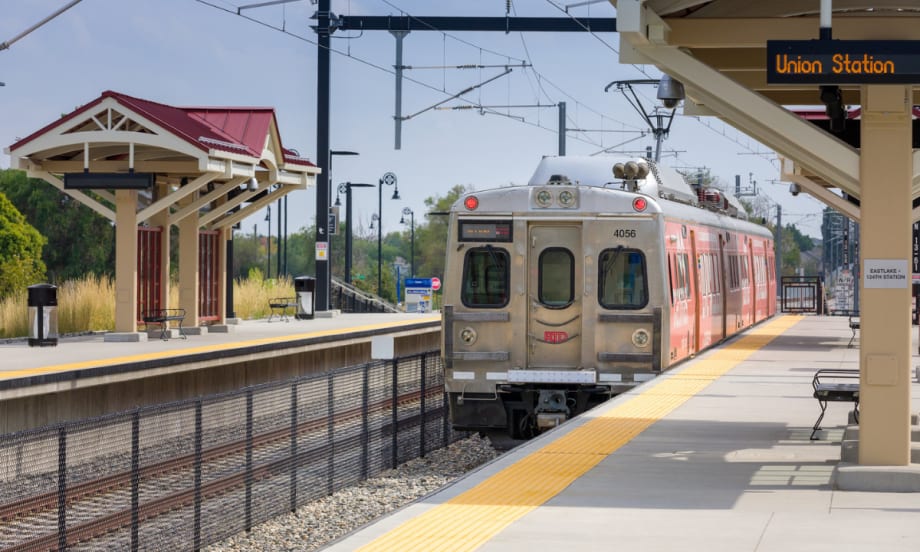
According to an agency release, legislation passed earlier this year required RTD to compile a report demonstrating how the agency will complete the four unfinished rail corridors by 2034.
Photo: Regional Transportation District
3 min to read
The Regional Transportation District (RTD) has released a draft of its comprehensive 2025 Finishing FasTracks Report, outlining the $1.6 billion capital and operating costs needed to complete the 2004 voter-approved transit expansion program, as well as the revenue and ridership projections for the four unfinished corridors.
The draft report also examines the challenges that are impacting the project's full completion, highlights potential new funding sources, and points to statewide collaboration focused on intercity passenger rail.
According to an agency release, legislation passed earlier this year required RTD to compile a report demonstrating how the agency will complete the four unfinished rail corridors by 2034. Senate Bill 25-161, titled "Transit Reform," also outlines engagement strategies the agency must follow before submitting the final 2025 Finishing FasTracks Report to the Governor of Colorado and General Assembly on December 1.
"RTD recognizes that this report is the first step in bringing the 20-year-old FasTracks plan to fruition," said Debra A. Johnson, RTD's general manager and CEO. "The agency welcomes the opportunity to build upon the current momentum of joint rail service planning by working with the Governor's Office, Colorado General Assembly, and other stakeholders across the Denver metro area to advance discussions about how best to optimize the sustainable expansion of public transport in the region."
The recently released draft report presents a comprehensive set of facts outlining the necessary steps to complete the program. The original FasTracks budget was $4.7 billion in 2004, and RTD has expended more than $5.5 billion on the program.
Significant challenges exist related to completing the Northwest, North Metro, Southwest, and Central corridors, including very low growth in sales and use tax revenues that started during the Great Recession, escalating construction costs, increases in raw materials costs, and supply chain and labor market challenges.
Funding Outlook for FasTracks Completion
RTD estimates $145 million would be available for FasTracks completion from the FasTracks Internal Savings Account by 2030, based on the agency's proposed 2026-2030 Five-Year Financial Forecast. This projection is a best-case scenario, assuming a larger share of statewide funds is also allocated towards the program.
If the four remaining FasTracks corridors were scaled back to include only the Northwest Rail Peak Service and North Metro corridor — excluding the Southwest and Central extensions — the total projected construction costs would be closer to $1 billion. Bringing the two corridors to fruition would also substantially exceed the projected $441 million available in funding. It also excludes the resources required to operate and maintain services once they are constructed, as well as the costs associated with asset renewal.
State funding from programs authorized by Senate Bill 21-260, Senate Bill 24-230, and Senate Bill 24-184 could contribute toward a limited completion of FasTracks projects. These additional revenue sources could potentially fund up to $296 million towards FasTracks projects between 2026 and 2034. Additionally, ongoing funding would still be required for the operation and maintenance of the rail corridors, as well as asset renewal.
FasTracks Program Milestones and Next Steps
Since 2004, RTD has completed approximately 75% of the FasTracks projects, including 25 miles of light rail track, 53 miles of commuter rail track, and the implementation of bus rapid transit service, the Flatiron Flyer, along US 36. Establishing Denver Union Station in downtown Denver as an intermodal transit hub in 2014, with commuter rail and light rail platforms and an underground bus concourse, was also part of the FasTracks program.
Community and stakeholders are invited to review the draft report, learn more about the FasTracks projects, and provide feedback by visiting www.rtd-denver.com/FasTracks.
The webpage provides an overview of each remaining corridor, the eight completed FasTracks corridors, maps, and cost projections to complete the project. Customers, community members, and stakeholders are encouraged to provide feedback on the draft report via RTD's FasTracks webpage through November 14.
RTD will present an introductory overview of the draft report during the Tuesday, September 30, Board meeting.
More Management

METRO Opens Submissions for 2026 Motorcoach Awards
Nominations are now being accepted for METRO Magazine’s Operator of the Year and Innovative Operator of the Year awards.
Read More →
New York MTA Advances Final Contract for Second Avenue Subway Expansion
Contract Four is the largest in the Second Avenue Subway Phase 2 project and includes construction of station infrastructure, tracks, and signals for the subway expansion, MTA officials said. Work on Contract Four will begin in 2027.
Read More →
Transit Agencies Highlight Safety Gains at National Summit
Leaders from 15 major transit systems shared crime-reduction results and safety initiatives while discussing the role of continued federal support.
Read More →

NITA Names New Leadership, Expands Reduced-Fare Program at First Board Meeting
The new regional transit authority appointed its first board chair and interim executive director while extending reduced fares across CTA, Metra, and Pace for eligible riders.
Read More →
Beyond the Checklist: A Structured Approach to Transit Maintenance
Reliability-Centered Maintenance helps transit agencies move beyond routine checklists to focus limited resources on the assets and failures that have the greatest impact on safety, reliability, and service.
Read More →
APTA 2026 Nominating Committee Selects Leadership Slate, Names Chair and Vice Chair Nominees
Leadership changes will help shape the association’s priorities and its representation of the transportation industry during the 2026–2027 term.
Read More →
DART Launches Major Security, Fare Enforcement Initiative
The 90-day demonstration will deploy coordinated security teams at five light rail stations while testing controlled access and gathering data to guide future investments.
Read More →
Sponsored•September 9, 2026
Advancing Fare Collection Through Technology and Innovation
Learn about delivering 1300 gates at 91 stations while managing fare evasion. Explore the large scale deployment, solution customization and real-world results that affect the region. Prepare for deployment in your region now.
Read More →
Game Day in Motion: Moving Millions During the 2026 World Cup
Between packed transit stations and team motorcoaches, see how agencies and operators across North America tackled the transportation demands of the 2026 FIFA World Cup.
Read More →
Surface Transportation Extension Averts Shutdown, Leaves Transit Funding Gap
The stopgap keeps federal transportation programs moving, but missing advance funding could complicate the transit and rail projects agencies are planning next.
Read More →