



S.C.’s The COMET Releases Progress Report
The document details the agency’s progress in four key areas: fiscal responsibility and operational accountability, ridership, safety and security, and creative partnerships.
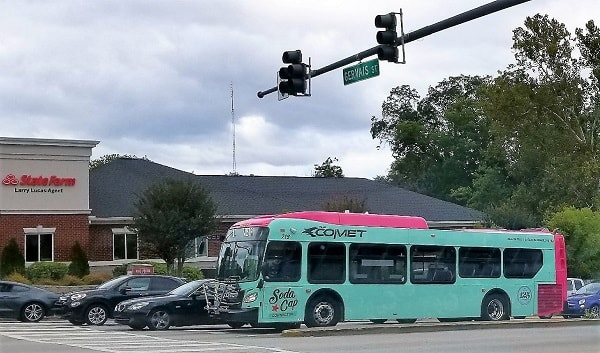
The report details The COMET's progress in four key areas: fiscal responsibility and operational accountability, ridership, safety and security, and creative partnerships.
The COMET
South Carolina’s Central Midlands Regional Transit Authority (The COMET) released its Vision:2020/COMPASS progress report, which provides the agency’s board of directors, the Central Midlands community, and other key stakeholders with an update on the agency’s advancements.
As this year marks the final year of The COMET’s guiding framework for operations, Vision: 2020, and the culmination of the agency’s five-year strategic plan, The COMPASS, results from both were combined into a single document to highlight the agency’s progress in four key areas: fiscal responsibility and operational accountability, ridership, safety and security, and creative partnerships.
“I am proud to say that many of the actionable items in both these documents have been achieved. Continuously fulfilling our commitment to the community and demonstrating fiscal responsibility is our highest goal,” said John Andoh, executive director/CEO of The COMET. “I would like to especially commend The COMET Board and administrative staff for their interest and support of the delivery of the tasks in a responsible and progressive manner.”
Several highlights of the report included:
Successful completion of two federal triennial reviews, eight annual reviews by the South Carolina Department of Transportation, and eight annual reviews by an independent auditor.
Expanded service throughout Lexington and Richland Counties thereby increasing ridership to more than 2.7 million annual trips.
Continuous essential travel service throughout Hurricane Sandy in 2015 and the COVID-19 pandemic.
Fleet upgrades using environmentally responsible and technologically progressive buses, cutaways, and trolleys.
Added local policing to The COMET buses and COMET Central to improve safety and security.
New partnerships with Uber and Lyft to connect low-income residents in food desert areas and provide cost-effective transit for riders during after-hours.
Partnership with the City of Columbia and Blue Cross Blue Shield of South Carolina allowing The COMET users free access to bicycles through the Blue Bike program.
According to Andoh, next steps include a strategic review and planning process over the course of 2021 to develop Vision: 2030 and The COMPASS through 2025. Key efforts would also involve determining a path for funding The COMET beyond 2029 and continuing to deliver quality transit service with mobility options to Richland and Lexington Counties.
More Management

METRO Opens Submissions for 2026 Motorcoach Awards
Nominations are now being accepted for METRO Magazine’s Operator of the Year and Innovative Operator of the Year awards.
Read More →
New York MTA Advances Final Contract for Second Avenue Subway Expansion
Contract Four is the largest in the Second Avenue Subway Phase 2 project and includes construction of station infrastructure, tracks, and signals for the subway expansion, MTA officials said. Work on Contract Four will begin in 2027.
Read More →
Transit Agencies Highlight Safety Gains at National Summit
Leaders from 15 major transit systems shared crime-reduction results and safety initiatives while discussing the role of continued federal support.
Read More →

NITA Names New Leadership, Expands Reduced-Fare Program at First Board Meeting
The new regional transit authority appointed its first board chair and interim executive director while extending reduced fares across CTA, Metra, and Pace for eligible riders.
Read More →
Beyond the Checklist: A Structured Approach to Transit Maintenance
Reliability-Centered Maintenance helps transit agencies move beyond routine checklists to focus limited resources on the assets and failures that have the greatest impact on safety, reliability, and service.
Read More →
APTA 2026 Nominating Committee Selects Leadership Slate, Names Chair and Vice Chair Nominees
Leadership changes will help shape the association’s priorities and its representation of the transportation industry during the 2026–2027 term.
Read More →
DART Launches Major Security, Fare Enforcement Initiative
The 90-day demonstration will deploy coordinated security teams at five light rail stations while testing controlled access and gathering data to guide future investments.
Read More →
Advancing Fare Collection Through Technology and Innovation
Learn about delivering 1300 gates at 91 stations while managing fare evasion. Explore the large scale deployment, solution customization and real-world results that affect the region. Prepare for deployment in your region now.
Read More →
Game Day in Motion: Moving Millions During the 2026 World Cup
Between packed transit stations and team motorcoaches, see how agencies and operators across North America tackled the transportation demands of the 2026 FIFA World Cup.
Read More →
Surface Transportation Extension Averts Shutdown, Leaves Transit Funding Gap
The stopgap keeps federal transportation programs moving, but missing advance funding could complicate the transit and rail projects agencies are planning next.
Read More →