



San Francisco breaks ground on $4.2B Transbay Transit Center
Will serve as the northern terminus for the California High-Speed Rail system and a multi-modal facility that will accommodate 11 transit operators and serve more than 45 million passengers a year. Project is estimated to create more than 48,000 jobs in its first phase of construction, which will last seven years.

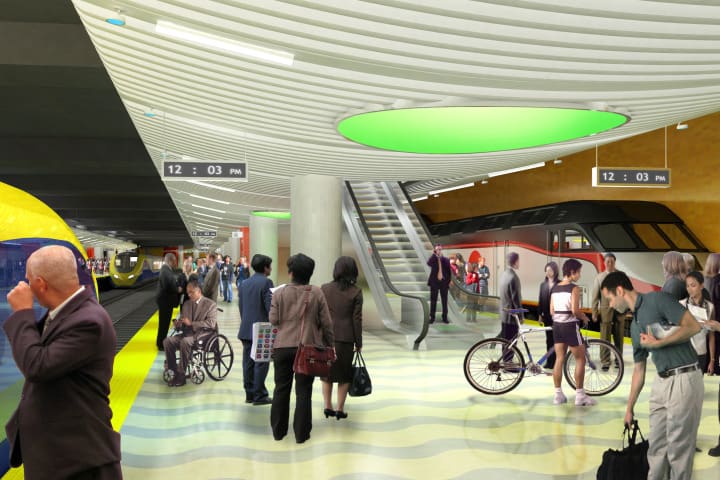
Project Architect: Pelli Clarke Pelli. Renderings courtesy of the Transbay Joint Powers Authority.
[IMAGE]TransbayRenderingPlatformFULL.jpg[/IMAGE] On Wednesday, federal, state and local officials joined together with the Transbay Joint Powers Authority (TJPA) to officially break ground on the Transbay Transit Center — the northern terminus for the California high-speed rail system and a multi-modal facility that will accommodate 11 transit operators and serve more than 45 million passengers a year.
“Today, in breaking ground on the Transbay Transit Center, we are opening a new chapter in that history of progress,” Speaker Nancy Pelosi said. “We are coming together to create jobs and revitalize our economy, and we are laying the first building blocks of a new ‘Grand Central Station of the West.’”
The project is estimated to create more than 48,000 jobs in its first phase of construction, which will last seven years. These jobs include the people who will design, build and operate the facility, the manufacturing jobs created by the materials being utilized in the facility and the businesses providing consumer goods and services to workers and the passengers utilizing the Transit Center.
"This is one of the most important and transformational public transportation projects in America. Once the dust has settled, San Francisco’s skyline will be transformed – as will transportation, housing, and employment choices for people across the Bay area and beyond,” said United States Secretary of Transportation Ray LaHood. "The U.S. Department of Transportation and the Federal Railroad Administration are proud to contribute to the first phase of this effort."
The full Phase 1 (Transit Center) and Phase 2 (Downtown Rail Extension) project and build out of the Redevelopment Plan will also increase the gross regional product in the Bay Area by $80 billion.
"This is a historic day for San Francisco and for the entire state," said Mayor Newsom. "History will write that high-speed rail and a new engine for job creation and economic growth in California began today, with the groundbreaking of this project. It is a culmination of decades of planning to fulfill our city's vision of leading the nation as a transit-first city and a hub of a modern high-speed rail system."
For more than 40 years, San Francisco has been planning for the replacement of the outdated and seismically deficient Transbay Terminal at First and Mission streets. The new one million square foot Transbay Transit Center will serve as San Francisco’s next landmark and will feature a 5.4-acre public park on the roof of the Transit Center.
The five-story Transit Center includes: one above-grade bus level, a ground floor entrance on Mission Street, concourse level, and two below-grade rail levels serving Caltrain and future California High-Speed Rail.
The $4.2 billion Transbay Transit Center Project is funded by various funding partners, including the Federal Government, the State of California, the Metropolitan Transportation Commission, the San Francisco County and San Mateo County Transportation Authorities and AC Transit, among others. The first phase of the program, which includes constructing the new Transit Center, is fully funded.
The new Transbay Transit Center is scheduled to open in August 2017.
More Rail

New York MTA Advances Final Contract for Second Avenue Subway Expansion
Contract Four is the largest in the Second Avenue Subway Phase 2 project and includes construction of station infrastructure, tracks, and signals for the subway expansion, MTA officials said. Work on Contract Four will begin in 2027.
Read More →
San Diego MTS Breaks Monthly Trolley Ridership Record
Agency officials said July’s ridership indicates MTS’s continued recovery from the pandemic.
Read More →
Report Examines NJ TRANSIT Reliability, Funding Challenges
The Garden State Initiative analysis examines the roles of Amtrak infrastructure, fleet management, and agency operations while recommending a more performance-based approach to improving reliability.
Read More →
Stadler, CapMetro Sign Long-Term Rail Fleet Support Agreement
Beginning in 2027, Stadler will provide on-site technical expertise, spare parts support, training, and obsolescence management to help extend the reliability and longevity of CapMetro’s GTW fleet.
Read More →
Biz Briefs: Alstom Lands Canadian Contract, LYT to Supply California TSP, and More
In METRO's latest installment, we take a look at recent news from Complete Coach Works, Beep, FlixBus, and more partnerships making headlines across the transportation sector.
Read More →
CATS Gold Line Marks 5 Years of Service, 2.8M Passenger Trips
With a six-mile expansion planned, the Charlotte streetcar is positioned to connect more neighborhoods and major transit hubs across the region.
Read More →
Why Simulating Pedestrian Movement Has Become Essential for Modern Rail Stations
Pedestrian microsimulation is helping rail planners identify bottlenecks, test station designs, and prepare complex transit hubs for growing passenger volumes.
Read More →
Amtrak Begins Major Construction at New York’s Sunnyside Yard
The new maintenance facility will support Amtrak’s Airo trainsets while improving maintenance efficiency and turnaround times in New York.
Read More →
Chicago Leaders Unveil Plans for O’Hare Airport Express Train
The privately developed project would offer a 15-minute trip between downtown and O’Hare’s Terminal 2, with trains operating every 15 minutes on a dedicated track. The service would use battery-electric trains and three existing freight rail rights-of-way.
Read More →
OCTA Maps Out 30-Year Strategy to Protect Coastal Rail Corridor
The draft feasibility report identifies strategies to protect the coastal rail line for decades as the agency continues near-term stabilization and sand placement efforts.
Read More →