




More to See: Transport for London’s Elizabeth Line Opens with Siemens Mobility’s Technology
Siemens Mobility Celebrates Paris Metro Line 4 Automation
After a trial run with no passengers that began in June, the automation of Line 4 is now a reality.
September 12, 2022
More automatic driverless shuttles will be introduced into the line's traffic over time to achieve full automation by the end of 2023.
Photo: Siemens Mobility
3 min to read
Siemens Mobility announced the modernization of Line 4 of the Paris Metro has been completed with the highest grade of automation, according to the company's news release.
Additionally, the automatic driverless metros have now begun revenue service.
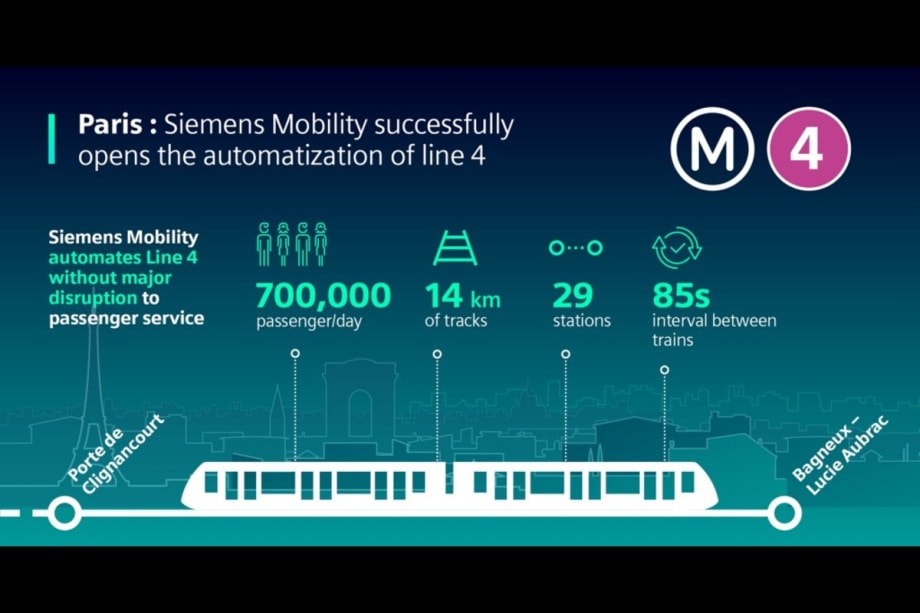
Siemens Mobility said the digitalization and optimization of Line 4 will allow RATP to safely increase frequency by reducing intervals between trains from 105 to 85 seconds.
Chosen in 2015 by RATP to automate Line 4, Siemens Mobility supplied their digitalized communication and CBTC signaling systems to modernize the network, according to the company. After a trial run with no passengers that began in June, the automation of Line 4 is now a reality. More automatic driverless shuttles will be introduced into the line's traffic over time to achieve full automation by the end of 2023, according to Siemens Mobility.
"This automation of a century-old line is a further demonstration of the unique know-how of the RATP group and its partner Siemens Mobility in terms of automatic metro systems. With IDFM, we have also taken advantage of this project to modernize the line for the benefit of passengers, with parlor doors and better passenger information. From now on, other modernization projects will be carried out with Siemens Mobility, in particular with the implementation of a new automatic control system on line 14 and its extensions to Saint-Denis Pleyel and Orly Airport," said Catherine Guillouard, president/CEO of the RATP group.
For this project, Siemens Mobility said it equipped the tracks, the technical premises, and the 52 automatic shuttles that will run on Line 4 with its digitalized systems and CBTC signaling. Siemens Mobility also supplied the equipment and software for the Operation Central Command (OCC), which manages the signaling system and the traction power supply, as well as interfacing with the on-board and trackside systems.
“We are proud to have partnered with RATP and Île-de-France Mobilités to complete this landmark project that provides Line 4 with the highest grade of signaling technology and automation services,” said Michael Peter, CEO of Siemens Mobility. “Paris has one of the busiest metro systems in the world. Our state-of-the-art CBTC signaling at GoA 4 allows trains to operate driverless and be automatically controlled and supervised without any onboard intervention. This truly modern system increases the reliability and availability of service, which will deliver an enhanced passenger experience for the 700k daily riders of Line 4.”
According to the company, Siemens Mobility’s digitalized CBTC signaling will allow RATP to safely increase capacity and accommodate more passengers on the system. The ability to continuously receive updates on system status will also improve operational efficiency, resulting in fewer delays and more up-to-date travel information. Additionally, the automated system will reduce traction energy consumption by up to 15%.
Line 4 carries 700,000 passengers per day through 29 stations.
More Rail

New York MTA Advances Final Contract for Second Avenue Subway Expansion
Contract Four is the largest in the Second Avenue Subway Phase 2 project and includes construction of station infrastructure, tracks, and signals for the subway expansion, MTA officials said. Work on Contract Four will begin in 2027.
Read More →
San Diego MTS Breaks Monthly Trolley Ridership Record
Agency officials said July’s ridership indicates MTS’s continued recovery from the pandemic.
Read More →
Report Examines NJ TRANSIT Reliability, Funding Challenges
The Garden State Initiative analysis examines the roles of Amtrak infrastructure, fleet management, and agency operations while recommending a more performance-based approach to improving reliability.
Read More →
Stadler, CapMetro Sign Long-Term Rail Fleet Support Agreement
Beginning in 2027, Stadler will provide on-site technical expertise, spare parts support, training, and obsolescence management to help extend the reliability and longevity of CapMetro’s GTW fleet.
Read More →
Biz Briefs: Alstom Lands Canadian Contract, LYT to Supply California TSP, and More
In METRO's latest installment, we take a look at recent news from Complete Coach Works, Beep, FlixBus, and more partnerships making headlines across the transportation sector.
Read More →
CATS Gold Line Marks 5 Years of Service, 2.8M Passenger Trips
With a six-mile expansion planned, the Charlotte streetcar is positioned to connect more neighborhoods and major transit hubs across the region.
Read More →
Why Simulating Pedestrian Movement Has Become Essential for Modern Rail Stations
Pedestrian microsimulation is helping rail planners identify bottlenecks, test station designs, and prepare complex transit hubs for growing passenger volumes.
Read More →
Amtrak Begins Major Construction at New York’s Sunnyside Yard
The new maintenance facility will support Amtrak’s Airo trainsets while improving maintenance efficiency and turnaround times in New York.
Read More →
Chicago Leaders Unveil Plans for O’Hare Airport Express Train
The privately developed project would offer a 15-minute trip between downtown and O’Hare’s Terminal 2, with trains operating every 15 minutes on a dedicated track. The service would use battery-electric trains and three existing freight rail rights-of-way.
Read More →
OCTA Maps Out 30-Year Strategy to Protect Coastal Rail Corridor
The draft feasibility report identifies strategies to protect the coastal rail line for decades as the agency continues near-term stabilization and sand placement efforts.
Read More →