



Related: 7 Bus Safety Practices Districts Are Planning for School Start
Solution, Fogging System Approved by EPA to Fight COVID-19
CURIS System’s CURoxide Hydrogen Peroxide blend and fogging system has been approved for inclusion on the agency’s List N.
by Staff
July 28, 2020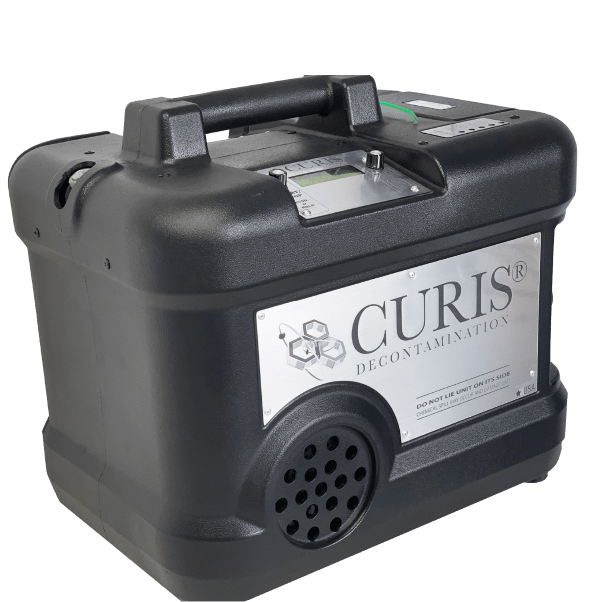
The CURIS Decontamination System is a portable, hydrogen peroxide-based fogging system capable of disinfecting a room or enclosed area via patented pulse technology.
Photo courtesy CURIS System
2 min to read
OVIEDO, Fla. — CURIS System’s proprietary CURoxide Hydrogen Peroxide blend and fogging system has been approved for inclusion on the Environmental Protection Agency’s (EPA’s) List N, meeting the criteria for use against SARS-CoV-2 (COVID-19).
CURoxide has been in use for more than seven years to stop the spread of infectious disease in commercial settings around the world, including most recently the National Guard, which was deployed to help the community in the fight against COVID-19.
CURoxide shows 99.9999% efficacy in killing the most resistant pathogens, according to CURIS System.
The CURIS Decontamination System is a portable, hydrogen peroxide-based fogging system capable of disinfecting a room or enclosed area via patented pulse technology.
Instead of relying on dispensing chemicals and turning off once the desired time is achieved or depending on manual spraying, the decontamination system goes a step further by focusing on a “maintained pathogen-kill zone,” according to the supplier. Its hands-free system is designed to reduce human error. Additionally, remote operation allows the operator to monitor, manage, measure, track, and report, including the ability to quickly prove, and continuously improve, decontamination efforts.
“We are very proud that our solution has been added to the EPA’s List N to use against SARS-CoV-2,” said Frances Grinstead, CEO of CURIS System. “As organizations scramble and struggle to find solutions to keep their employees and customers safe and their businesses operational, we are confident that our products are effective, efficacious, and the safest on the market today — so much so, that we have used these in my own daughter’s school for past infectious outbreaks and felt safe sending her back to a clean and safe environment.”
The CURIS Decontamination System is currently used in environments such as:
• Transportation systems, including school buses and transit buses, airplanes, subways, and taxis.
• Emergency response operations, including fire stations and police stations.
• Schools.
• Medical facilities, including hospitals, and assisted living and long-term care facilities.
• Laboratory spaces.
• Sports facilities and gyms.
• Military facilities.
“The ability to not only disinfect a space thoroughly and effectively and prove and continually improve those efforts through our proprietary cloud-based reporting system, brings companies and the public the reassurance and peace of mind they deserve in these uncertain times,” Grinstead added.
Read the EPA’s statement of efficacy for the CURIS Decontamination System.
Topics:Security and Safety
Originally posted on School Bus Fleet
More Security and Safety

FTA Ends Direct Oversight of MBTA Safety Actions
The federal agency closed its remaining special directive to the Massachusetts Department of Public Utilities following a safety review that began in 2022.
Read More →
Transit Agencies Highlight Safety Gains at National Summit
Leaders from 15 major transit systems shared crime-reduction results and safety initiatives while discussing the role of continued federal support.
Read More →
DART Launches Major Security, Fare Enforcement Initiative
The 90-day demonstration will deploy coordinated security teams at five light rail stations while testing controlled access and gathering data to guide future investments.
Read More →
RTD Launches NextRide App to Consolidate Trip Planning, Fares, Security Reporting
The app expands on RTD’s existing NextRide web application and allows customers to view real-time vehicle locations and service alerts, purchase and store digital fares, and access customer support.
Read More →
TAPTCO Updates OSHA Compliance Training for Transit Maintenance Operations
The revamped program addresses 26 OSHA standards for maintenance facilities, with TAPTCO pointing to training, documentation, and everyday shop hazards as continuing challenges for transit operations.
Read More →
FRA Announces $5.3B in Rail Investments, Including $2B for Amtrak
Funding will support grade-crossing improvements, infrastructure upgrades, and new Amtrak equipment in 23 states.
Read More →
Chicago, Maryland Expand Non-Law-Enforcement Safety, Rider Support
The CTA and MTA are launching new programs aimed at de-escalation, crisis response, rider assistance, and greater transparency.
Read More →
LA Metro, City of West Hollywood, and Partners Advance Smarter Bus Lane Enforcement
The award-winning partnership combines AI-powered detection with human oversight to improve bus reliability, accessibility, and enforcement efficiency.
Read More →
LA Metro Reports 57% Decline in Homelessness on Transit System Since 2024
The agency's latest homelessness count offers new data on how care-based services and cross-sector partnerships can complement traditional transit security strategies.
Read More →
FTA Launches 'Transit Moves America' Dashboard to Highlight Agency Safety and Performance
The online dashboard transforms National Transit Database information into a public-facing resource that allows users to compare transit agencies on key operational and safety metrics.
Read More →