



Sound Transit Light Rail Trains Now Running on Clean Energy
The accomplishment is made possible through an innovative agreement with Puget Sound Energy to purchase wind energy directly from the utility’s Green Direct program.
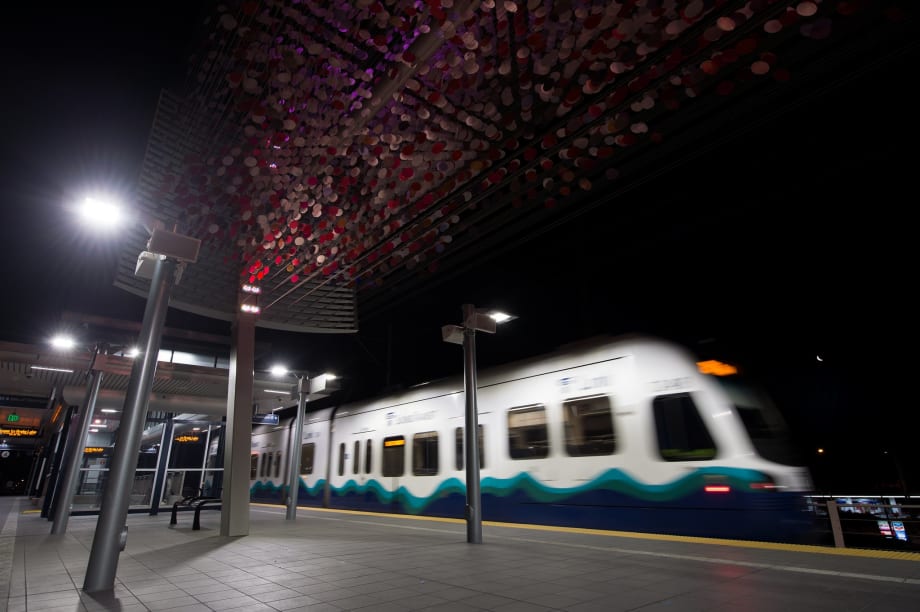
The agreement with PSE is projected to save more than $390,000 in electricity costs over the 10-year contract while also supporting the creation of local clean energy jobs.
Sound Transit
Seattle’s Sound Transit Link light rail system is now running on 100% carbon-free electricity, making it the first major light rail system in the country to achieve this milestone. The accomplishment is made possible through an innovative agreement with Puget Sound Energy (PSE) to purchase wind energy directly from the utility’s Green Direct program. The agreement with PSE is projected to save more than $390,000 in electricity costs over the 10-year contract while also supporting the creation of local clean energy jobs.
“Sound Transit is now at the national forefront of operating carbon-free transit,” said Sound Transit CEO Peter Rogoff. “What’s exciting about this partnership is that we are demonstrating that sustainability leadership can be accomplished by simultaneously lowering costs for taxpayers while maximizing positive impacts to the local economy.”
The Green Direct program supplies renewable energy to customers from the largest wind project in western Washington, the Skookumchuk Wind Facility. Green Direct provides renewable energy directly to six Link Light Rail accounts that serve the Airport Station and Angle Lake Station. These six accounts alone account for just over 70% of the agency’s greenhouse gas emissions from electricity. Because the rest of the Link system is powered by Seattle City Light, the nation’s first carbon neutral electric utility, all of Link light rail now runs on carbon-free and renewable energy.
The Green Direct program will help Sound Transit advance efforts to meet its sustainability goals and implement sustainability initiatives from the voter-approved Sound Transit 3 ballot measure. The agency is committed to reducing greenhouse gas emissions, expanding the use of renewable energy, and making all electricity used for operations carbon free by 2030.
Sound Transit is a national leader in transit sustainability and a Platinum level signatory to the American Public Transportation Association’s Sustainability Commitment. Sound Transit values external validation of its sustainability efforts and is a member of The Climate Registry (TCR), the premier organization supporting governments in North America to measure, report and verify their carbon footprints. In advance of executing the Green Direct agreement, the agency secured Climate Registered Silver recognition status from TCR by conducting an external audit of its 2018 light rail greenhouse gas inventory and elements of its carbon-free claims; Sound Transit is currently seeking third-party verification of its entire greenhouse gas inventory to continue to verify claims of carbon-free operations.
In addition to continuing to partner with the Green Direct program, in the coming months Sound Transit will be adding a 100KW solar power installation to the Operations and Maintenance Facility – East. In 2021, the agency will receive additional renewable energy from Phase 2 of the Green Direct Program to power the remainder of its PSE accounts, which will enable Sound Transit to reduce its agency-wide greenhouse gas emissions from electricity by 96%.
More Rail

New York MTA Advances Final Contract for Second Avenue Subway Expansion
Contract Four is the largest in the Second Avenue Subway Phase 2 project and includes construction of station infrastructure, tracks, and signals for the subway expansion, MTA officials said. Work on Contract Four will begin in 2027.
Read More →
San Diego MTS Breaks Monthly Trolley Ridership Record
Agency officials said July’s ridership indicates MTS’s continued recovery from the pandemic.
Read More →
Report Examines NJ TRANSIT Reliability, Funding Challenges
The Garden State Initiative analysis examines the roles of Amtrak infrastructure, fleet management, and agency operations while recommending a more performance-based approach to improving reliability.
Read More →
Stadler, CapMetro Sign Long-Term Rail Fleet Support Agreement
Beginning in 2027, Stadler will provide on-site technical expertise, spare parts support, training, and obsolescence management to help extend the reliability and longevity of CapMetro’s GTW fleet.
Read More →
Biz Briefs: Alstom Lands Canadian Contract, LYT to Supply California TSP, and More
In METRO's latest installment, we take a look at recent news from Complete Coach Works, Beep, FlixBus, and more partnerships making headlines across the transportation sector.
Read More →
CATS Gold Line Marks 5 Years of Service, 2.8M Passenger Trips
With a six-mile expansion planned, the Charlotte streetcar is positioned to connect more neighborhoods and major transit hubs across the region.
Read More →
Why Simulating Pedestrian Movement Has Become Essential for Modern Rail Stations
Pedestrian microsimulation is helping rail planners identify bottlenecks, test station designs, and prepare complex transit hubs for growing passenger volumes.
Read More →
Amtrak Begins Major Construction at New York’s Sunnyside Yard
The new maintenance facility will support Amtrak’s Airo trainsets while improving maintenance efficiency and turnaround times in New York.
Read More →
Chicago Leaders Unveil Plans for O’Hare Airport Express Train
The privately developed project would offer a 15-minute trip between downtown and O’Hare’s Terminal 2, with trains operating every 15 minutes on a dedicated track. The service would use battery-electric trains and three existing freight rail rights-of-way.
Read More →
OCTA Maps Out 30-Year Strategy to Protect Coastal Rail Corridor
The draft feasibility report identifies strategies to protect the coastal rail line for decades as the agency continues near-term stabilization and sand placement efforts.
Read More →