



Stertil-Koni debuts new HD inground vehicle lift adapter kits
Have been optimized for both new vehicles with the latest axles as well as older vehicles that have been on the road for some time.

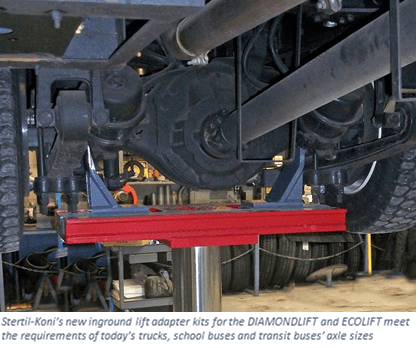
Stertil-Koni's new inground lift adapter kit for the DIAMONDLIFT and ECOLIFT meet the requirements of today's trucks, school buses, and transit buses' axle sizes.
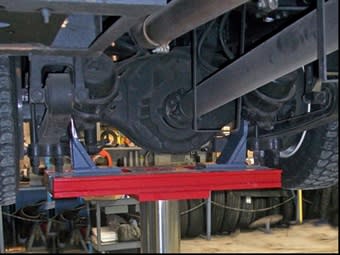
Stertil-Koni's new inground lift adapter kit for the DIAMONDLIFT and ECOLIFT meet the requirements of today's trucks, school buses, and transit buses' axle sizes.
Heavy duty vehicle lift leader Stertil-Koni introduced two new adapter kits tailored for its inground scissor and piston lifts — each engineered to facilitate more efficient lifting by engaging the front and rear lifting points on buses and trucks.
Driving Stertil-Koni’s engineering approach is a transformation in how heavy duty vehicles are now being built.
Following a notable increase in the size of newer transit buses, school buses, and heavy duty trucks, along with the requirements for larger axles to support them, Stertil-Koni recently engineered two new adapter kits — one expressly manufactured for transit buses and another suitable for both trucks and school buses. Stertil-Koni’s school bus and truck adapters are constructed to be wider and taller, while transit bus adapters are flatter and broader.
Even better, the new adapters have been optimized for both new vehicles with the latest axles as well as older vehicles that have been on the road for some time.
“The net result is to increase the versatility, safety, and performance of Stertil-Koni’s DIAMONDLIFT, a state-of-the-art high-pressure telescopic piston lift, and ECOLIFT, the original ultra-shallow, full-rise axle-engaging scissor lift,” notes Matthias Lennemann, Stertil-Koni heavy-duty inground lift sales manager. “Today’s trucks and buses coming off the production line have bigger and wider axles. In response, Stertil-Koni listened to our end-users and tailored these adapter kits to meet the newer requirements. Each kit contains various front and rear adapters and is included, as standard, with new inground lift purchases from Stertil-Koni. Customers simply choose which adapter kit best suits their fleet.”
Lennemann also added: “The adapters are all engineered to embrace the axles, frame or suspension on the vehicle securely.” Each adapter pair has a capacity of up to 35,000 lbs., depending on the type of lift with which it is used.
The kits are also available to current Stertil-Koni inground lift customers.
This announcement comes on the heels of Stertil-Koni’s introduction last September of its differential adapter for the DIAMONDLIFT, specifically engineered to safely and effectively lift vehicles by the rear differential. More recently, Stertil-Koni launched a series of multipurpose adapters for its highly acclaimed Mobile Column Lifts — again designed to bring wheels-free lifting to shops servicing and maintaining heavy-duty vehicles across North America.
More Technology

From Hardware to Digital Partner: Luminator Charts Its Next Chapter
CEO Magnus Friberg discusses Luminator’s shift toward becoming a digital partner, the growing importance of software and interoperability, and how AI can help agencies improve operations and passenger experience.
Read More →
Beyond the Checklist: A Structured Approach to Transit Maintenance
Reliability-Centered Maintenance helps transit agencies move beyond routine checklists to focus limited resources on the assets and failures that have the greatest impact on safety, reliability, and service.
Read More →
NJ TRANSIT Advances Bus Technology Upgrades Across Statewide Fleet
More than 1,500 buses now feature upgraded technology designed to improve arrival predictions and provide free Wi-Fi, with deployment expected to reach nearly 2,000 buses by the end of 2026.
Read More →

Building a Flexible Path to Transit Electrification
John Hroncich discusses BAE Systems’ modular and scalable approach, lessons learned from decades of real-world operations, and how agencies can identify electrification strategies that fit their fleets.
Read More →
Biz Briefs: Alstom Lands Canadian Contract, LYT to Supply California TSP, and More
In METRO's latest installment, we take a look at recent news from Complete Coach Works, Beep, FlixBus, and more partnerships making headlines across the transportation sector.
Read More →
From Legacy Silos to Conversational Intelligence
What if transit leaders could ask any operational question and get a trusted answer in seconds? Conversational AI is transforming how agencies use their data.
Read More →
USDOT Announces Rail Vehicle Replacement Grants, Chattanooga AV Shuttle Funding
More than $191 million in federal funding will help three transit agencies replace aging rail vehicles and support a new autonomous shuttle service in Chattanooga.
Read More →
Bus Tech Talk: Keeping Transit Technicians Ahead of the Technology Curve
LA Metro’s Obed Mejia discusses technician training, evolving maintenance technology, fleet replacement, and strategies for getting the most out of today’s transit fleets.
Read More →
Biz Briefs: RIPTA Unveils New Frontrunners, Clevland RTA Adds New Siemens, and More
In METRO's latest installment, we take a look at recent news from Siemens, Prevost, Dodge, and more partnerships making headlines across the transportation sector.
Read More →
Why Simulating Pedestrian Movement Has Become Essential for Modern Rail Stations
Pedestrian microsimulation is helping rail planners identify bottlenecks, test station designs, and prepare complex transit hubs for growing passenger volumes.
Read More →