



RELATED: 'Going to school' to cultivate next-gen transit employees
Students’ tour of TriMet rail ops sparks interest in transit engineering
Engineering and rail training supervisors provided insight into rail operations, as well as hands-on demonstrations of its systems.
by By Tyler Graf, TriMet
December 18, 2019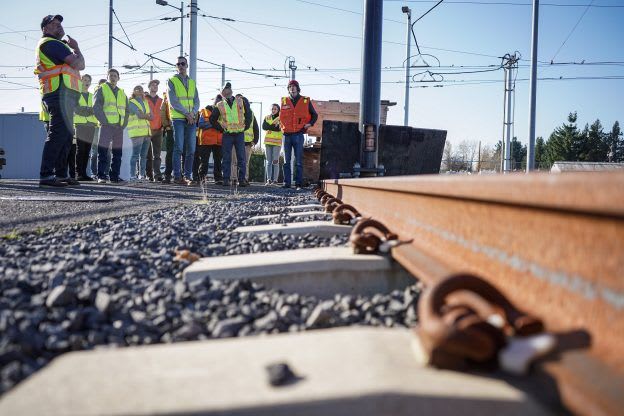
TriMet Engineering and rail training supervisors provided students from a local community college with insight into rail operations, as well as hands-on demonstrations of its systems.
TriMet
5 min to read
TriMet Engineering and rail training supervisors provided students from a local community college with insight into rail operations, as well as hands-on demonstrations of its systems.
TriMet
Transit systems don’t simply sprout up all on their own. They’re cultivated over time, with care and attention coming from people with the technical expertise and vision to keep buses and trains moving. The way a transit system looks, feels, develops and operates all matter to our riders, and engineers play key roles in making sure all the pieces fit together.
That’s something a group of Mount Hood Community College (MHCC) engineering students discovered when they took an in-depth tour of Portland, Ore.-based mass transit provider, TriMet’s Ruby Junction Rail Operations Facility. There, they learned how our various engineering teams, along with maintenance staff, help to keep transit running.
A look under the hood
Rail Controller Russ Fortney came up with the idea for the tour. A former MHCC engineering student, he fondly recalled the field trips he took during Introduction to Engineering, to places like Bonneville Dam and Microchip Technology Inc., and believed TriMet would be an ideal location for engineering students to tour.
“I thought that with the multiple engineering disciplines that we hire here at TriMet, especially on the rail side, the Ruby Junction yard would be a great place for a tour for the class,” Fortney said.
He reached out to Troy Donaldson, the Introduction to Engineering instructor whose class Fortney took a decade ago, to see if he’d be interested in bringing his students to TriMet’s Ruby Junction facility in Gresham. Donaldson thought it was a great idea and brought around 60 students to the facility over the course of two days.
During the tour, engineering and rail training supervisors from TriMet provided the students with insight into rail operations, as well as hands-on demonstrations of its systems. One group went to the shop floor, while the other went out to the rail yard, where they got up close and personal with switches and substations. Discussions ran the engineering gamut. They learned about “track ballast,” the crushed rock between rail ties that helps hold the track in place, prevents vegetation from growing and improves water drainage. They learned how switches move trains from one set of tracks to another and got to manually throw one using a large metal lever.
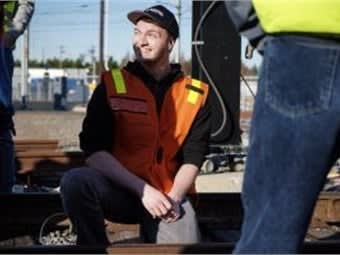
Even if students don’t end up going into an engineering field, their knowledge of mechanics, design and analysis are all transferrable and could prepare them for roles within TriMet.
TriMet
Student Baron Johnson uses transit to get to class but said she hadn’t considered the complexity of transit systems — or how much mechanical, electrical and civil engineering work goes into making sure buses and trains run efficiently — until she took the tour.
“As a passenger, you don’t think about why your train is running late. You just care about time,” Johnson said. “When I’m riding on the bus, I’m definitely going to think about this more. Now that I’ve seen it, it’s more of a component. It’s fresh on my mind now.”
Exposing students to new engineering concepts is the goal of tours like this, Fortney said. This "peek under the hood" is a way of sparking passion among students who otherwise wouldn’t know these opportunities existed. And, as a former engineering student himself, it’s a way of paying it forward to a new generation.
“As far as TriMet as a whole, some of these students might become engineers and end up working at TriMet and design the next projects down the road,” Fortney said. “Overall, I think (this exposure) is a really good benefit to TriMet and the students themselves.”
Engineering the future
Over the next decade, transportation engineering jobs are expected to rise by 6%, according to the U.S. Bureau of Labor Statistics. This is particularly important as tracks, bridges and roads all continue to age and they’re either repaired or replaced. Engineers will be needed to manage various types of projects in the years to come, ranging from designing, upgrading and rebuilding those systems.
“It’s important to bring students out onto tours, especially in the engineering disciplines, because most of them don’t have practical knowledge about what that career is like,” Donaldson said. “You can talk about concepts all you want, but to see it live in action, it changes their perspective on what they’re getting into.”
Even if students don’t end up going into an engineering field, their knowledge of mechanics, design and analysis are all transferrable and could prepare them for roles within TriMet.
Fortney studied to be a civil engineer and said much of what he learned helps him do a better job as a rail controller working out of TriMet’s Operations Command Center. Like an air traffic controller but for trains, Fortney is responsible for monitoring and directing their movement throughout the system to make sure they’re operating safely and on time. He and the other controllers maintain contact with train operators through radio communication and track trains in real-time using a giant monitor at the front of the room.
“I’d say there are many, many opportunities in transit,” Donaldson said. “Engineering, in general, is expanding quickly, but transportation seems to be growing. I’d say that’s an opportunity (the students) should jump on.”
Building a better transit system
Engineering disciplines help build transit systems that are safe, reliable and sustainable. TriMet continues working to make transit better for everyone by developing solutions that improve the overall experience for our riders.
Counterweights keep overhead wires taut in high heat: TriMet crews have been improving the overhead wire and counterweight system to make MAX trains faster and more reliable in high heat. The new counterweight system is designed to prevent the overhead wires from sagging during heat waves of up to 100 degrees.
Rail tie anchors prevent rail kinks: Excessive heat also causes steel to bend, creating what’s known as “sun kinks.” TriMet has worked to reduce this type of heat-related issue by installing rail tie anchors to prevent the rail from bowing in high heat.
Substations: Substations feed power to the overhead wire. When the MAX Orange Line opened in 2015, it was the first light rail line in the country to feature an energy storage unit with supercapacitor technology. It captures and stores electrical energy generated by trains during braking, and feeds it back into the system when the trains accelerate.
These are just a few of TriMet’s agency-wide efforts to make our transit service better and keep trains running on time. At TriMet, we continuously work to improve the resiliency of our bus and rail systems while growing our service and enhancing the customer experience.
More Rail

New York MTA Advances Final Contract for Second Avenue Subway Expansion
Contract Four is the largest in the Second Avenue Subway Phase 2 project and includes construction of station infrastructure, tracks, and signals for the subway expansion, MTA officials said. Work on Contract Four will begin in 2027.
Read More →
San Diego MTS Breaks Monthly Trolley Ridership Record
Agency officials said July’s ridership indicates MTS’s continued recovery from the pandemic.
Read More →
Report Examines NJ TRANSIT Reliability, Funding Challenges
The Garden State Initiative analysis examines the roles of Amtrak infrastructure, fleet management, and agency operations while recommending a more performance-based approach to improving reliability.
Read More →
Stadler, CapMetro Sign Long-Term Rail Fleet Support Agreement
Beginning in 2027, Stadler will provide on-site technical expertise, spare parts support, training, and obsolescence management to help extend the reliability and longevity of CapMetro’s GTW fleet.
Read More →
Biz Briefs: Alstom Lands Canadian Contract, LYT to Supply California TSP, and More
In METRO's latest installment, we take a look at recent news from Complete Coach Works, Beep, FlixBus, and more partnerships making headlines across the transportation sector.
Read More →
CATS Gold Line Marks 5 Years of Service, 2.8M Passenger Trips
With a six-mile expansion planned, the Charlotte streetcar is positioned to connect more neighborhoods and major transit hubs across the region.
Read More →
Why Simulating Pedestrian Movement Has Become Essential for Modern Rail Stations
Pedestrian microsimulation is helping rail planners identify bottlenecks, test station designs, and prepare complex transit hubs for growing passenger volumes.
Read More →
Amtrak Begins Major Construction at New York’s Sunnyside Yard
The new maintenance facility will support Amtrak’s Airo trainsets while improving maintenance efficiency and turnaround times in New York.
Read More →
Chicago Leaders Unveil Plans for O’Hare Airport Express Train
The privately developed project would offer a 15-minute trip between downtown and O’Hare’s Terminal 2, with trains operating every 15 minutes on a dedicated track. The service would use battery-electric trains and three existing freight rail rights-of-way.
Read More →
OCTA Maps Out 30-Year Strategy to Protect Coastal Rail Corridor
The draft feasibility report identifies strategies to protect the coastal rail line for decades as the agency continues near-term stabilization and sand placement efforts.
Read More →