



Study: Chicago public transit should integrate ride-sharing
Study authors make recommendations including, integrating transit services and ride-sharing into the agency's Ventra fare app.

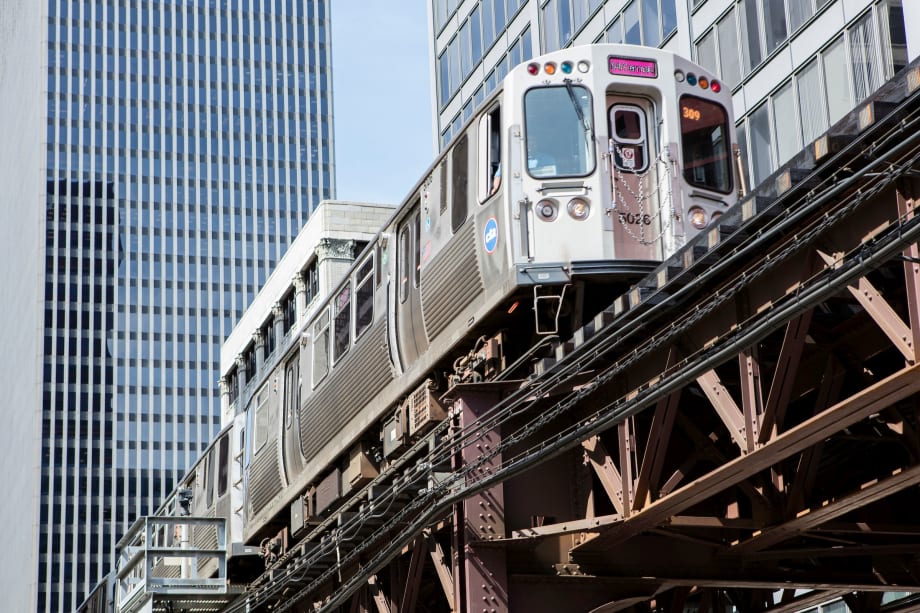
Chicago Transit Authority's 'L' train. Photo: DePaul University-Jeff Carrion
Chicago Transit Authority's 'L' train. Photo: DePaul University-Jeff Carrion
Public transit agencies should find ways to integrate with ride-sharing services for trips within Chicago, recommend researchers at DePaul University. A new study from the Chaddick Institute of Metropolitan Development finds that convenience and comfort are factors that divert passengers from public transit to ride-sharing services, including Uber and Lyft.
“The Chicago Transit Authority can attract new riders by working with ride-sharing providers to allow consumers to mix different travel options. Right now, they must choose one or the other, and many default to ride-sharing, particularly when transit involves long walks and late-night transfers," said Joseph Schwieterman, director of the institute and a professor in the School of Public Service. Chaddick Institute researcher Mallory Livingston co-authored the study.
Ride-sharing — services in which several parties share a vehicle on one given trip— has the potential to divert passengers from public transit and back into cars unless public transit offers better options, said Schwieterman. Part of this is how passengers perceive their experience on both modes of transport. DePaul researchers analyzed how differences in price, travel time and other service attributes affect choices among ride-sharing options. They looked at 3,075 fares for more than 614 trips on Uber, Lyft and Chicago Transit Authority buses and trains and found:
The fares charged for ride-sharing services Lyft Line and UberPool have fallen both in absolute terms and relative to Lyft and Uber and to the Chicago Transit Authority. Despite a recent increase in the city’s tax on these services, the inflation-adjusted cost of riding these services fell by around 5% between 2016 and 2018.
Uber and Lyft tend to be relatively costly for Chicago passengers traveling to and from downtown. When expressed in terms of the cost per hour, the average trip in an Uber or Lyft costs more than $50 per hour saved across the entire sample, making them uneconomical for most commuters. Between the neighborhoods, however, the value proposition of ride-sharing is greater.
Passengers place great value on nonmonetary costs, including a desire to avoid walking and perceived difference in comfort and safety. If a public transit experience is considered favorable, the average commuter is five times less likely to opt for ride-sharing than when it is considered unfavorable.
"Above all else, we find that transit and ride-sharing serve different roles, with each adding something different to the mobility equation," said Livingston. She adds: "Public transit agencies need to worry about the little things— such as station amenities, employee courtesy and vehicle cleanliness — because they make a big difference when customers are tempted to divert to ride-sharing."
To adapt to these changing modes of transportation, the study’s authors recommend that the Chicago Transit Authority:
Integrate transit services and ride-sharing into the Ventra app and other online tools.
Work with companies like Uber and Lyft to offer discounted rides to CTA bus and rail-transit stations at times when feeder bus service is not available as well as during special events.
Create pilot programs with Uber and Lyft for disabled passengers and those on medical-related trips.
Establish “guaranteed ride home” programs that provide additional flexibility to commuters who avoid driving.
The full study, “Uber Economics: Evaluating the Monetary and Nonmonetary Tradeoff of TNC and Transit Service in Chicago, Illinois,” is available at http://bit.ly/chaddickDPUrsrch.
More New Mobility

From Hardware to Digital Partner: Luminator Charts Its Next Chapter
CEO Magnus Friberg discusses Luminator’s shift toward becoming a digital partner, the growing importance of software and interoperability, and how AI can help agencies improve operations and passenger experience.
Read More →
Biz Briefs: Alstom Lands Canadian Contract, LYT to Supply California TSP, and More
In METRO's latest installment, we take a look at recent news from Complete Coach Works, Beep, FlixBus, and more partnerships making headlines across the transportation sector.
Read More →
CharterUP’s Armir Harris on Technology, AI, and the Future of Group Mobility
In a recent episode of METROspectives, CharterUP Founder/CEO Armir Harris discussed the company’s evolution from an online charter bus marketplace into a technology platform supporting public- and private-sector mobility and much more.
Read More →
Jacksonville’s NAVI Project Charts a New Course for Autonomous Public Transportation
Through its NAVI program, JTA is showing how autonomous vehicles, intelligent infrastructure, and coordinated operations can work together to deliver everyday public transportation.
Read More →
Biz Briefs: Luminator Marks Milestone and More
From manufacturers and suppliers to transit agencies and motorcoach operators, these updates offer a snapshot of the projects, partnerships and business moves driving the industry forward.
Read More →
New Tricks for Old Bureaucracies: Joshua Schank on Making Transit Innovation Stick
Former LA Metro Chief Innovation Officer Joshua Schank discusses why good ideas aren't enough, how transit agencies can overcome resistance to change, and why today's challenges demand more innovation.
Read More →
How DART's GoPass Is Redefining Regional Mobility
Serving 14 transit agencies, GoPass simplifies multimodal travel by allowing riders to plan, pay for, and manage an entire trip through one app.
Read More →
Biz Briefs: OCTA Taps Clean Energy for Hydrogen Station, Stadler to Supply Via Rail Vehicles, and More
From manufacturers and suppliers to transit agencies and motorcoach operators, these updates offer a snapshot of the projects, partnerships and business moves driving the industry forward.
Read More →CharterUP Expands Into New Mobility and Autonomous Transportation
Vice President of New Mobility Stephen Joos discusses how CharterUP is leveraging its nationwide transportation network, technology platform, and autonomous vehicle partnerships to expand into workforce mobility, campus shuttles, and transit solutions.
Read More →
METRO Magazine Announces 2026 Innovative Solutions Awards Winners
Projects Recognized for Advancing Mobility Through Technology, Accessibility, Workforce Innovation, and Operational Excellence
Read More →