



Study Shows Bike Sharing Leads to Higher Property Values
Bike sharing is touted as a measure that’s good for people’s health, for the environment, and for life in busy cities.

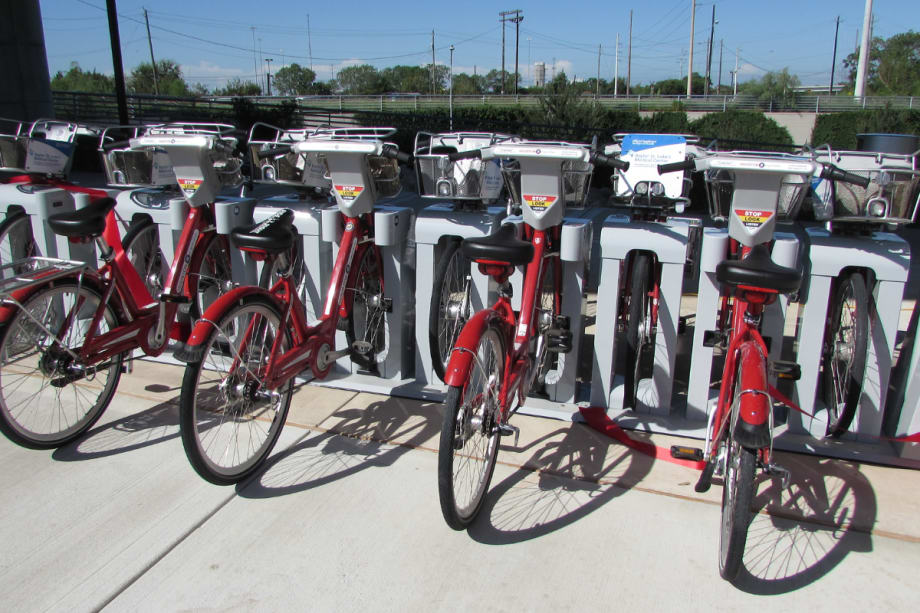
The findings show that, in neighbourhoods that are at least 1.2 kilometres away from subway stations, bike usage intensity was linked with higher home prices.
Photo: Houston Public Media
New UBC Sauder School of Business research titled "Does Bike Sharing increase House Prices? Evidence from Micro‑level Data and the Impact of COVID‑19," shows that bike sharing raises property values, and is especially beneficial to homeowners who aren’t within close walking distance of subway stations.
Bike sharing is touted as a measure that’s good for people’s health, for the environment, and for life in busy cities. A new study from UBC Sauder shows it can boost the value of people’s homes.
Property values have long been tied to proximity to public transit. So the researchers wanted to explore a key question: if shared bikes are solving that last mile problem, what effect do they have on property values?
For the study, the researchers examined bike sharing data in Shanghai, China, a country that, by August 2019, had 300 million bike share users and a daily rider volume of 47 million people across 360 cities.
Focusing specifically on data from before and after the 2016 arrival of Meituan Bike (formerly Mobike), the researchers mapped the intensity of usage around each neighbourhood, then looked at the relationship between that usage and home prices. They also controlled for other factors that could be affecting property values.
The findings show that, in neighbourhoods that are at least 1.2 kilometres away from subway stations, bike usage intensity was linked with higher home prices, which points to bike sharing as a complement to the existing subway network.
“When people try to decide where to live, whether they’re renting or purchasing, one of the decisions is how easy it is for them to get to work and back,” said Anming Zhang, UBC Sauder professor. “And when they’re more than a kilometre away from a subway station, bike sharing can fill the gap.”
The researchers also found that in some areas, bike usage intensity was actually linked with lower home prices, likely because of “bike misplacement."
“Because there are no fixed stations, people can place their bikes wherever they find space. So sometimes when riders finish their trips, the dockless bikes are scattered around. They’re so disorganized, and some bikes just fall down because people are rushing, so it doesn’t look pretty,” said Zhang. “So, if you have an apartment near the station, it can have negative effect.”
Zhang said the results indicate that bike sharing is likely an industry that will remain viable in cities over the long term.
“They are doing good things for society and perhaps for homeowners,” said Zhang. “Longer term, sustainability and emissions reductions are the way of the future, and bicycles are a sustainable alternative.”
More New Mobility

From Hardware to Digital Partner: Luminator Charts Its Next Chapter
CEO Magnus Friberg discusses Luminator’s shift toward becoming a digital partner, the growing importance of software and interoperability, and how AI can help agencies improve operations and passenger experience.
Read More →
Biz Briefs: Alstom Lands Canadian Contract, LYT to Supply California TSP, and More
In METRO's latest installment, we take a look at recent news from Complete Coach Works, Beep, FlixBus, and more partnerships making headlines across the transportation sector.
Read More →
CharterUP’s Armir Harris on Technology, AI, and the Future of Group Mobility
In a recent episode of METROspectives, CharterUP Founder/CEO Armir Harris discussed the company’s evolution from an online charter bus marketplace into a technology platform supporting public- and private-sector mobility and much more.
Read More →
Jacksonville’s NAVI Project Charts a New Course for Autonomous Public Transportation
Through its NAVI program, JTA is showing how autonomous vehicles, intelligent infrastructure, and coordinated operations can work together to deliver everyday public transportation.
Read More →
Biz Briefs: Luminator Marks Milestone and More
From manufacturers and suppliers to transit agencies and motorcoach operators, these updates offer a snapshot of the projects, partnerships and business moves driving the industry forward.
Read More →
New Tricks for Old Bureaucracies: Joshua Schank on Making Transit Innovation Stick
Former LA Metro Chief Innovation Officer Joshua Schank discusses why good ideas aren't enough, how transit agencies can overcome resistance to change, and why today's challenges demand more innovation.
Read More →
How DART's GoPass Is Redefining Regional Mobility
Serving 14 transit agencies, GoPass simplifies multimodal travel by allowing riders to plan, pay for, and manage an entire trip through one app.
Read More →
Biz Briefs: OCTA Taps Clean Energy for Hydrogen Station, Stadler to Supply Via Rail Vehicles, and More
From manufacturers and suppliers to transit agencies and motorcoach operators, these updates offer a snapshot of the projects, partnerships and business moves driving the industry forward.
Read More →CharterUP Expands Into New Mobility and Autonomous Transportation
Vice President of New Mobility Stephen Joos discusses how CharterUP is leveraging its nationwide transportation network, technology platform, and autonomous vehicle partnerships to expand into workforce mobility, campus shuttles, and transit solutions.
Read More →
METRO Magazine Announces 2026 Innovative Solutions Awards Winners
Projects Recognized for Advancing Mobility Through Technology, Accessibility, Workforce Innovation, and Operational Excellence
Read More →