



Study testing Pedestrian-Avoidance Safety System for transit buses
Using Lidar technology, PASS is designed to help professionally-trained operators avoid or reduce the severity of a collision.

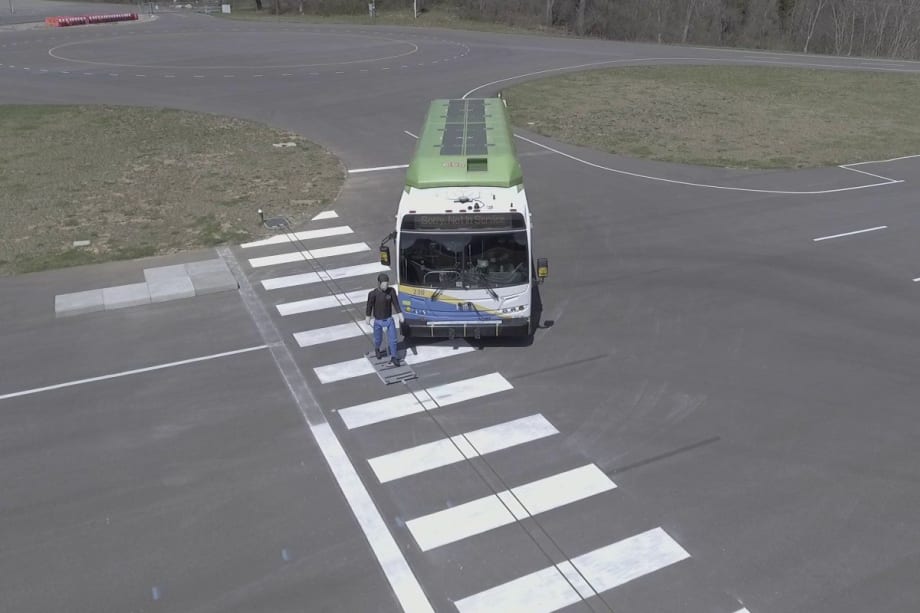
Virginia Tech Transportation Institute is using an inflatable vehicle target for forward-collision testing and a remote-controlled “pedestrian” mannequin that can simulate standing, walking, and running in front of the bus.
VTTI/Stephen Tanner
Virginia Tech Transportation Institute is using an inflatable vehicle target for forward-collision testing and a remote-controlled “pedestrian” mannequin that can simulate standing, walking, and running in front of the bus.
VTTI/Stephen Tanner
Nearly 6,000 pedestrians were killed in traffic crashes in 2017, according to the National Highway Traffic Safety Administration. To combat this issue and improve road user safety overall, leaders in transit, government, industry, and academia are joining forces to evaluate an innovative Pedestrian Avoidance Safety System (PASS) for transit buses. If successful, the technology could be implemented in transit fleets across the nation.
Using Lidar technology, PASS, developed by DCS Technologies Inc., is designed to help professionally-trained operators avoid or reduce the severity of a collision. When an imminent collision with a pedestrian, bicyclist, or vehicle is detected, PASS warns the driver and automatically decelerates the bus, thus, providing operators more time and distance to bring their buses to a controlled stop. This is especially important in the transit industry, which often carries standing or unrestrained passengers.
The goal of the project is to demonstrate this technology’s potential to significantly reduce the frequency and severity of bus collisions and provide estimates of the potential magnitude of reductions in collisions and claims.
Earlier this year Wash.-based Pierce Transit shipped a bus to the Virginia Tech Transportation Institute (VTTI), the largest transportation safety institute in the U.S., to install and evaluate the equipment under controlled conditions on the Virginia Smart Roads testing facility. VTTI is currently evaluating approximately 150 scenarios under various weather and lighting conditions using two main props: an inflatable vehicle target for forward-collision testing and a remote-controlled “pedestrian” mannequin that can simulate standing, walking, and running in front of the bus. Effects on passenger motion are also being studied, as well as driver opinions of and trust in the technology.
The project seeks to ensure the Pedestrian Avoidance Safety System is successful in a variety of road user scenarios, can be installed into new and legacy buses, and is accepted by a highly-trained community of professional drivers.
Other collision-avoidance technologies are operating on streets and highways nationwide in light vehicles and commercial trucks. This project provides an important opportunity to test the application in transit buses, which have and will continue to play a critical role in providing equitable transportation for the country, as well as reducing congestion and carbon emissions.
Following testing, the data will be analyzed, and the FTA will receive a report that will include items such as the project’s cost/benefit, the return on investment, any impact on insurance claims, and reductions in collisions and near misses.Industry organizations can then use this data in considering whether to equip their transit buses with driver assistance technology in the future.
The project is anticipated to be complete by 2021.
The project is funded by a $1.66 million grant from the Federal Transit Administration (FTA), as well as additional funds and support from the following organizations and individuals:
Pierce Transit; Washington State Transit Insurance Pool; Virginia Tech Transportation Institute (VTTI); University of Washington; DCS Technologies Inc.; Munich Reinsurance America Inc.; University of South Florida’s Center for Urban Transportation Research; Veritas Forensic Accounting and Economics;
Janet Gates, project coordinator; Jerome M. Lutin, PhD, LLC, principal researcher
Project Partners and Roles:
Pierce Transit is the sole transit partner involved in this national FTA research project. Following the work at VTTI, Pierce Transit will test the technology on four Pierce Transit buses in Pierce County, Washington, without passengers on board for about six months. If successful, the agency will add the technology to 26 additional buses (30 total) to test in revenue service for another approximately 18 months.
Washington State Transit Insurance Pool (WSTIP) is a risk pool consisting of 25 Washington transit agencies. WSTIP is a financial contributor to the project and has the role of managing the research partners. WSTIP pioneered an earlier research study on collision-avoidance technology that was a catalyst for this enhanced project. WSTIP’s goal is to find technology that will assist bus operators with the safe operation of their vehicles and can be retrofitted to the existing fleet. WSTIP has strategic goals focused on reducing rear-end collisions and bus pedestrian/strikes.
Virginia Tech Transportation Institute is evaluating the PASS system to ensure it meets user needs.
The Smart Transportation Applications and Research Laboratory (STAR Lab) at the University of Washington is focusing primarily on developing an on-board video-based near-miss detection tool for evaluating off-the-shelf collision warning systems and designing data reduction, storage, and analysis methodologies for efficient data management and safety analysis.
DCS Technologies is the PASS technology vendor.
Munich Reinsurance America Inc. In collaboration with the Washington State Transit Insurance Pool, Munich RE launched a pilot program equipping 38 transit buses with collision avoidance technology known as Mobileye Shield+TM. Rosco®Vision Systems is the official North American provider and driver-interface manufacturer of this system. The advanced driver assistance technology empowers drivers to avoid and mitigate imminent collisions, protecting the most vulnerable and difficult-to-observe road users: cyclists, pedestrians and motorcyclists.
University of South Florida’s Center for Urban Transportation Research. Through a cooperative agreement with FTA’s Office of Research, Demonstration, and Innovation. CUTR is working with Pierce Transit to coordinate and monitor performance measures, and the collection and analysis of deployment data to track those performance measures.
Veritas Forensic Accounting and Economics will be analyzing the technology’s return on investment.
Janet Gates is the project coordinator.
Jerome M. Lutin, PhD, LLC is a retired senior director of Statewide and Regional Planning at New Jersey Transit and is currently serving as the study’s principal research investigator.
More Technology

From Hardware to Digital Partner: Luminator Charts Its Next Chapter
CEO Magnus Friberg discusses Luminator’s shift toward becoming a digital partner, the growing importance of software and interoperability, and how AI can help agencies improve operations and passenger experience.
Read More →
Beyond the Checklist: A Structured Approach to Transit Maintenance
Reliability-Centered Maintenance helps transit agencies move beyond routine checklists to focus limited resources on the assets and failures that have the greatest impact on safety, reliability, and service.
Read More →
NJ TRANSIT Advances Bus Technology Upgrades Across Statewide Fleet
More than 1,500 buses now feature upgraded technology designed to improve arrival predictions and provide free Wi-Fi, with deployment expected to reach nearly 2,000 buses by the end of 2026.
Read More →

Building a Flexible Path to Transit Electrification
John Hroncich discusses BAE Systems’ modular and scalable approach, lessons learned from decades of real-world operations, and how agencies can identify electrification strategies that fit their fleets.
Read More →
Biz Briefs: Alstom Lands Canadian Contract, LYT to Supply California TSP, and More
In METRO's latest installment, we take a look at recent news from Complete Coach Works, Beep, FlixBus, and more partnerships making headlines across the transportation sector.
Read More →
From Legacy Silos to Conversational Intelligence
What if transit leaders could ask any operational question and get a trusted answer in seconds? Conversational AI is transforming how agencies use their data.
Read More →
USDOT Announces Rail Vehicle Replacement Grants, Chattanooga AV Shuttle Funding
More than $191 million in federal funding will help three transit agencies replace aging rail vehicles and support a new autonomous shuttle service in Chattanooga.
Read More →
Bus Tech Talk: Keeping Transit Technicians Ahead of the Technology Curve
LA Metro’s Obed Mejia discusses technician training, evolving maintenance technology, fleet replacement, and strategies for getting the most out of today’s transit fleets.
Read More →
Biz Briefs: RIPTA Unveils New Frontrunners, Clevland RTA Adds New Siemens, and More
In METRO's latest installment, we take a look at recent news from Siemens, Prevost, Dodge, and more partnerships making headlines across the transportation sector.
Read More →
Why Simulating Pedestrian Movement Has Become Essential for Modern Rail Stations
Pedestrian microsimulation is helping rail planners identify bottlenecks, test station designs, and prepare complex transit hubs for growing passenger volumes.
Read More →