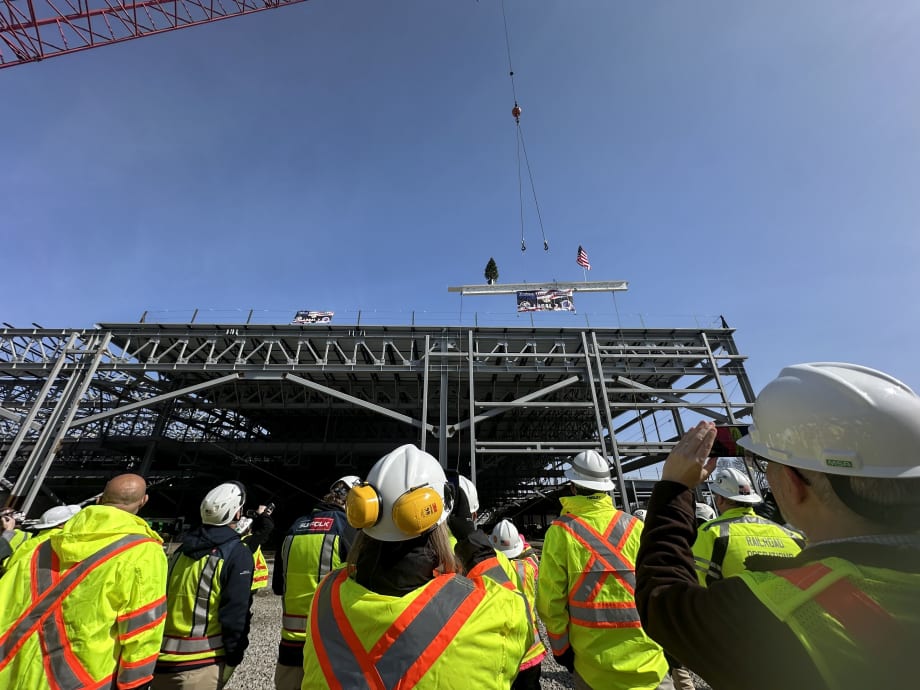
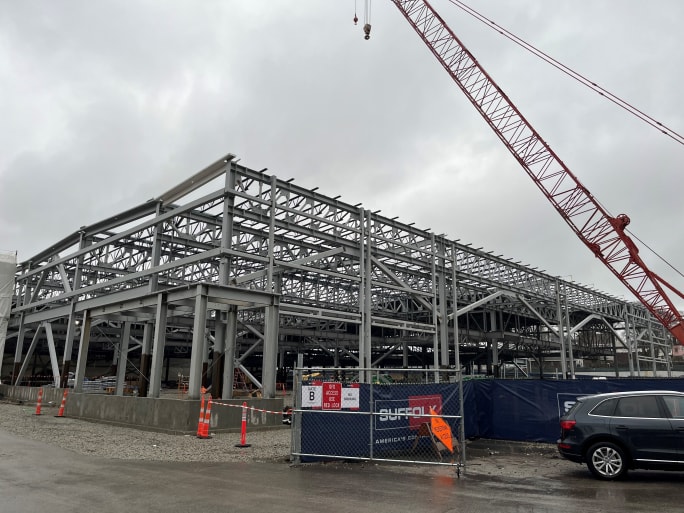
The Quincy Bus Maintenance Facility’s design features four interconnected structures, including dedicated areas for bus storage, maintenance, administrative operations, and fueling.
Photo: MBTA
2 min to read
STV joined Boston’s Massachusetts Bay Transportation Authority (MBTA) in celebrating the topping-off ceremony for the state-of-the-art Quincy Bus Maintenance Facility, where STV serves as the lead design and engineering firm for the project.
The ceremony marks the completion of the facility’s structural frame and celebrates the setting of the last steel beam.
Ad Loading...
Celebrating MBTA’s Milestone
To commemorate the occasion, STV joined project team members in signing the final structural beam before it was hoisted into place.
Designed to accommodate 120 buses, with a maximum capacity of 135, the 300,000-square-foot facility, located across from the Red Line Quincy Adams Station, will replace the agency’s oldest maintenance infrastructure and support the transition to battery-electric buses (BEBs).
In addition to servicing the current bus fleet, it will provide the technological infrastructure necessary for the MBTA’s future electric vehicle fleet.
“This topping-off ceremony marks a key milestone in building a cleaner, more efficient public transportation system that meets our community’s evolving needs,” said Marian Barth, VP and Boston area manager at STV.
Designed to accommodate 120 buses, with a maximum capacity of 135, the 300,000-square-foot facility, located across from the Red Line Quincy Adams Station, will replace the agency’s oldest maintenance infrastructure and support the transition to battery-electric buses.
Photo: MBTA
MBTA’s New Maintenance Facility
The Quincy Bus Maintenance Facility’s design features four interconnected structures, including dedicated areas for bus storage, maintenance, administrative operations, and fueling.
Ad Loading...
Notably, the project integrates advanced resilience strategies for extreme weather and sustainable design elements, positioning the MBTA at the forefront of environmentally responsible transit infrastructure.
As part of its role, STV provided quality assurance oversight to ensure compliance with project drawings and specifications.
STV has played a vital role in shaping Boston’s infrastructure, including its bridges and transit systems.
The firm has contributed to landmark projects like the Green Line Light Rail Extension, Wellington Carhouse Expansion, and recent efforts such as the Belden G. Bly Drawbridge, Fore River Bridge Replacement, Longfellow Bridge Rehabilitation, and Raymond Flynn Marine Park.
The agency is seeking manufacturers for 650 new CNG buses to replace aging vehicles, improve reliability, and advance its broader fleet modernization strategy.
John Hroncich discusses BAE Systems’ modular and scalable approach, lessons learned from decades of real-world operations, and how agencies can identify electrification strategies that fit their fleets.
LA Metro’s Obed Mejia discusses technician training, evolving maintenance technology, fleet replacement, and strategies for getting the most out of today’s transit fleets.
In METRO's latest installment, we take a look at recent news from Siemens, Prevost, Dodge, and more partnerships making headlines across the transportation sector.
In this edition, we also cover recent appointments and announcements at Pace, CamTran, MCI, and more, showcasing the individuals helping to shape the future of transportation.
Transit leaders and policymakers examine how standardized bus designs, streamlined procurement, and predictable funding could help agencies stretch budgets and deliver better service.
As chair of APTA’s Business Members Board of Governors, Ray Melleady explains how more than 850 business members are partnering with transit agencies to advance funding, innovation, and industry-wide collaboration.
Bus Business Consultants founder Brian Dickson shares lessons on leadership, organizational health, and creating options for long-term success in a changing transportation industry.
The award-winning partnership combines AI-powered detection with human oversight to improve bus reliability, accessibility, and enforcement efficiency.