



Texas Transit Agencies Continue to Enforce Federal Mask Mandate
Despite Gov. Gregg Abbott’s calls to ease the state’s COVID restrictions, agencies like DCTA and DART are keeping their focus on employee and passenger safety.

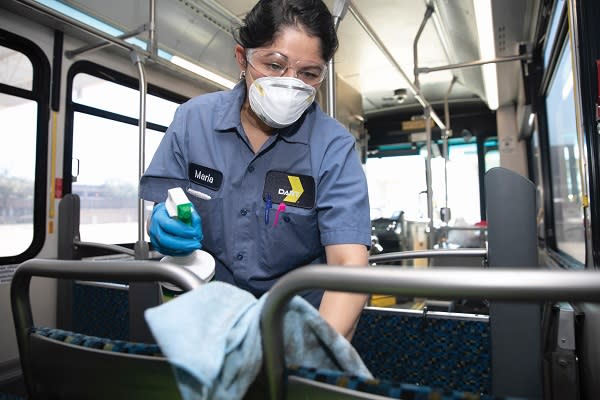
If a DART passenger is concerned with someone not wearing a mask on board, they can contact DART Customer Service, or use the "DART Say Something" app.
DART
As Texas loosens its COVID restrictions, the state’s transit agencies are still taking measures to ensure employee and passenger safety with the enforcement of the federal mask mandate on public transit and enhanced cleaning and service efforts.
On March 2, Gov. Gregg Abbott announced that he would be easing the state’s restrictions meant to prevent the spread of COVID by getting rid of the state’s mask requirement and opening up businesses to full capacity due to a decrease in hospitalizations and positive COVID cases.
The announcement brought about immediate responses from several Texas transit agencies, including Denton County Transportation Authority (DCTA) and Dallas Area Rapid Transit (DART), which both confirmed that they would continue to enforce federal guidelines and require a CDC-approved face mask to be worn by all passengers and operators on all vehicles and at all transit facilities. Passengers who refuse to do so, could be subject to denial of boarding or removal, and possibly federal penalties.
“Our number one priority for our agency is safety, and we’re committed to serving our many communities with specific safety protocols in place, such as requiring masks while riding and at agency facilities and platforms/bus stops, social distancing, practicing safe hand hygiene, and more,” says Adrienne Hamilton, DCTA’s sr. marketing and communications manager.
“We are very fortunate that both our passengers and employees have the seen the importance of wearing face masks while utilizing public transit,” adds Gordon Shattles, DART’s director, external relations. “We hear from passengers every day who thank us for taking and maintaining the appropriate precautions to keep them safe.”
Since the state’s mask mandate was lifted on March 10, DART and DCTA have continued to focus their efforts on bringing ridership back to pre-COVID levels with greater cleaning and service efforts — some of which have included offering complimentary masks to passengers, installing hand sanitizer dispensers on board all vehicles, and conducting daily (sometimes hourly) cleanings of vehicles and facilities.
Additionally, if a DART passenger is concerned with someone not wearing a mask, they can contact DART Customer Service, or use the "DART Say Something" app, which can be downloaded from the Apple Store or Google Play for free.

DCTA will continue to track ridership on all of its services following the state’s lifted mask mandate.
DCTA
So far, neither agency has reported any increases in mask violations since the state mandate was lifted. The agencies also have not required the use of additional security officers to enforce the federal mask mandate as ridership picks back up.
“At this time, it’s too early for us at DCTA to confirm if the lifted state mandate has affected ridership,” Hamilton says. “However, we diligently track ridership on all our services and are monitoring for this in the upcoming weeks and months.”
DCTA transported roughly 1.6 million passengers systemwide in FY 20, a 44% decrease from almost 2.8 million passengers in FY 19. Ridership decreased drastically in the second half of FY 20 as a result of the pandemic, stay-at-home orders, and mandatory closures of non-essential businesses.
Meanwhile, at DART, Shattles says the agency’s ridership is “rising steadily” as more businesses return, especially to the downtown Dallas area. He also says the agency expects the vaccine rollout to play a key role in bringing more passengers back on board.
More Security and Safety

Transit Agencies Highlight Safety Gains at National Summit
Leaders from 15 major transit systems shared crime-reduction results and safety initiatives while discussing the role of continued federal support.
Read More →
DART Launches Major Security, Fare Enforcement Initiative
The 90-day demonstration will deploy coordinated security teams at five light rail stations while testing controlled access and gathering data to guide future investments.
Read More →
RTD Launches NextRide App to Consolidate Trip Planning, Fares, Security Reporting
The app expands on RTD’s existing NextRide web application and allows customers to view real-time vehicle locations and service alerts, purchase and store digital fares, and access customer support.
Read More →

TAPTCO Updates OSHA Compliance Training for Transit Maintenance Operations
The revamped program addresses 26 OSHA standards for maintenance facilities, with TAPTCO pointing to training, documentation, and everyday shop hazards as continuing challenges for transit operations.
Read More →
How VaporVision Adds Value to Transit Door Systems
Wabtec engineers explain how the system improves doorway detection, strengthens diagnostics and gives transit agencies and OEMs greater operating flexibility.
Read More →
FRA Announces $5.3B in Rail Investments, Including $2B for Amtrak
Funding will support grade-crossing improvements, infrastructure upgrades, and new Amtrak equipment in 23 states.
Read More →
Chicago, Maryland Expand Non-Law-Enforcement Safety, Rider Support
The CTA and MTA are launching new programs aimed at de-escalation, crisis response, rider assistance, and greater transparency.
Read More →
LA Metro, City of West Hollywood, and Partners Advance Smarter Bus Lane Enforcement
The award-winning partnership combines AI-powered detection with human oversight to improve bus reliability, accessibility, and enforcement efficiency.
Read More →
LA Metro Reports 57% Decline in Homelessness on Transit System Since 2024
The agency's latest homelessness count offers new data on how care-based services and cross-sector partnerships can complement traditional transit security strategies.
Read More →
FTA Launches 'Transit Moves America' Dashboard to Highlight Agency Safety and Performance
The online dashboard transforms National Transit Database information into a public-facing resource that allows users to compare transit agencies on key operational and safety metrics.
Read More →