




RELATED: Tailored transit services take fans to the ballpark
Thousands take Metro to 'Women’s March' in Downtown L.A.
Metro Rail carried a total of 592,000 boarding passengers — 360,000 more riders than on a typical Saturday.
January 25, 2017
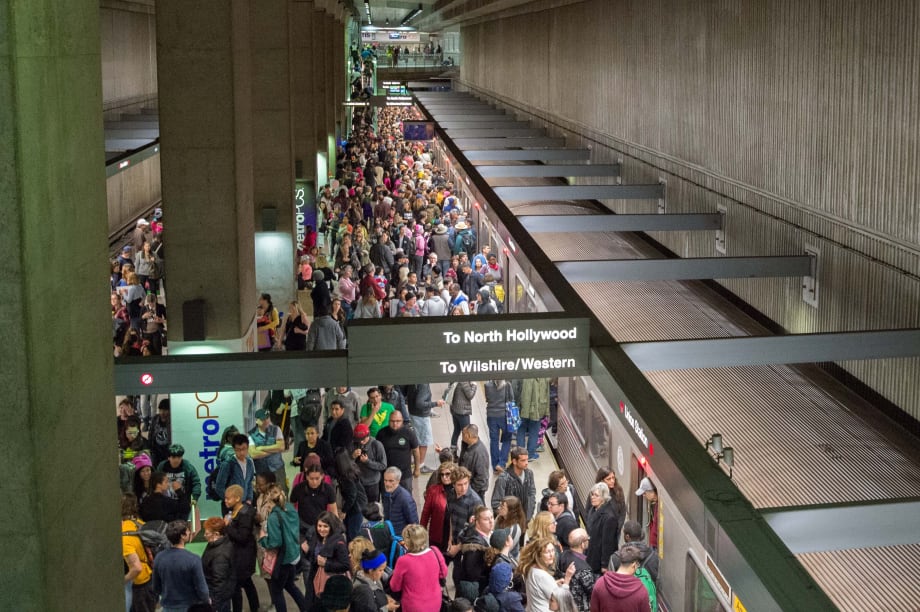
On some Metro lines, rail cars were crowded — many to capacity — and most stations in downtown L.A. also were filled. Photo: Metro
2 min to read
On some Metro lines, rail cars were crowded — many to capacity — and most stations in downtown L.A. also were filled. Photo: Metro
As thousands converged on downtown Los Angeles for the Saturday Women’s March, Metro Rail carried a total of 592,000 boarding passengers — 360,000 more riders than on a typical Saturday. Los Angeles Police Department estimates placed the crowd at 100,000 and event organizers pegged that number at more than 750,000.
On some Metro lines, rail cars were crowded — many to capacity — and most stations in downtown L.A. also were filled.
“This was an amazing experience for our region, as well as for Metro,” said Metro Board Chair John Fasana. “Whatever your political thoughts, it was exciting to see so many people exercising their right to demonstrate peacefully. And it spoke to the crowds that there was no violence and that despite crowding, at the end of the day our patrons were safe.”
To gear up for the march, Metro added service and security to accommodate what organizers at first estimated would be 75,000 participants. As attendance projections grew, more rail cars and more frequent service were scheduled. When trains began to crowd on Saturday, additional service was added. To accommodate the massive crowds, extra rail cars were added to service. The result was a 60% increase in car capacity, compared with a typical Saturday. Staff also was on hand to help new customers buy TAP cards at ticket machines and yet the lines were long in a handful of stations.
Among the busiest rail stations in downtown Los Angeles were the 7th Street/Metro Center Station, which serves the Red, Purple, Blue and Expo lines; Pershing Square and Civic Center stations, which carry Red and Purple line passengers, and Union Station, which serves the Red, Purple and Gold lines, as well as Metrolink. Beyond downtown, the North Hollywood and Universal/Studio City stations for the Red Line were among the busiest.
“I applaud our operations team for their outstanding efforts to provide this critical service to Los Angeles,” said Metro CEO Phillip A. Washington. “As much planning as we did, the heavy ridership still required the good spirit and patience of our patrons, and we appreciate that. We are very pleased overall that Metro was able to serve so many people on Saturday.”
Ridership began to spike at 7 a.m., dipped between 10 a.m. and 1 p.m. and then peaked again at about 5 p.m. The event was scheduled to begin at 9 a.m. and continue until 4 p.m. More than 40,000 new TAP fare cards were sold within a short period of time on Saturday. TAP cards are the method of payment for Metro trains and buses.
More Management

METRO Opens Submissions for 2026 Motorcoach Awards
Nominations are now being accepted for METRO Magazine’s Operator of the Year and Innovative Operator of the Year awards.
Read More →
New York MTA Advances Final Contract for Second Avenue Subway Expansion
Contract Four is the largest in the Second Avenue Subway Phase 2 project and includes construction of station infrastructure, tracks, and signals for the subway expansion, MTA officials said. Work on Contract Four will begin in 2027.
Read More →
Transit Agencies Highlight Safety Gains at National Summit
Leaders from 15 major transit systems shared crime-reduction results and safety initiatives while discussing the role of continued federal support.
Read More →

NITA Names New Leadership, Expands Reduced-Fare Program at First Board Meeting
The new regional transit authority appointed its first board chair and interim executive director while extending reduced fares across CTA, Metra, and Pace for eligible riders.
Read More →
Beyond the Checklist: A Structured Approach to Transit Maintenance
Reliability-Centered Maintenance helps transit agencies move beyond routine checklists to focus limited resources on the assets and failures that have the greatest impact on safety, reliability, and service.
Read More →
APTA 2026 Nominating Committee Selects Leadership Slate, Names Chair and Vice Chair Nominees
Leadership changes will help shape the association’s priorities and its representation of the transportation industry during the 2026–2027 term.
Read More →
DART Launches Major Security, Fare Enforcement Initiative
The 90-day demonstration will deploy coordinated security teams at five light rail stations while testing controlled access and gathering data to guide future investments.
Read More →
Sponsored•September 9, 2026
Advancing Fare Collection Through Technology and Innovation
Learn about delivering 1300 gates at 91 stations while managing fare evasion. Explore the large scale deployment, solution customization and real-world results that affect the region. Prepare for deployment in your region now.
Read More →
Game Day in Motion: Moving Millions During the 2026 World Cup
Between packed transit stations and team motorcoaches, see how agencies and operators across North America tackled the transportation demands of the 2026 FIFA World Cup.
Read More →
Surface Transportation Extension Averts Shutdown, Leaves Transit Funding Gap
The stopgap keeps federal transportation programs moving, but missing advance funding could complicate the transit and rail projects agencies are planning next.
Read More →