



Transdev, Babcock Ranch unveil first autonomous school shuttle
BNS students living within the community will be the first in the nation to catch a ride to school on an autonomous shuttle.


For days with foul weather, or for students who live farther from the school, the autonomous shuttle will remain a viable option during the pilot.
Photos via Transdev
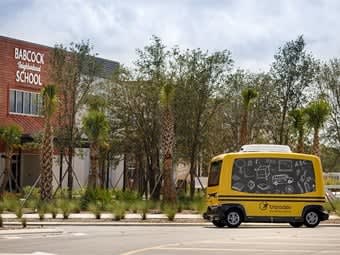
For days with foul weather, or for students who live farther from the school, the autonomous shuttle will remain a viable option during the pilot.
Photos via Transdev
Transdev, the mobility partner for Babcock Ranch, is completing more than two months of testing on school shuttle routes that will supplement existing autonomous options within the community. During the pilot-program, Transdev will evaluate rider behavior and demand by offering the service to Babcock Neighborhood School (BNS) students who live within the new town located just northeast of Fort Myers, Fla.
As the town — the first solar-powered community in the country — continues to grow to its estimated capacity of nearly 50,000 residents, mobility options will continue to evolve to meet new demands, including student transit.
“Imagine how excited these students will be the first time that yellow school shuttle pulls up outside their house. What an incredible moment for them,” “Not only are we providing an important mobility option for these children, but what an opportunity for them to see the amazing power of science, technology, engineering, and math that help this shuttle run safely and efficiently,” said Dick Alexander, executive VP, mobility innovation, at Transdev. “The whole experience is something we hope they will never forget.”
BNS students living within the community will be the first in the nation to catch a ride to school on an autonomous shuttle. Nearly 30 of the 316 students enrolled in grades K to 7 at BNS this year will be residing within the new solar-powered town by January.
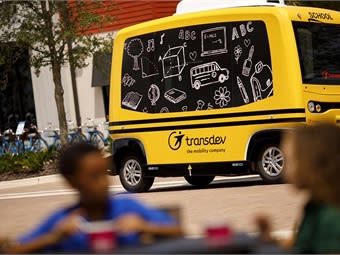
Babcock Ranch and Transdev have been offering autonomous shuttle service since the town opened in January as part of an overall devotion to reducing reliance on automobiles.
Safety is always the highest priority. The 12-person Easy Mile EZ10 Gen II shuttle reaches a standard cruising speed of eight miles per hour and brakes automatically and swiftly when obstacles are detected — a new software update will even allow the shuttle to maneuver around an obstacle if safe conditions permit. A safety attendant will remain on board at all times students are riding to ensure their comfort and to answer all the questions curious minds may have about autonomous technology. Transdev will test the autonomous shuttle with students and families before the pilot officially begins.
As part of that dedication to sustainability, walking, and biking will always be encouraged. For days with foul weather, or for students who live farther from the school, the autonomous shuttle will remain a viable option during the pilot. Eventually, students and parents will be able to book on-demand, door-to-door school shuttles based on individual needs.
Babcock Ranch and Transdev have been offering autonomous shuttle service since the town opened in January as part of an overall devotion to reducing reliance on automobiles. The school shuttle service will utilize all the knowledge and expertise gained during that
Autonomous shuttles and more will be discussed at BusCon 2018 at the Indiana Convention Center in Indianapolis, Oct. 1 to 3. Click here for more info.
More New Mobility

From Hardware to Digital Partner: Luminator Charts Its Next Chapter
CEO Magnus Friberg discusses Luminator’s shift toward becoming a digital partner, the growing importance of software and interoperability, and how AI can help agencies improve operations and passenger experience.
Read More →
Biz Briefs: Alstom Lands Canadian Contract, LYT to Supply California TSP, and More
In METRO's latest installment, we take a look at recent news from Complete Coach Works, Beep, FlixBus, and more partnerships making headlines across the transportation sector.
Read More →
CharterUP’s Armir Harris on Technology, AI, and the Future of Group Mobility
In a recent episode of METROspectives, CharterUP Founder/CEO Armir Harris discussed the company’s evolution from an online charter bus marketplace into a technology platform supporting public- and private-sector mobility and much more.
Read More →
Jacksonville’s NAVI Project Charts a New Course for Autonomous Public Transportation
Through its NAVI program, JTA is showing how autonomous vehicles, intelligent infrastructure, and coordinated operations can work together to deliver everyday public transportation.
Read More →
Biz Briefs: Luminator Marks Milestone and More
From manufacturers and suppliers to transit agencies and motorcoach operators, these updates offer a snapshot of the projects, partnerships and business moves driving the industry forward.
Read More →
New Tricks for Old Bureaucracies: Joshua Schank on Making Transit Innovation Stick
Former LA Metro Chief Innovation Officer Joshua Schank discusses why good ideas aren't enough, how transit agencies can overcome resistance to change, and why today's challenges demand more innovation.
Read More →
How DART's GoPass Is Redefining Regional Mobility
Serving 14 transit agencies, GoPass simplifies multimodal travel by allowing riders to plan, pay for, and manage an entire trip through one app.
Read More →
Biz Briefs: OCTA Taps Clean Energy for Hydrogen Station, Stadler to Supply Via Rail Vehicles, and More
From manufacturers and suppliers to transit agencies and motorcoach operators, these updates offer a snapshot of the projects, partnerships and business moves driving the industry forward.
Read More →CharterUP Expands Into New Mobility and Autonomous Transportation
Vice President of New Mobility Stephen Joos discusses how CharterUP is leveraging its nationwide transportation network, technology platform, and autonomous vehicle partnerships to expand into workforce mobility, campus shuttles, and transit solutions.
Read More →
METRO Magazine Announces 2026 Innovative Solutions Awards Winners
Projects Recognized for Advancing Mobility Through Technology, Accessibility, Workforce Innovation, and Operational Excellence
Read More →