




RELATED: Ridership would increase if it was easier to pay for
Transit could drive contactless payment growth
Large transit agencies have moved or are moving to open contactless payments, including in Chicago, Portland, and New York.
April 17, 2019
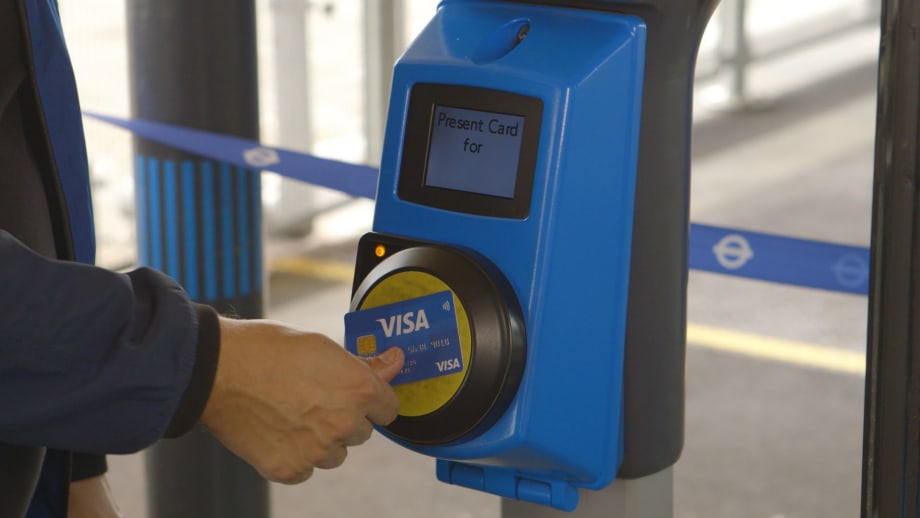
Large transit agencies have moved or are moving to open contactless payments, including in Chicago, Portland, and New York.
Via Visa
3 min to read
Large transit agencies have moved or are moving to open contactless payments, including in Chicago, Portland, and New York.
Via Visa
The U.S. Payments Forum released its quarterly Market Snapshot, providing a look at the state of EMV chip adoption in the U.S., fraud, what’s next for payments in 2019, and Forum priorities and projects for the year.
Contact chip payments are now firmly ingrained in the U.S. market, with payments volume coming from chip-enabled merchants approaching 70%. To improve customer experience and provide more payment choice in-stores, the payments industry is now turning its attention to contactless chip technology for fast and secure payments with a tap of a card or mobile device. Momentum is growing: tens of millions of contactless cards are expected to be issued this year and 78 of the top 100 merchants accept contactless payments today.
Just as in other countries, the U.S. Payments Forum expects that transit will be a driver for contactless payments in the U.S. Large transit agencies have moved or are moving to open contactless payments, including in Chicago, Portland, and New York.
“What we’ve seen in other countries, and expect to see here, is the contactless ‘halo effect’ when transit riders start using contactless cards,” said Randy Vanderhoof, director of the U.S. Payments Forum. “When a large transit agency moves to open contactless payments, issuers get cards in the hands of riders who quickly get used to tapping and seek it out wherever they can. As a result, contactless transactions rise dramatically at merchants in surrounding geographical areas. We’ve seen this in the U.K. and Canada, and will start to see this in the U.S. this year.”
With contactless technology taking center stage, many people have questions about how contactless devices work and what their security features are. To assist, the U.S. Payments Forum launched the GetContactless.com website and has published implementation resources.
Forum Priorities
As merchants and issuers work to secure the e-commerce channel, several authentication methodologies and standards have become available, leaving stakeholders with questions around what they are, what problems they solve and how they fit together. These include EMV 3-D Secure (3DS), W3C Web Payments and Web Authentication, FIDO and EMV Secure Remote Commerce (SRC).
The Forum has already delivered education relating to EMV 3DS including the recent EMV 3-D Secure Data Elements Webinar and plans to deliver a more detailed paper about the use of new EMV 3DS data elements by merchants, issuers, and other payments industry stakeholders. The Forum plans additional projects to help the industry understand these different authentication methodologies and standards and how they can best be implemented for payment credential, user, and transaction authentication in e-commerce.
Securing the e-commerce channel is the focus of several Forum projects underway including white papers on tokenization and fraud mitigation approaches. Other EMV and emerging technology-related Forum projects underway include:
A Contactless Open Payments for Transit webinar to provide a high-level overview and implementation guidance for transit open payments.
A white paper on transit contactless open payments use cases for paying with aggregated fares.
A best practices guide for customer-facing terminology for transit agencies implementing contactless open payments.
A white paper providing best practices for contactless transactions at the point of sale.
Resources providing guidance on streamlining Level 3 contactless testing and certification.
An updated resource on effective approaches for mitigating card-not-present fraud.
A resource to provide a primer and discuss lessons learned with payment tokenization implementation.
An educational resource on emerging data elements used for mobile payments.
A guide on mobile payments standards and specifications.
A resource on authentication methodologies used for mobile in-app and remote payment transactions.
More Technology

From Hardware to Digital Partner: Luminator Charts Its Next Chapter
CEO Magnus Friberg discusses Luminator’s shift toward becoming a digital partner, the growing importance of software and interoperability, and how AI can help agencies improve operations and passenger experience.
Read More →
Beyond the Checklist: A Structured Approach to Transit Maintenance
Reliability-Centered Maintenance helps transit agencies move beyond routine checklists to focus limited resources on the assets and failures that have the greatest impact on safety, reliability, and service.
Read More →
NJ TRANSIT Advances Bus Technology Upgrades Across Statewide Fleet
More than 1,500 buses now feature upgraded technology designed to improve arrival predictions and provide free Wi-Fi, with deployment expected to reach nearly 2,000 buses by the end of 2026.
Read More →

Building a Flexible Path to Transit Electrification
John Hroncich discusses BAE Systems’ modular and scalable approach, lessons learned from decades of real-world operations, and how agencies can identify electrification strategies that fit their fleets.
Read More →
Biz Briefs: Alstom Lands Canadian Contract, LYT to Supply California TSP, and More
In METRO's latest installment, we take a look at recent news from Complete Coach Works, Beep, FlixBus, and more partnerships making headlines across the transportation sector.
Read More →
Sponsored•September 8, 2026
From Legacy Silos to Conversational Intelligence
What if transit leaders could ask any operational question and get a trusted answer in seconds? Conversational AI is transforming how agencies use their data.
Read More →
USDOT Announces Rail Vehicle Replacement Grants, Chattanooga AV Shuttle Funding
More than $191 million in federal funding will help three transit agencies replace aging rail vehicles and support a new autonomous shuttle service in Chattanooga.
Read More →
Bus Tech Talk: Keeping Transit Technicians Ahead of the Technology Curve
LA Metro’s Obed Mejia discusses technician training, evolving maintenance technology, fleet replacement, and strategies for getting the most out of today’s transit fleets.
Read More →
Biz Briefs: RIPTA Unveils New Frontrunners, Clevland RTA Adds New Siemens, and More
In METRO's latest installment, we take a look at recent news from Siemens, Prevost, Dodge, and more partnerships making headlines across the transportation sector.
Read More →
Why Simulating Pedestrian Movement Has Become Essential for Modern Rail Stations
Pedestrian microsimulation is helping rail planners identify bottlenecks, test station designs, and prepare complex transit hubs for growing passenger volumes.
Read More →