



TransLink Sees Highest Jump in Ridership Since Start of Pandemic
The four weekdays after Labor Day brought the largest jump in ridership since March 2020, with an average increase of 17% when compared to an average weekday in August.
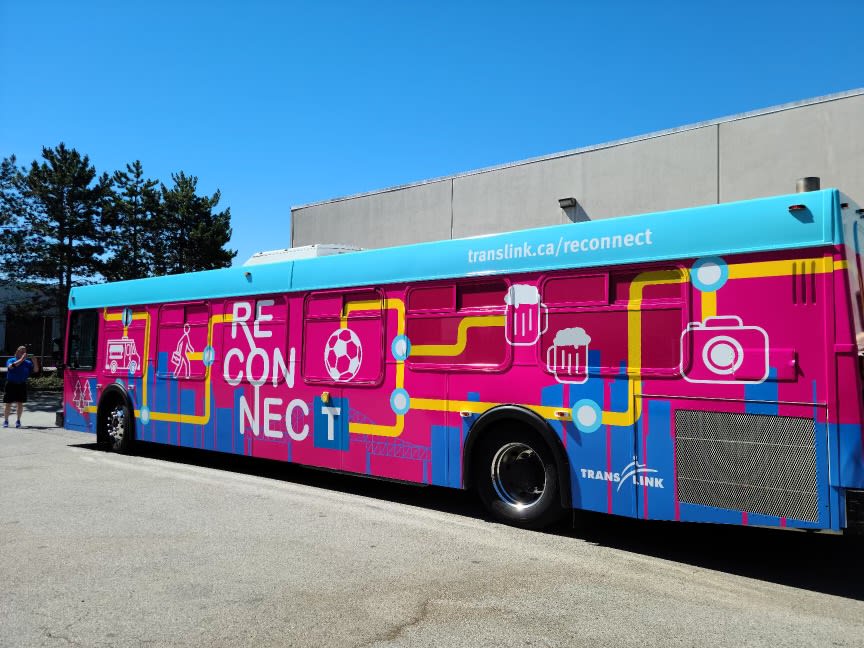
The positive data comes as TransLink launches its “Ride On” marketing campaign, which encourages more customers to choose transit as they return to their regular fall routines.
Art courtesy TransLink
B.C.’s TransLink is experiencing its highest boost in ridership in 18 months, as people return to their offices and students to classrooms.
The four weekdays after Labor Day brought the largest jump in ridership since March 2020, with an average increase of 17% when compared to an average weekday in August. There were approximately 120,000 more average weekday boardings system-wide than the week before. An increase in ridership is typical for early September, but the back-to-school bump the agency has seen in 2021 is five percentage points larger than the 12% increases in 2019 and 2018.
System-wide boardings are at about 55% of pre-COVID ridership. Ridership varies by mode, location, and destination, with post-secondary routes leading the recovery.
Routes serving post-secondary institutions made strong gains towards pre-COVID ridership levels over the first week of in-person classes including Route 49 Metrotown Stn./Dunbar Loop (71%), Route 145 SFU/Production Stn. (55%), and Route 25 Brentwood Stn./UBC (62%).
Routes serving industrial areas have recovered to near pre-COVID ridership levels including Routes 418 Kingswood/22nd St. Stn. and 175 Coquitlam Central Stn./Meridian (95%), and Routes 531 White Rock Centre/Willowbrook, and 640 Ladner Exch/Scott Rd Stn. (90%).
Ridership return continues to be strongest in the Southeast part of the region, with bus ridership in this area at 66% of pre-COVID levels. TransLink believe this is, in part, due to a higher percentage of frontline workers.
“The early data we are seeing with students now back to in-class learning at the post-secondary level is very encouraging,” said TransLink CEO Kevin Quinn. “I’m optimistic about ridership growth as we move into the fall. We are seeing people eager to get back into routines of work and school and we hope people make transit their first choice in getting to and from their daily activities.”
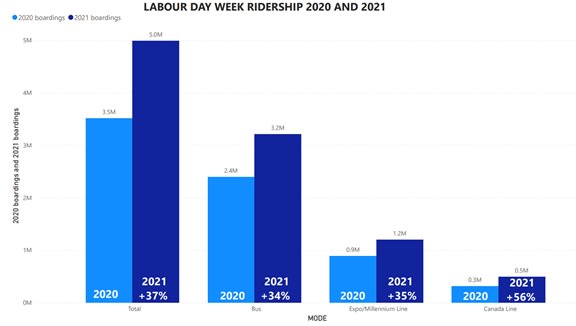
The four weekdays after Labor Day brought the largest jump in ridership since March 2020, with an average increase of 17% when compared to an average weekday in August.
The positive data comes as TransLink launches its “Ride On” marketing campaign, which encourages more customers to choose transit as they return to their regular fall routines. The brightly colored Reconnect Bus will be touring the city and making stops at many post-secondary institutions. Customers can jump on board the bus to learn more about what’s new and improved on transit and the many ways we are keeping the system safe.
Transit has been a safe and reliable way to get around our region throughout the pandemic. TransLink continues to work closely with provincial health officials to ensure our Safe Operating Action Plan reflects current public health advice. TransLink will continue to add more initiatives to the Reconnect Campaign throughout the year to further encourage and welcome customers back to transit.
More Management

METRO Opens Submissions for 2026 Motorcoach Awards
Nominations are now being accepted for METRO Magazine’s Operator of the Year and Innovative Operator of the Year awards.
Read More →
New York MTA Advances Final Contract for Second Avenue Subway Expansion
Contract Four is the largest in the Second Avenue Subway Phase 2 project and includes construction of station infrastructure, tracks, and signals for the subway expansion, MTA officials said. Work on Contract Four will begin in 2027.
Read More →
Transit Agencies Highlight Safety Gains at National Summit
Leaders from 15 major transit systems shared crime-reduction results and safety initiatives while discussing the role of continued federal support.
Read More →

NITA Names New Leadership, Expands Reduced-Fare Program at First Board Meeting
The new regional transit authority appointed its first board chair and interim executive director while extending reduced fares across CTA, Metra, and Pace for eligible riders.
Read More →
Beyond the Checklist: A Structured Approach to Transit Maintenance
Reliability-Centered Maintenance helps transit agencies move beyond routine checklists to focus limited resources on the assets and failures that have the greatest impact on safety, reliability, and service.
Read More →
APTA 2026 Nominating Committee Selects Leadership Slate, Names Chair and Vice Chair Nominees
Leadership changes will help shape the association’s priorities and its representation of the transportation industry during the 2026–2027 term.
Read More →
DART Launches Major Security, Fare Enforcement Initiative
The 90-day demonstration will deploy coordinated security teams at five light rail stations while testing controlled access and gathering data to guide future investments.
Read More →
Advancing Fare Collection Through Technology and Innovation
Learn about delivering 1300 gates at 91 stations while managing fare evasion. Explore the large scale deployment, solution customization and real-world results that affect the region. Prepare for deployment in your region now.
Read More →
Game Day in Motion: Moving Millions During the 2026 World Cup
Between packed transit stations and team motorcoaches, see how agencies and operators across North America tackled the transportation demands of the 2026 FIFA World Cup.
Read More →
Surface Transportation Extension Averts Shutdown, Leaves Transit Funding Gap
The stopgap keeps federal transportation programs moving, but missing advance funding could complicate the transit and rail projects agencies are planning next.
Read More →