



UC Berkeley launches high-tech transit study
The pilot invites the public to use a free online trip planner. Researchers are trying to determine whether commuters will use transit more often if they are provided with accessible, current and information-rich transit, parking and traffic options before they start their journeys.

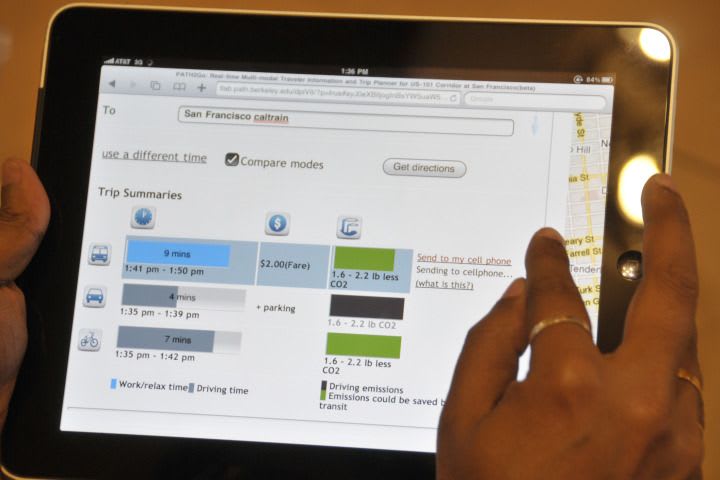
The pre-trip planner compares modes. Photo by Jay Sullivan, California Partners for Advanced Transit and Highways.
[IMAGE]UCBerkeleyPATH2GO2479FULL-2.jpg[/IMAGE] A new pilot project by transportation researchers at the University of California, Berkeley seeks to determine whether commuters will use transit more often if they are provided with accessible, current and information-rich transit, parking and traffic options before they start their journeys.
The field test takes place along the US 101 corridor between San Jose and San Francisco, one of the busiest commute routes in the Bay Area, and provides a comparison of real-time traffic, bus and Caltrain information for custom-selected routes.
The pilot, called the Networked Traveler, formally launched on Tuesday, with an invitation for the public to use the free online trip planner and/or download the mobile phone application, called PATH2Go. The technology allows travelers between San Francisco and San Jose to select the best commute option based on personalized priorities of cost-efficiency, time-efficiency or a low-carbon footprint. The mobile application is also available in the mobile apps section of www.511.org.
Researchers said that the study’s multi-agency cooperation was key to attaining real-time, region-wide data for multiple modes of transportation. “Commuters can compare driving, Caltrain and the bus based on the up-to-the minute status of traffic and transit,” said Liping Zhang, the lead developer on the project, which is being conducted at the California Partners for Advanced Transit and Highways (PATH), a research center at the UC Berkeley Institute of Transportation Studies.
Zhang said Networked Traveler aggregates information from a variety of sources — including live next-train and next-bus information from Caltrain, SamTrans, San Francisco Municipal Railway (Muni), BART, the Santa Clara Valley Transportation Authority (VTA) 522 bus rapid transit line, and real-time traffic conditions from traffic.com and SpeedInfo. “Smart parking” instrumentation that counts and transmits the number of available spots — displays current parking availability at the Millbrae, Redwood City, Menlo Park and Palo Alto Caltrain stations.
Networked Traveler has two main features: a trip planner for multimodal pre-trip planning, and, for people who already know their routes, a menu of transit agencies for quick access to next-bus/next train information. There are also a series of alerts to help transit riders navigate their trips. For driver safety, "geofencing" technology is used to block the cell phone application while a driver is in a moving automobile.
Commuters who register their GPS-activated smart phones at www.networkedtraveler.org can opt to receive a number of in-transit screen alerts – with audio and vibrate options – telling them where the nearest stop is, and, after they are already in transit, how many minutes are left on their trip and when their destination is approaching.
The California Department of Transportation (Caltrans) is sponsoring the pilot with the aim of developing tools that will reduce traffic congestion and alleviate traveler stress. Project partners include the Metropolitan Transportation Commission (MTC), San Mateo County Transit District (SamTrans), Caltrain, VTA, NAVTEQ, ParkingCarma and SpeedInfo.
Sign-up is required to receive the PATH2Go mobile application, so that the research team can contact participants for surveys and feedback. The study will not save cell phone numbers or associate the numbers with user names.
The field test is slated to continue for several months. To learn which information is most likely to influence traveler behavior, researchers will study how and when people use the services and which services people find most helpful.
More Bus

New York MTA Plans Largest Bus Fleet Upgrade in More Than a Decade
The agency is seeking manufacturers for 650 new CNG buses to replace aging vehicles, improve reliability, and advance its broader fleet modernization strategy.
Read More →
Building a Flexible Path to Transit Electrification
John Hroncich discusses BAE Systems’ modular and scalable approach, lessons learned from decades of real-world operations, and how agencies can identify electrification strategies that fit their fleets.
Read More →
Bus Tech Talk: Keeping Transit Technicians Ahead of the Technology Curve
LA Metro’s Obed Mejia discusses technician training, evolving maintenance technology, fleet replacement, and strategies for getting the most out of today’s transit fleets.
Read More →
Biz Briefs: RIPTA Unveils New Frontrunners, Clevland RTA Adds New Siemens, and More
In METRO's latest installment, we take a look at recent news from Siemens, Prevost, Dodge, and more partnerships making headlines across the transportation sector.
Read More →
People Movement: Holly Arnold Joins Transdev and More
In this edition, we also cover recent appointments and announcements at Pace, CamTran, MCI, and more, showcasing the individuals helping to shape the future of transportation.
Read More →
The High Cost of Transit Buses: Industry Leaders Look to Procurement Reform
Transit leaders and policymakers examine how standardized bus designs, streamlined procurement, and predictable funding could help agencies stretch budgets and deliver better service.
Read More →
The Business Voice Behind Public Transportation
As chair of APTA’s Business Members Board of Governors, Ray Melleady explains how more than 850 business members are partnering with transit agencies to advance funding, innovation, and industry-wide collaboration.
Read More →
From Surviving to Thriving: Building Stronger Transportation Organizations
Bus Business Consultants founder Brian Dickson shares lessons on leadership, organizational health, and creating options for long-term success in a changing transportation industry.
Read More →
Finding the ‘Happy Medium’: Optimizing Maintenance Without Sacrificing Reliability
The key to maintenance optimization isn’t doing less work—it’s doing the right work at the right time on the right assets.
Read More →
LA Metro, City of West Hollywood, and Partners Advance Smarter Bus Lane Enforcement
The award-winning partnership combines AI-powered detection with human oversight to improve bus reliability, accessibility, and enforcement efficiency.
Read More →