



UW-Madison team wins Innovation Award in Hyperloop competition
The team competed against 30 teams from colleges and universities from around the world in the second phase of SpaceX’s Hyperloop pod competition.

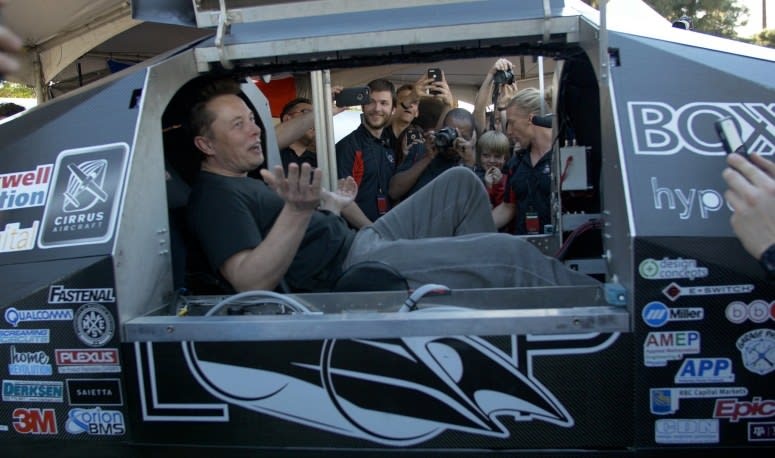
SpaceX and Tesla Motors co-founder Elon Musk, who is the driving force behind the Hyperloop competition, took the opportunity to sit in the Badgerloop pod while touring the various team’s booths. The team purposefully built its pod to fit Musk, who is 6 feet 2 inches tall. Photo: Badgerloop
SpaceX and Tesla Motors co-founder Elon Musk, who is the driving force behind the Hyperloop competition, took the opportunity to sit in the Badgerloop pod while touring the various team’s booths. The team purposefully built its pod to fit Musk, who is 6 feet 2 inches tall. Photo: Badgerloop
A team of University of Wisconsin–Madison students won an innovation award in a worldwide SpaceX Hyperloop pod competition.
The UW–Madison Badgerloop team competed against 30 teams from colleges and universities from around the world in the second phase of SpaceX’s Hyperloop pod competition, which was held Jan. 27-29, 2017, outside SpaceX headquarters in Hawthorne, Calif.
Teams spent the week leading up to the competition on site at SpaceX, where they put their pods through a litany of tests in hopes of getting the chance to run their pods on SpaceX’s one-mile Hyperloop test track.
The brainchild of SpaceX and Tesla Motors co-founder Elon Musk, the Hyperloop is a futuristic high-speed transportation system. The idea is for passengers to travel in levitating vehicles – “Hyperloop pods” – through an above-ground vacuum tube, enabling super-fast travel between distant cities.
After more than a year of intensive design work and construction, the Badgerloop team brought its 15-foot-long, 2,100-pound pod to California for the competition. While some bugs in the pod’s mechanical and electrical systems ultimately prevented Badgerloop from making a run on the test track, Badgerloop operations director Claire Holesovsky said the experience of building the pod as a team and participating in the competition has been very rewarding.
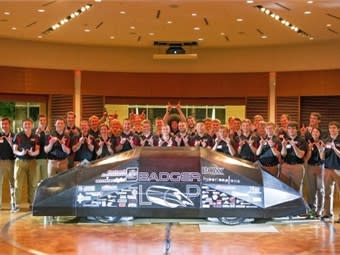
The Badgerloop team poses with its pod. Photo: Badgerloop
“It’s been an awesome experience, and we’ve learned so much,” Holesovsky says. “We received great feedback from the SpaceX judges and from talking with the other teams. It’s really exciting to be working on technology that has the potential to revolutionize high-speed transportation.”
In the end, only three of the 30 teams in the competition were able to actually launch their pods on the test track, which highlights the extreme difficulty of the technical and engineering challenges the student teams faced as they attempted to design and build pods for an entirely new mode of transportation.
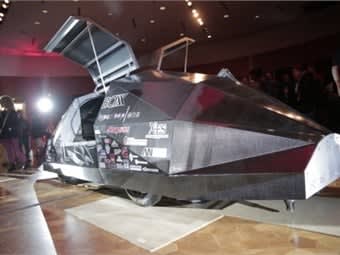
After more than a year of intensive design work and construction, the Badgerloop team brought its 15-foot-long, 2,100-pound pod to California for the competition. Photo: Stephanie Precourt/UW-Madison College of Engineering
When they announced the results of the competition, the SpaceX judges emphasized how difficult it was to build a levitating Hyperloop pod that doesn’t crash, adding that they weren’t sure if any of the teams would be able clear all the technical hurdles that would allow them to safely run their pod on the track. Delft University of Technology from the Netherlands was the overall winner with the highest score in the competition, and the Technical University of Munich won the award for fastest speed achieved in the Hyperloop tube.
Badgerloop received one of two innovation awards in the competition. The judges noted the team’s innovative designs, including the virtual reality setup that Badgerloop created.
The team purposefully built its pod to fit Musk, who is 6 feet 2 inches tall. Badgerloop got its wish when, after delivering remarks at the competition, Musk toured the various teams’ booths and took the opportunity to sit in the Badgerloop pod.
“We were all ecstatic to see Elon sit in our pod,” Holesovsky. “He checked out our pod’s technology. It was a great highlight in an incredible week for the team.”
Badgerloop, which won third place in the initial round of SpaceX’s Hyperloop pod competition, will continue to work on and refine its pod. The team already has plans to compete in the next installment of the competition, which is set to take place in summer 2017 at SpaceX’s Hyperloop test track.
More Rail

New York MTA Advances Final Contract for Second Avenue Subway Expansion
Contract Four is the largest in the Second Avenue Subway Phase 2 project and includes construction of station infrastructure, tracks, and signals for the subway expansion, MTA officials said. Work on Contract Four will begin in 2027.
Read More →
San Diego MTS Breaks Monthly Trolley Ridership Record
Agency officials said July’s ridership indicates MTS’s continued recovery from the pandemic.
Read More →
Report Examines NJ TRANSIT Reliability, Funding Challenges
The Garden State Initiative analysis examines the roles of Amtrak infrastructure, fleet management, and agency operations while recommending a more performance-based approach to improving reliability.
Read More →
Stadler, CapMetro Sign Long-Term Rail Fleet Support Agreement
Beginning in 2027, Stadler will provide on-site technical expertise, spare parts support, training, and obsolescence management to help extend the reliability and longevity of CapMetro’s GTW fleet.
Read More →
Biz Briefs: Alstom Lands Canadian Contract, LYT to Supply California TSP, and More
In METRO's latest installment, we take a look at recent news from Complete Coach Works, Beep, FlixBus, and more partnerships making headlines across the transportation sector.
Read More →
CATS Gold Line Marks 5 Years of Service, 2.8M Passenger Trips
With a six-mile expansion planned, the Charlotte streetcar is positioned to connect more neighborhoods and major transit hubs across the region.
Read More →
Why Simulating Pedestrian Movement Has Become Essential for Modern Rail Stations
Pedestrian microsimulation is helping rail planners identify bottlenecks, test station designs, and prepare complex transit hubs for growing passenger volumes.
Read More →
Amtrak Begins Major Construction at New York’s Sunnyside Yard
The new maintenance facility will support Amtrak’s Airo trainsets while improving maintenance efficiency and turnaround times in New York.
Read More →
Chicago Leaders Unveil Plans for O’Hare Airport Express Train
The privately developed project would offer a 15-minute trip between downtown and O’Hare’s Terminal 2, with trains operating every 15 minutes on a dedicated track. The service would use battery-electric trains and three existing freight rail rights-of-way.
Read More →
OCTA Maps Out 30-Year Strategy to Protect Coastal Rail Corridor
The draft feasibility report identifies strategies to protect the coastal rail line for decades as the agency continues near-term stabilization and sand placement efforts.
Read More →