



Valley Metro partners with Waymo for autonomous vehicle pilot
Agency will begin utilizing the self-driving vehicle technology for first- and last-mile transit trips next month.

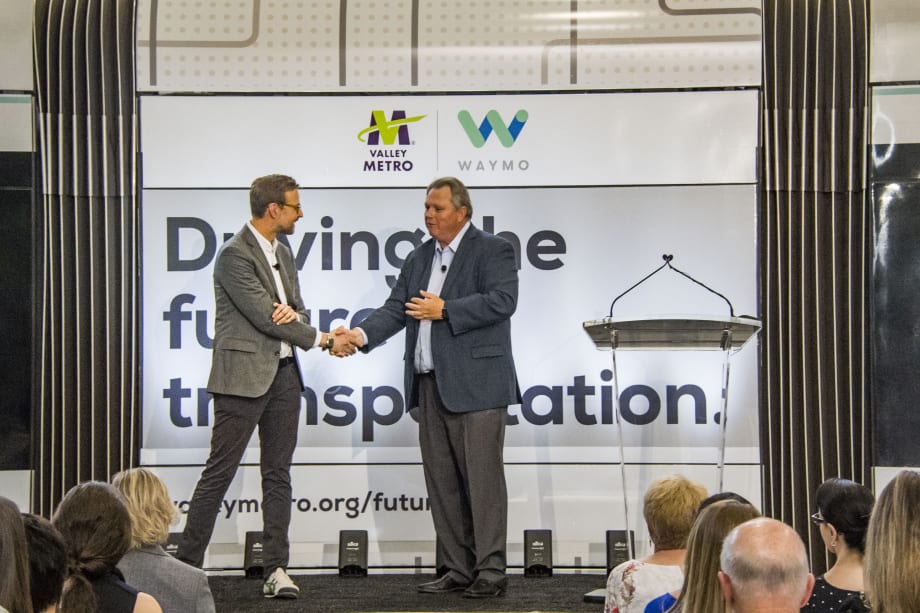
Shaun Stewart, Waymo Chief Business Development Officer and Scott Smith, Valley Metro CEO shake hands over forging a new partnership that will help drive the future of transportation. Photo: Valley Metro
Shaun Stewart, Waymo Chief Business Development Officer and Scott Smith, Valley Metro CEO shake hands over forging a new partnership that will help drive the future of transportation. Photo: Valley Metro
Valley Metro and self-driving technology company, Waymo are joining forces to pilot autonomous vehicle (AV) for first- and last-mile transit trips next month. This collaboration will generate ideas and different testing strategies to collect, share and innovate using data and experience.
“This is the first partnership between a public transit system and a private autonomous vehicle company that will provide a mobility service outside of a controlled environment,” said Scott Smith, Valley Metro CEO. “Think of it as the start of mobility on demand or mobility as a service.”
An exploration of using AVs as another mode of transportation for public transit, as well as the potential of expanding public/private transit partnerships. Valley Metro and Waymo believe that transportation and mobility on demand will be transformed through these types of partnerships.
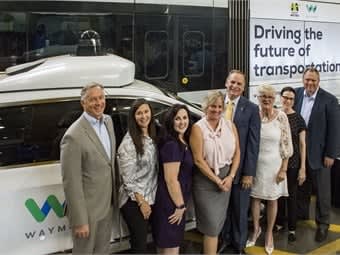
Valley Metro RPTA and Valley Metro Rail Board members unanimously approve the technology partnership between the agency and Waymo.
From left: Mesa Mayor John Giles, Tempe Vice Mayor Robin Arredondo-Savage, Gilbert Councilmember Brigette Peterson, Glendale Vice Mayor & Valley Metro RPTA Chair Lauren Tolmachoff, Chandler Councilmember Kevin Hartke, Phoenix Mayor & Valley Metro Rail Chair Thelda Williams, Scottsdale Councilwoman Suzanne Klapp and Valley Metro CEO Scott Smith. Photo: Valley Metro
The Pilot Project
The pilot will support first and last-mile connections to transit stops, centers and park-and-rides and could evolve into augmenting some of Valley Metro’s more on-demand services. Test groups will also have the opportunity to travel using AV to local destinations to support the collection of additional data.
The pilot self-driving vehicle service sets up the potential to safely and cost-effectively serve travelers who may not have walkable access or vehicle options to reach public transit. A self-driving vehicle does not travel on a specific route, so it will attract riders located beyond walkable distances to transit stops.
How it Works
The pilot begins in August. A two-year pilot to expand the test group is planned after an evaluation of an initial three months of service experienced by public transportation professionals.
Waymo self-driving vehicles will arrive “on demand” through an app that’s available to test groups provided by Valley Metro.
The pilot will be focused in the southeast Valley where Waymo vehicles have been
gathering travel data. Additionally, the agency will be collecting trip information including travel patterns, ease of access and user satisfaction and feedback.
More New Mobility
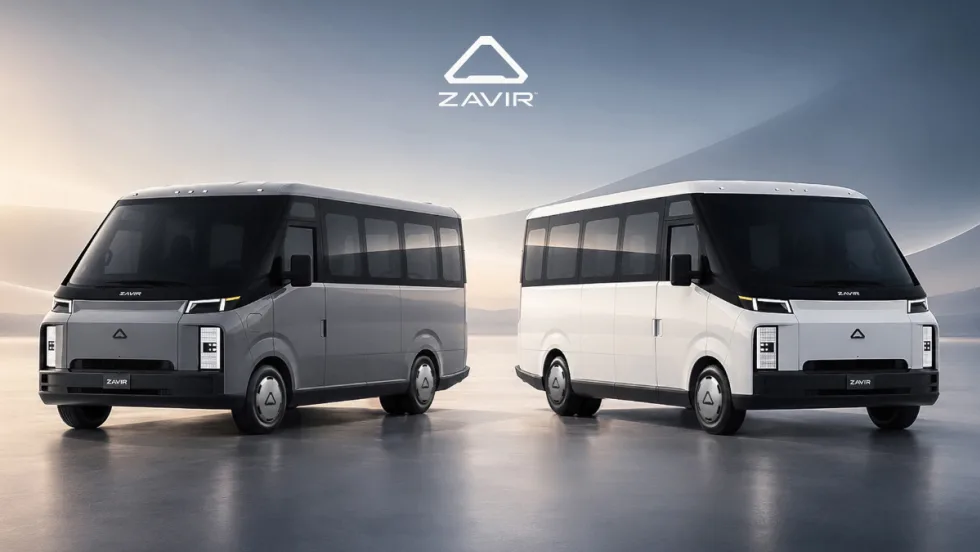
ENC Unveils ZAVIR Medium-Duty Electric Shuttle at APTA EXPO
The new ZAVIR brand targets shuttle and paratransit operations with battery-electric and range-extended electric vehicle options.
Read More →
Public Transit Conference Returning to GFX in 2027, Call for Papers Now Open
The Call for Papers is now open, allowing transit agency professionals and industry experts to help shape the PTC educational program by submitting session ideas for consideration.
Read More →
Everett Transit, Community Transit Outline Consolidation Agreement
The proposed agreement calls for a 50% increase in bus service in Everett, a new microtransit zone, continued paratransit service, and the transfer of Everett Transit operations to Community Transit.
Read More →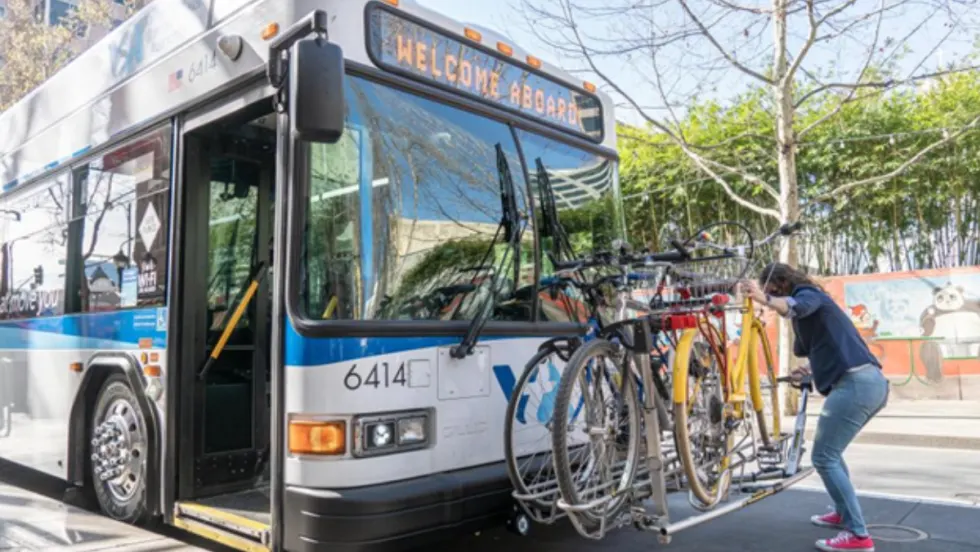
What Multimodal Data Can Tell Transit Agencies About Rider Demand
See how bike-on-bus data is giving transit agencies new insight into rider demand, capacity constraints, and gaps in first- and last-mile connections.
Read More →
From Hardware to Digital Partner: Luminator Charts Its Next Chapter
CEO Magnus Friberg discusses Luminator’s shift toward becoming a digital partner, the growing importance of software and interoperability, and how AI can help agencies improve operations and passenger experience.
Read More →
Biz Briefs: Alstom Lands Canadian Contract, LYT to Supply California TSP, and More
In METRO's latest installment, we take a look at recent news from Complete Coach Works, Beep, FlixBus, and more partnerships making headlines across the transportation sector.
Read More →
CharterUP’s Armir Harris on Technology, AI, and the Future of Group Mobility
In a recent episode of METROspectives, CharterUP Founder/CEO Armir Harris discussed the company’s evolution from an online charter bus marketplace into a technology platform supporting public- and private-sector mobility and much more.
Read More →
Jacksonville’s NAVI Project Charts a New Course for Autonomous Public Transportation
Through its NAVI program, JTA is showing how autonomous vehicles, intelligent infrastructure, and coordinated operations can work together to deliver everyday public transportation.
Read More →
Biz Briefs: Luminator Marks Milestone and More
From manufacturers and suppliers to transit agencies and motorcoach operators, these updates offer a snapshot of the projects, partnerships and business moves driving the industry forward.
Read More →
New Tricks for Old Bureaucracies: Joshua Schank on Making Transit Innovation Stick
Former LA Metro Chief Innovation Officer Joshua Schank discusses why good ideas aren't enough, how transit agencies can overcome resistance to change, and why today's challenges demand more innovation.
Read More →