



Veolia, New Orleans open streetcar extension
The line, which officially opened on Jan. 28, has already generated $2.7 billion in development along the streetcar’s new corridor, including new apartments, condominiums, and an entertainment/sports complex.

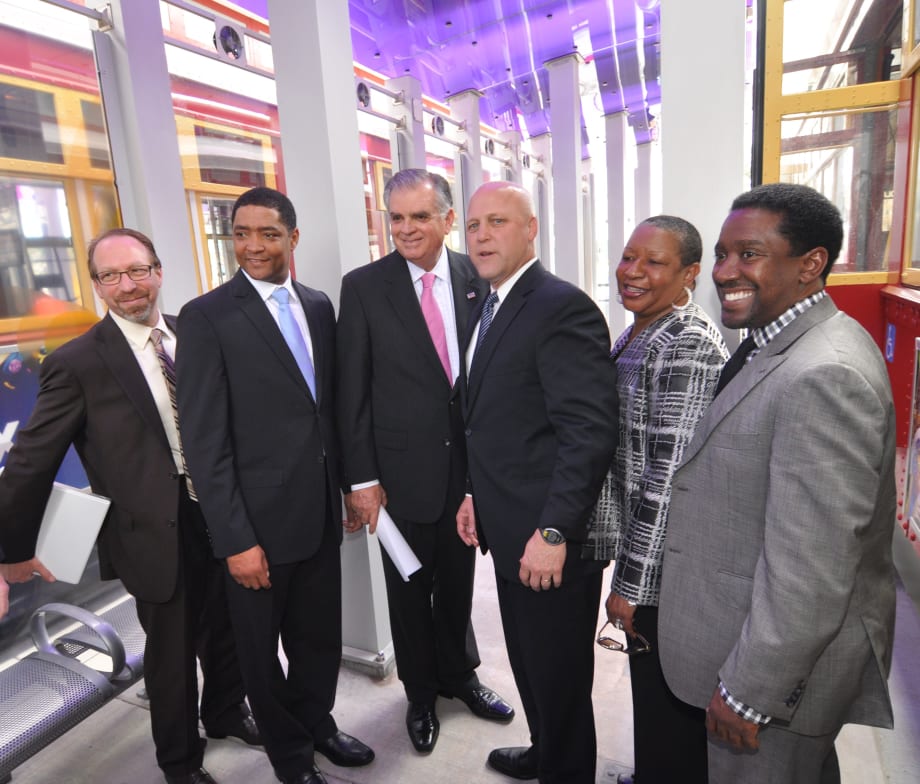
Shown left to right: FTA Administrator Peter Rogoff; U.S. Congressman Cedric Richmond; U.S. Secretary of Transportation Ray LaHood; New Orleans Mayor Mitchell J. Landrieu; RTA Board Chairwoman Barbara C. Major; and RTA Board Commissioner Flozell Daniels, Jr.
Shown left to right: FTA Administrator Peter Rogoff; U.S. Congressman Cedric Richmond; U.S. Secretary of Transportation Ray LaHood; New Orleans Mayor Mitchell J. Landrieu; RTA Board Chairwoman Barbara C. Major; and RTA Board Commissioner Flozell Daniels, Jr.
New Orleans’ Regional Transit Authority (RTA) and the City of New Orleans celebrated the opening of the new Loyola Avenue/Union Passenger Terminal (UPT) streetcar line on Jan. 28, the week before the Super Bowl, with a grand opening ceremony that was distinctively New Orleans.
The ceremony featured marching bands, choirs and an inaugural ride where local businesses and even judges from the Court House came out to the street to offer champagne toasts to city leaders and RTA dignitaries who addressed them from the steps of the streetcar.
The new streetcar line operates approximately 1.6 miles along Loyola Avenue between the Canal Street and the Union Passenger Terminal. The line has already generated $2.7 billion in development along the streetcar’s new corridor, including new apartments and condominiums, a new entertainment/sports complex, an expanded and renovated Hyatt Regency, and a new grocery store. Some 70 projects in all have already converted a formerly bleak area into a vibrant avenue. The expansion improves connectivity between convention, tourism, entertainment, energy, and health care and biosciences facilities and enhances quality of life for residents.
Dignitaries at the opening ceremony included U.S. Transportation Secretary Ray LaHood; Federal Transit Administration (FTA) Administrator Peter Rogoff; U.S. Congressman Cedric Richmond; Mayor Mitchell J. Landrieu; RTA Chairwoman Barbara C. Major and RTA Board of Commissioners; Veolia Transdev global CEO Jean-Marc Janaillac, Veolia Transportation CEO Mark Joseph and other Veolia executives; and a host of other city and state elected officials.
The $53 million project was funded primarily through a $45 million TIGER grant from the FTA which the RTA and Veolia’s management team secured in February 2010. Additional funds for the project were secured through the RTA Sales Tax Revenue Bond Series 2010. Construction began in June of 2010, and a full 30% of the funding went to local businesses (DBEs).
“It gives me great pride to open a streetcar line to bring better transportation services to the community as well as access to jobs and economic investment in this corridor,” said Barbara C. Major, Chairwoman of the RTA Board of Commissioners. “This project is only the beginning for the RTA as we continue to expand our streetcar network around the city.”
“We salute and congratulate the Mayor, the RTA Board of Commissioners, the FTA, our leading engineering and construction partners — AECOM, Parsons Brinckerhoff, Archer Western and RailWorks — plus the development community, and city departments and utilities, all of whom made valuable contributions,” said Justin Augustine, VP of Veolia and GM of the RTA.
Veolia Transportation manages and operates the transit system of New Orleans under a “Delegated Management” contract with the RTA Board of Commissioners.
“Veolia Transportation is proud to have played a key role in making this rail expansion a reality for the city of New Orleans,” Joseph added. “Our team that manages RTA operations has done exceptional work to complete this project and improve operational performance, both of which are contributing to the economic growth of the city as it recreates itself after one of the largest natural and transit disasters in the country.”
In his remarks, Secretary LaHood referenced the more than $2 billion in economic development projects in and around the corridor stating, “This is a stimulus project that worked.”
Plans for the next streetcar expansion are in the design phase and will extend the line down North Rampart Street along the edge of the French Quarter. That project is expected to break ground in early 2014.
More Rail

New York MTA Advances Final Contract for Second Avenue Subway Expansion
Contract Four is the largest in the Second Avenue Subway Phase 2 project and includes construction of station infrastructure, tracks, and signals for the subway expansion, MTA officials said. Work on Contract Four will begin in 2027.
Read More →
San Diego MTS Breaks Monthly Trolley Ridership Record
Agency officials said July’s ridership indicates MTS’s continued recovery from the pandemic.
Read More →
Report Examines NJ TRANSIT Reliability, Funding Challenges
The Garden State Initiative analysis examines the roles of Amtrak infrastructure, fleet management, and agency operations while recommending a more performance-based approach to improving reliability.
Read More →
Stadler, CapMetro Sign Long-Term Rail Fleet Support Agreement
Beginning in 2027, Stadler will provide on-site technical expertise, spare parts support, training, and obsolescence management to help extend the reliability and longevity of CapMetro’s GTW fleet.
Read More →
Biz Briefs: Alstom Lands Canadian Contract, LYT to Supply California TSP, and More
In METRO's latest installment, we take a look at recent news from Complete Coach Works, Beep, FlixBus, and more partnerships making headlines across the transportation sector.
Read More →
CATS Gold Line Marks 5 Years of Service, 2.8M Passenger Trips
With a six-mile expansion planned, the Charlotte streetcar is positioned to connect more neighborhoods and major transit hubs across the region.
Read More →
Why Simulating Pedestrian Movement Has Become Essential for Modern Rail Stations
Pedestrian microsimulation is helping rail planners identify bottlenecks, test station designs, and prepare complex transit hubs for growing passenger volumes.
Read More →
Amtrak Begins Major Construction at New York’s Sunnyside Yard
The new maintenance facility will support Amtrak’s Airo trainsets while improving maintenance efficiency and turnaround times in New York.
Read More →
Chicago Leaders Unveil Plans for O’Hare Airport Express Train
The privately developed project would offer a 15-minute trip between downtown and O’Hare’s Terminal 2, with trains operating every 15 minutes on a dedicated track. The service would use battery-electric trains and three existing freight rail rights-of-way.
Read More →
OCTA Maps Out 30-Year Strategy to Protect Coastal Rail Corridor
The draft feasibility report identifies strategies to protect the coastal rail line for decades as the agency continues near-term stabilization and sand placement efforts.
Read More →