




RELATED: LAN tapped as part of Calif. rail construction team
LAN to manage construction of Calif. rail project's maintenance facility
The 15,000-square-foot facility and storage tracks will accommodate six DMUs.
May 10, 2018
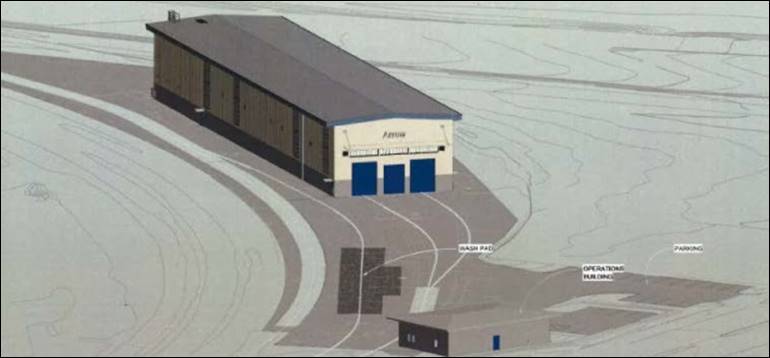
Rendering of facility via LAN.
2 min to read
Rendering of facility via LAN.
Calif.’s San Bernardino County Transportation Authority (SBCTA) selected civil engineering firm Lockwood, Andrews & Newnam Inc. (LAN) to manage the construction of the new storage and maintenance facility that will be built as part of the Redlands Passenger Rail Project.
SBCTA is implementing a new nine-mile rail transit service with the construction of the Redlands Passenger Rail Project. The project, which will be constructed and operated on the rail corridor along I-10, traverses the cities of San Bernardino and Redlands and will provide an environmentally-friendly and cost-efficient service to thousands of residents, businesses, and visitors in San Bernardino County.
For service operation, Diesel Multiple Unit (DMU) vehicles will be used for commuting passengers. To keep the DMUs running smoothly, a maintenance and storage facility will be built as part of the project. The 15,000-square-foot facility and storage tracks will accommodate six DMUs. The maintenance building will be equipped with an inspection pit, pedestal, and maintenance tracks with portable jacking pads, lockers, restrooms, office space, and storage parts for the vehicles.
As the construction management consultant, LAN will provide scheduling evaluation, construction project advertising, bid analysis and award, construction inspection, materials testing and inspection, contractor interface, and contract administration services.
“DMU is a European technology, therefore these types of maintenance facilities are new to the United States. They have specific requirements that are different than a standard rail maintenance facility,” said Timothy Schimdt, LAN’s California transit director. “We are looking forward to working with SBCTA to build a facility that will keep the vehicles running smoothly for several decades.”
The design of the facility is underway and will be completed by June 2018 and construction is scheduled to begin January 2019.
More Rail

New York MTA Advances Final Contract for Second Avenue Subway Expansion
Contract Four is the largest in the Second Avenue Subway Phase 2 project and includes construction of station infrastructure, tracks, and signals for the subway expansion, MTA officials said. Work on Contract Four will begin in 2027.
Read More →
San Diego MTS Breaks Monthly Trolley Ridership Record
Agency officials said July’s ridership indicates MTS’s continued recovery from the pandemic.
Read More →
Report Examines NJ TRANSIT Reliability, Funding Challenges
The Garden State Initiative analysis examines the roles of Amtrak infrastructure, fleet management, and agency operations while recommending a more performance-based approach to improving reliability.
Read More →
Stadler, CapMetro Sign Long-Term Rail Fleet Support Agreement
Beginning in 2027, Stadler will provide on-site technical expertise, spare parts support, training, and obsolescence management to help extend the reliability and longevity of CapMetro’s GTW fleet.
Read More →
Biz Briefs: Alstom Lands Canadian Contract, LYT to Supply California TSP, and More
In METRO's latest installment, we take a look at recent news from Complete Coach Works, Beep, FlixBus, and more partnerships making headlines across the transportation sector.
Read More →
CATS Gold Line Marks 5 Years of Service, 2.8M Passenger Trips
With a six-mile expansion planned, the Charlotte streetcar is positioned to connect more neighborhoods and major transit hubs across the region.
Read More →
Why Simulating Pedestrian Movement Has Become Essential for Modern Rail Stations
Pedestrian microsimulation is helping rail planners identify bottlenecks, test station designs, and prepare complex transit hubs for growing passenger volumes.
Read More →
Amtrak Begins Major Construction at New York’s Sunnyside Yard
The new maintenance facility will support Amtrak’s Airo trainsets while improving maintenance efficiency and turnaround times in New York.
Read More →
Chicago Leaders Unveil Plans for O’Hare Airport Express Train
The privately developed project would offer a 15-minute trip between downtown and O’Hare’s Terminal 2, with trains operating every 15 minutes on a dedicated track. The service would use battery-electric trains and three existing freight rail rights-of-way.
Read More →
OCTA Maps Out 30-Year Strategy to Protect Coastal Rail Corridor
The draft feasibility report identifies strategies to protect the coastal rail line for decades as the agency continues near-term stabilization and sand placement efforts.
Read More →