



Toyota begins sales of high-tech fuel-cell bus
Toyota expects to introduce over 100 fuel-cell buses, mainly within the Tokyo metropolitan area, ahead of the Olympic and Paralympic Games Tokyo 2020.

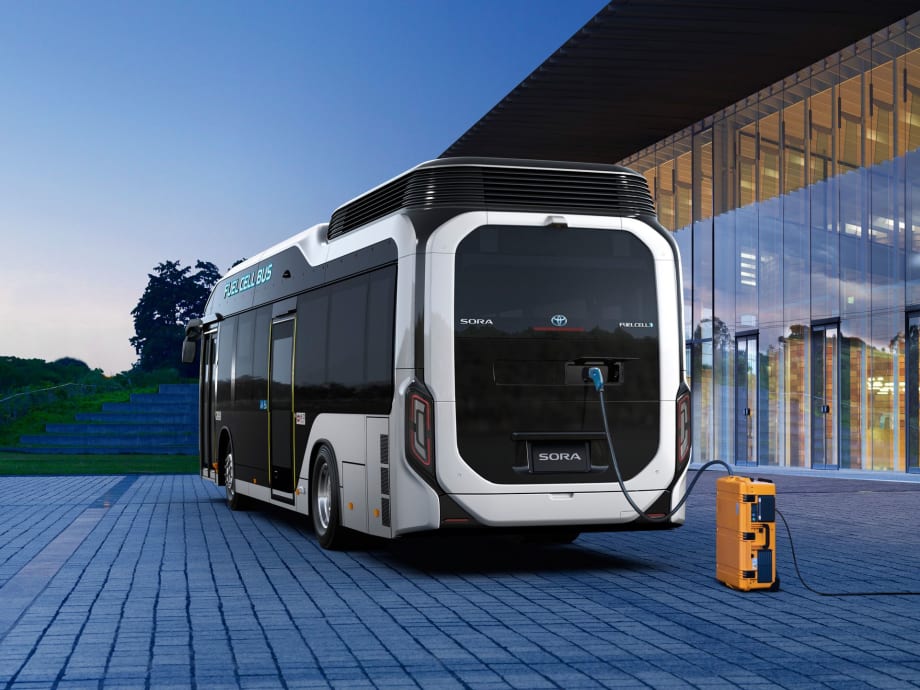
Toyota's Sora fuel cell bus feature a high-capacity external power output device. Photo: Toyota
Toyota's Sora fuel cell bus feature a high-capacity external power output device. Photo: Toyota
Toyota Motor Corp. announced that sales began on March 7 of its fuel-cell bus, Sora*1, the first FC bus to receive vehicle type certification in Japan.
Vehicle feature highlights
The Toyota Fuel Cell System (TFCS), which was developed for the company's Mirai fuel cell electric vehicle (FCEV), has been leveraged to realize high environmental performance with no CO2 emissions or Substances of Concern (SoC) emitted when in operation, as well as quiet comfort with minimal vibration.
The Sora is equipped with a high-capacity external power output device, which can provide high output and a large capacity of electricity supply (9 kW maximum output, and electricity supply of 235 kWh*2) and has potential use as an emergency power source following disasters.
Universal design and function
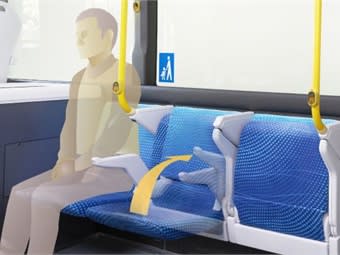
The Sora has horizontal seats with an automatic storage mechanism. Photo: Toyota
Horizontal seats with an automatic storage mechanism (first in Japan*3). The Sora's seats are automatically stored when not in use, improving comfort and convenience for passengers with strollers and wheelchairs as well as other passengers.
Field of vision support camera system (bus peripheral monitoring function) (first in Japan*3). Eight high-definition cameras fitted inside and outside the vehicle detect pedestrians and bicyclists around the bus providing a field of vision support camera system. When at bus stops, the system warns the driver of surrounding pedestrians and bicyclists through sound notifications and images thereby improving safety.
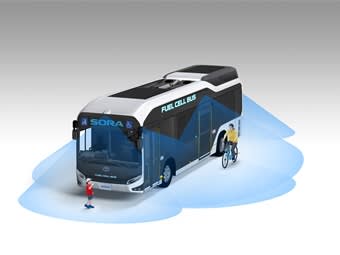
Toyota's new fuel cell bus offers a field of vision support camera system. Photo: Toyota
Acceleration control function delivers improved safety (first in Japan*3). The acceleration control function suppresses sudden acceleration and enables smooth acceleration from complete stops in consideration of the safety of standing passengers. Also, as the bus is not motor operated, there is no gear shifting, resulting in minimal lurching.
Design
The design pursues stereoscopic shaping that significantly differs from the hexahedron (box shape) of conventional buses. It also uses LED technology for the front and rear lights. Such design features make the FC bus instantly recognizable.
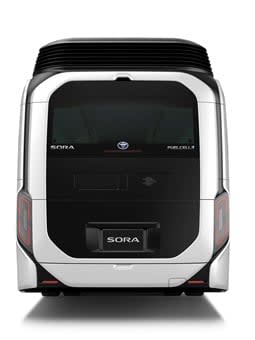
The rear of the bus showcases the stereoscopic design of the Sora bus. Photo: Toyota
Toyota expects to introduce over 100 fuel cell buses, mainly within the Tokyo metropolitan area, ahead of the Olympic and Paralympic Games Tokyo 2020. As the number of FC buses in operation within the metropolitan area increases, Toyota anticipates greater awareness of the vehicle among the general public.
Last year, Toyota launched the "Start Your Impossible" global corporate initiative to transform the company from an automobile company to a mobility service company. This was guided by the company's desire to contribute to the improvement and enhancement of customers' lives and society as a whole through support of the creation of a more inclusive and sustainable society in which everyone feels inspired to challenge his or her impossible.
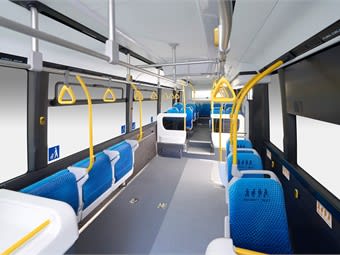
Toyota Sora interior. Photo: Toyota
*1 Sora is an acronym for Sky, Ocean, River, Air, representing the earth's water cycle.
*2 The power that can be supplied and the power amount may differ, depending on the performance of the power supply unit, amount of hydrogen remaining, and power consumption. External power output device sold separately.
*3 As of March 28 (according to Toyota Motor Corp.).
More Technology

From Hardware to Digital Partner: Luminator Charts Its Next Chapter
CEO Magnus Friberg discusses Luminator’s shift toward becoming a digital partner, the growing importance of software and interoperability, and how AI can help agencies improve operations and passenger experience.
Read More →
Beyond the Checklist: A Structured Approach to Transit Maintenance
Reliability-Centered Maintenance helps transit agencies move beyond routine checklists to focus limited resources on the assets and failures that have the greatest impact on safety, reliability, and service.
Read More →
NJ TRANSIT Advances Bus Technology Upgrades Across Statewide Fleet
More than 1,500 buses now feature upgraded technology designed to improve arrival predictions and provide free Wi-Fi, with deployment expected to reach nearly 2,000 buses by the end of 2026.
Read More →

Building a Flexible Path to Transit Electrification
John Hroncich discusses BAE Systems’ modular and scalable approach, lessons learned from decades of real-world operations, and how agencies can identify electrification strategies that fit their fleets.
Read More →
Biz Briefs: Alstom Lands Canadian Contract, LYT to Supply California TSP, and More
In METRO's latest installment, we take a look at recent news from Complete Coach Works, Beep, FlixBus, and more partnerships making headlines across the transportation sector.
Read More →
From Legacy Silos to Conversational Intelligence
What if transit leaders could ask any operational question and get a trusted answer in seconds? Conversational AI is transforming how agencies use their data.
Read More →
USDOT Announces Rail Vehicle Replacement Grants, Chattanooga AV Shuttle Funding
More than $191 million in federal funding will help three transit agencies replace aging rail vehicles and support a new autonomous shuttle service in Chattanooga.
Read More →
Bus Tech Talk: Keeping Transit Technicians Ahead of the Technology Curve
LA Metro’s Obed Mejia discusses technician training, evolving maintenance technology, fleet replacement, and strategies for getting the most out of today’s transit fleets.
Read More →
Biz Briefs: RIPTA Unveils New Frontrunners, Clevland RTA Adds New Siemens, and More
In METRO's latest installment, we take a look at recent news from Siemens, Prevost, Dodge, and more partnerships making headlines across the transportation sector.
Read More →
Why Simulating Pedestrian Movement Has Become Essential for Modern Rail Stations
Pedestrian microsimulation is helping rail planners identify bottlenecks, test station designs, and prepare complex transit hubs for growing passenger volumes.
Read More →