



AI Bus Lane Enforcement Boosts Safety, Reliability in West Hollywood
Traditionally, bus lane enforcement has relied on manual processes carried out by transit police or parking enforcement officers. While it may be effective in certain municipalities, this approach is resource-intensive and very difficult to sustain.
When a bus is forced to merge out of a dedicated lane to avoid a blocked stop, delays can escalate quickly, particularly during peak commuting hours.
METRO
- Illegally parked vehicles in bus-only lanes cause delays and safety hazards, challenging city transit agencies.
- Blocked bus lanes force buses to merge into traffic, escalating delays and reducing service reliability during peak hours.
- Accessibility for passengers with disabilities is impacted when vehicles obstruct boarding and alighting at stops.
*Summarized by AI
Bus-only lanes are designed to speed up transit, improve reliability, and move more people efficiently through busy urban corridors. Yet in many U.S. cities, keeping those lanes clear remains one of the most persistent operational challenges facing transit agencies. Vehicles parked or standing illegally in bus lanes not only slow down service but also create safety risks and reduce accessibility.
For riders, the impact is immediate and visible.
When a bus is forced to merge out of a dedicated lane to avoid a blocked stop, delays can escalate quickly, particularly during peak commuting hours. Over time, these disruptions undermine the quality and reliability of bus transit and negatively impact ridership, pushing travelers toward private vehicles or ride-hailing services that further congest city streets.
For passengers with disabilities and other access needs, vehicles blocking bus lanes impede their ability to board or alight the bus. Although many cities are committed to providing fair and equitable public transportation, the lack of accessibility for the populations who need it most undermines this objective.
For transit agencies, the consequences extend beyond rider experience. Blocked bus lanes complicate scheduling, increase operator stress, and make it harder to meet on-time performance goals for which agencies are publicly accountable. Even modest disruptions, repeated dozens of times per day, can cascade across a route and ripple through an entire network.
Growing Pressure on the Curb
Curb demand continues to strain cities and infrastructure.
Ride-hailing services, food and package delivery, micromobility, freight loading, and passenger pickups all compete for the same limited urban curb space. According to the World Economic Forum, urban deliveries in the world’s 100 largest cities could increase by more than 60% by 2030, contributing to a projected 21% rise in congestion.
As curb space becomes more constrained, bus lanes are often treated as overflow zones, seen as temporarily convenient for drivers but highly disruptive for transit operations. Well-designed bus priority corridors can’t achieve their transit goals without consistent enforcement.
This challenge is not unique to large urban municipalities. Mid-sized and growing cities face similar pressures as they expand bus-only lanes to support transit development, climate goals, and Vision Zero safe street initiatives. In many cases, agencies invest heavily in paint, signage, and public outreach campaigns only to learn that inconsistent enforcement undermines their investments.
Why Cities are Accelerating Automated Enforcement
Traditionally, bus lane enforcement has relied on manual processes carried out by transit police or parking enforcement officers. While it may be effective in certain municipalities, this approach is resource-intensive and very difficult to sustain.
Enforcement programs are designed to change bad driver behavior. Predictable and consistent enforcement is key to changing habits; when violations are only occasionally penalized, noncompliance becomes normalized.
Since parking tickets for bus lane violations don’t have a direct impact on a driver's record or insurance rates because the vehicle is stopped at the time of the violation, they may influence how motorists perceive the importance of risk. When drivers know that illegal parking will consistently result in a citation, especially given the accuracy of automated systems, the likelihood of compliance increases.
Manual enforcement can also put officers in dangerous situations, particularly on high-volume streets, where issuing citations may disrupt traffic flow and expose motorists and officers to roadway hazards. Staffing shortages, budget constraints, and competing priorities for police and enforcement officers often lead to more sporadic enforcement rather than continuous.
That’s why automated enforcement is increasingly being viewed not as a parking function, but as a transit operations tool to help meet operational goals. By providing reliable and repeatable monitoring with high accuracy, automated systems help cities enforce bus-only restrictions consistently, changing driver behavior over time rather than relying on intermittent penalties.
Rather than replacing human judgment, automated systems shift staff time from repetitive administrative tasks to higher-value activities such as oversight, community engagement, and strategic planning. This reframing is critical for agencies seeking to do more with limited resources.
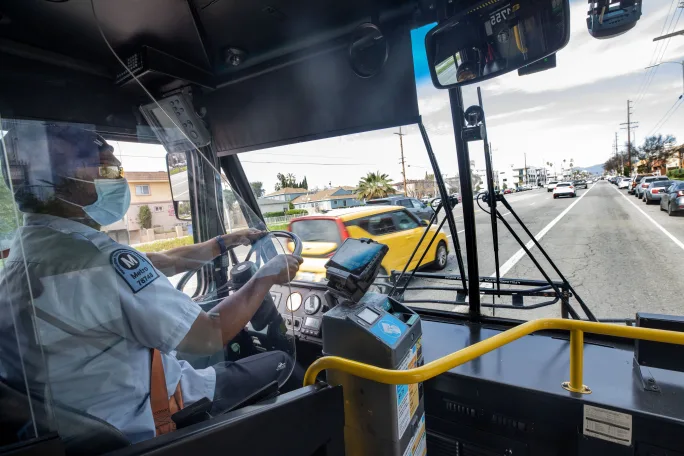
Traditionally, bus lane enforcement has relied on manual processes carried out by transit police or parking enforcement officers. While it may be effective in certain municipalities, this approach is resource-intensive and very difficult to sustain.
LA Metro
Shining the Spotlight on West Hollywood’s Transit Priority
A recent example is West Hollywood, California, where the city partnered with the Los Angeles County Metropolitan Transportation Authority (Metro) to launch an automated bus lane enforcement program along North La Brea Avenue, a heavily traveled north-south corridor serving approximately 9,000 transit passengers daily. West Hollywood is a compact but influential city known for its progressive urban policy.
The initiative builds on Metro’s earlier pilot with the Los Angeles Department of Transportation and reflects a broader regional strategy to protect bus priority investments across jurisdictions. Regional alignment plays an important role in driver compliance: when rules, signage, and enforcement practices are consistent across neighboring cities, drivers are more likely to align their behavior.
Along La Brea Avenue, frequent parking and standing in bus lanes had disrupted Metro service, particularly during morning and evening peak periods. When buses were forced to merge into general traffic, delays increased and travel times became less predictable. For riders with disabilities or mobility challenges, blocked bus stops created additional barriers, sometimes preventing buses from fully pulling to the curb and from deploying ramps safely.
The automated enforcement program, launched in September 2025 following a 60-day warning period, integrates front-facing, bus-mounted AI cameras from HaydenAi with a centralized parking management platform from T2 Systems. When a potential violation is detected, image evidence is captured and transmitted for human review. If confirmed, the city issues a citation to the vehicle’s registered owner.
The warning period was a critical component of the rollout. By prioritizing education over enforcement, the city of West Hollywood emphasized compliance and safety over revenue, helping to build public understanding and acceptance while allowing internal processes to be refined.
Fundamental Principles of Openness and Trust
Public trust was a central consideration in the program design. All potential violations are reviewed by trained city parking staff before citations are issued, ensuring due process and fairness.
Community outreach efforts, including signage, digital communications, and coordinated messaging with Metro, helped inform motorists about the program’s goals, regulations, and penalties for noncompliance. Communication reinforced that the initiative was about keeping buses moving safely and reliably, not punitive enforcement or financial motivation.
As automated enforcement becomes more common, transparency around data use and retention is critical. Data retention policies were clearly defined in West Hollywood’s design: images without violations are deleted after 15 days, while evidence is retained for six months, as required for enforcement. Clear policies help agencies demonstrate accountability and address public concerns about privacy.
The data provides additional benefits, such as identifying repeat problem locations, peak violation times, and recurring behaviors, to inform decisions on curb design, loading zones, signage, and policy adjustments. This way, automated enforcement supports proactive curb management, not just compliance. Over time, these insights can inform broader transportation planning efforts, helping cities align curb policies with transit service goals and emerging mobility trends.
Early Outcomes and Lessons Learned
West Hollywood has reported clearer bus lanes and stops, more reliable travel times along the corridor, improved accessibility for riders with disabilities, and more efficient use of enforcement resources.
While long-term behavior change takes time, early indicators suggest that consistent enforcement is helping reinforce bus lanes as essential transit infrastructure.
Several lessons emerge for transit agencies and cities considering similar programs:
- Treat bus lane enforcement as a transit issue, not solely a parking concern.
- Use automation to reduce administrative burden while maintaining human oversight.
- Establish clear privacy and data governance policies from the outset.
- Pair enforcement with education and outreach to build community trust.
- Foster collaboration among transit agencies, cities, and enforcement partners.
The automated enforcement program has also delivered meaningful operational efficiencies. Enforcement staff previously entered violation data manually, which could take up to 15 minutes per occurrence. With automation, the process now takes seconds, freeing staff to focus on higher-value tasks, especially during peak periods.
The Road Ahead
As cities expand bus lanes and priority corridors to support climate goals, Vision Zero safety initiatives, transit accessibility, and equitable mobility, enforcement will remain central to success. Dedicated lanes only deliver value when they function as intended.
Automated enforcement is not a standalone solution, but part of a broader ecosystem that includes policy, design, operations, and public engagement. When aligned with these elements, technology can help agencies move from reactive problem-solving to sustained performance improvement.
West Hollywood’s experience demonstrates that AI-enabled, thoughtfully implemented enforcement can help protect transit investments, improve rider experience, and support safer, more accessible streets. For transit agencies nationwide, keeping bus lanes clear is fundamental to delivering reliable, efficient service in increasingly complex urban environments.
About the Author: Matt Howard is Head of Product at T2 Systems
Quick Answers
Bus-only lanes are designed to speed up transit, improve reliability, and efficiently move more people through busy urban corridors.
*Summarized by AI
More Technology

ENC Lands MATA Contract and More in Biz Briefs
In this edition of Biz Briefs, we spotlight the latest developments shaping the future of mobility.
Read More →
Strada360’s Steve Lassey on Turning Transit Data Into Better Decisions
From breaking down data silos to preparing for AI, Strada360 CEO Steve Lassey discusses how transit agencies can use technology to improve operations, customer information, and long-term decision-making.
Read More →
Almaviva Looks to Open Architecture to Advance Transit Technology
Eric Reese discusses how interoperability, open architecture, and modular design can help transit agencies control costs, reduce vendor lock-in, and upgrade technology without starting over.
Read More →

Driving Smarter Paratransit
John Hanlon shares how AlphaRoute is leveraging AI-powered technology to help paratransit providers optimize operations, support frontline staff, and enhance the rider experience.
Read More →
From Hardware to Digital Partner: Luminator Charts Its Next Chapter
CEO Magnus Friberg discusses Luminator’s shift toward becoming a digital partner, the growing importance of software and interoperability, and how AI can help agencies improve operations and passenger experience.
Read More →
Beyond the Checklist: A Structured Approach to Transit Maintenance
Reliability-Centered Maintenance helps transit agencies move beyond routine checklists to focus limited resources on the assets and failures that have the greatest impact on safety, reliability, and service.
Read More →
NJ TRANSIT Advances Bus Technology Upgrades Across Statewide Fleet
More than 1,500 buses now feature upgraded technology designed to improve arrival predictions and provide free Wi-Fi, with deployment expected to reach nearly 2,000 buses by the end of 2026.
Read More →
Building a Flexible Path to Transit Electrification
John Hroncich discusses BAE Systems’ modular and scalable approach, lessons learned from decades of real-world operations, and how agencies can identify electrification strategies that fit their fleets.
Read More →
Biz Briefs: Alstom Lands Canadian Contract, LYT to Supply California TSP, and More
In METRO's latest installment, we take a look at recent news from Complete Coach Works, Beep, FlixBus, and more partnerships making headlines across the transportation sector.
Read More →
From Legacy Silos to Conversational Intelligence
What if transit leaders could ask any operational question and get a trusted answer in seconds? Conversational AI is transforming how agencies use their data.
Read More →