



St. Cloud Training Center Improves Paratransit Process
Prior to opening its $2.2 million facility, Metro Bus paid a health care agency to conduct the physical assessments. Now, trained staff performs applicant interviews and cognitive and physical assessments during one appointment, creating a cost savings of about $125 per assessment.
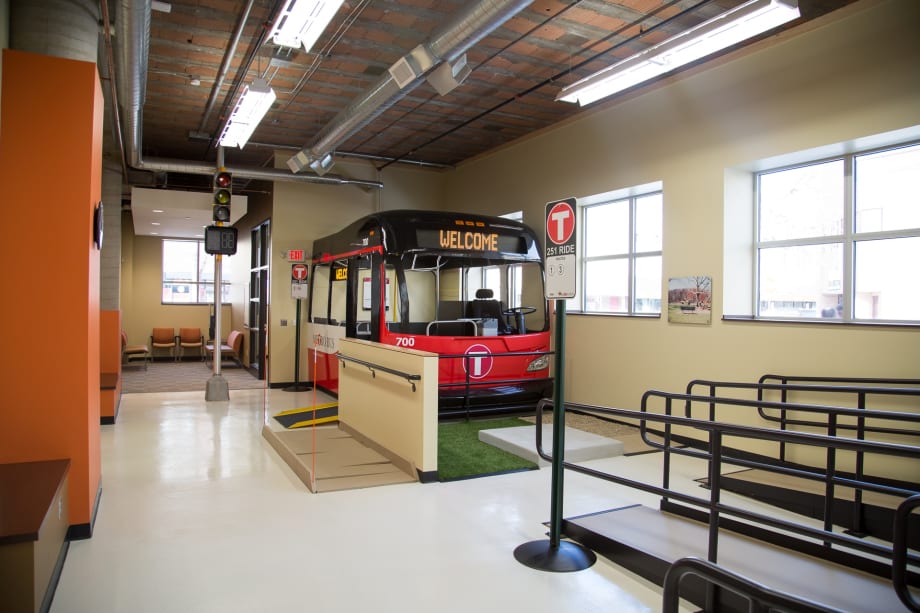
The highlight of St. Cloud’s Mobility Training Center is the assessment course, which features a training bus and a variety of simulated surfaces to test a person’s gait, balance and transition from surface to surface.
All photos courtes HMA Architects
The highlight of St. Cloud’s Mobility Training Center is the assessment course, which features a training bus and a variety of simulated surfaces to test a person’s gait, balance and transition from surface to surface.
All photos courtes HMA Architects
The Minn.-based St. Cloud Metropolitan Transit Commission’s (Metro Bus) Community Outreach and Travel Training program was born of the need to transition customers from the Dial-a-Ride service to the fixed-route system, in an effort to reduce strain on the paratransit service. The success of that program led to a need for a customized physical location to provide the assessment and training services more efficiently and customer-friendly manner.
St. Cloud’s Mobility Training Center was opened in the summer of 2014 in a renovated bank building, which contributed to the revitalization of the historic downtown district in St. Cloud.
Metro Bus spent about $2.2 million to renovate and construct the training center. The project was funded by a $1 million state grant and local bond. Because the building was built in 1951, much work was needed to bring it up to code, including new electrical, plumbing and HVAC systems, as well as a significant amount of asbestos removal.
The agency also worked closely with the city’s Heritage Preservation Commission and Minnesota’s State Historic Preservation Office to preserve the historic features of the building, including replacing windows with a period-correct design and cleaning and repairing the granite exterior using approved historic preservation techniques. The facility’s interior was opened up to take advantage of as much natural light as possible and features exposed ceilings and concrete columns. To defray some of the operating costs, Metro Bus leased out the top floor.
“Our tenants, HMA Architects, designed our space, were looking to expand their offices and wanted to stay downtown,” explains Debbie Anderson, community outreach and mobility manager for St. Cloud Metro Bus. “[They found] our vacant top floor as an empty canvas they could design to meet their office needs.”
Facility highlights
The highlight of the facility is the assessment course, which features a training bus; a variety of simulated surfaces to test a person’s gait, balance and transition from surface to surface; a traffic signal; mobility device measurement tools; operational bike rack and is set up for trip simulation through a set of photos used for the Functional Assessment of Cognitive Transit Skills tool.
The training bus is made from the front half of a real bus body. The bus’s floor plan is the same dimensions of an actual bus in St. Cloud’s fleet. The seating is designed to mimic an actual bus and allows for individuals using wheelchairs to practice boarding and getting into the securement area. The farebox and destination signs are fully operational. Staff designed the bus to simulate a real-bus experience so visitors can demonstrate their abilities as they pertain to riding a fixed-route bus. Staff also assesses a person’s ability to identify a destination sign, boarding and debarking, paying a fare and signaling for a stop.
Prior to this facility, Metro Bus paid a health care agency to conduct the physical assessments. Now, trained Metro Bus staff are able to perform applicant interviews and cognitive and physical assessments during one appointment, in a space that models real-life transit scenarios. This is a cost savings of about $125 per assessment.
An additional benefit to bringing assessments in-house is that the agency doesn’t have to rely on a paper application to decide if they need an assessment only to find out they didn’t. All individuals now participate in an in-person interview, enabling St. Cloud to make the determination very easily.
“Staff can observe clients as they walk in the door, which saves the client unnecessary stress when it is obvious they have mobility issues,” says Anderson. “The money we save on third-party assessments can now be used on program enhancements.”
Bringing assessments in-house also allows for increased efficiency of the eligibility screening process, and is more customer-friendly. The space is inviting and staff are able to establish a certain level of trust with the client during the interview and assessment process. If the applicant is not approved for Dial-a-Ride paratransit service, or is granted “conditional use” status, the client is more easily transitioned to the fixed-route system by addressing the individual skills and abilities they witnessed firsthand during the assessment process.
The training is also perceived as an extension of the assessment. This increases customer follow-through on training and results in increased ridership. This increases the client’s confidence in their own ability to navigate the fixed-route system. Also, because training can be provided at the facility where they are tested, the client has a higher level of comfort, which increases their ability to learn. Staff is able to take the client out on a real route with greater effectiveness in learning because the basic skillsets are taught in a controlled environment.
Staff at the Mobility Training Center work with more than 70 referral agencies. This includes group homes, non-profits, and social and human service agencies that serve people with disabilities, seniors and others with special needs. Many of these agencies previously helped their clients apply for Dial-a-Ride paratransit service.
“These agencies now refer their clients to us for travel training,” says Anderson. “They know we do not graduate someone from the program unless we are confident in their ability to safely ride the bus on their own. They have witnessed their clients’ success first hand.”
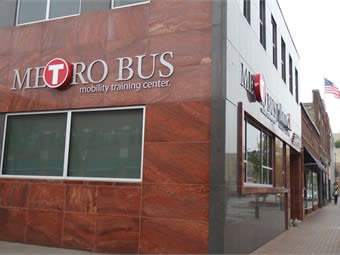
The Mobility Training Center contributed to the revitalization of the historic downtown district in St. Cloud.
Community partnerships
The secret to the success of this program, which won one of
METRO’s Innovative Solutions Awards at BusCon 2015, is the strong community outreach component. Metro Bus has developed mutually beneficial relationships within the network of care providers, senior living sites, social service agencies, and organizations that support people with disabilities and seniors. Because these agencies have seen the success individuals have in learning how to ride and become more independent, they continue to refer people to Metro Bus’s program.
Systems that operate fixed-route and paratransit services like Metro Bus can benefit from combining their eligibility, assessment, training and outreach program staff into one facility. This is more convenient for the customer and facilitates a smoother process and improved learning. It also creates a more efficient and seamless process for the organization. A system that has a paratransit service that is busting at the seams can also benefit from implementing a similar program to help shift some of the trips to the fixed-route system by taking the time to assess a person’s ability to use the system for some of their trips and helping that customer gain the skills and confidence to ride fixed route.
When the transit system can focus on matching riders with the most appropriate form of transportation, it allows human service agencies to focus on their areas of expertise. Prior to this program, partner agencies had limited understanding of transportation options for their clients and often paid expensive cab fares.
The creative use of space, such as renovating a vacant building and renting out unused space, is also an idea that other transit systems could benefit from trying. Public transportation can, and should be, be part of the revitalization of a commercial area.
The assessment course is 1,266 square feet — relatively small compared to some mobility centers.
“Those who have toured our facility are impressed by the efficient use of space,” says Anderson, who was part of the team that worked with the architects to design the space. “The smaller space may be easier for others to replicate.”
Berta Hartig, marketing and communications manager at Metro Bus, contributed to this story.
More Paratransit

Biz Briefs: RIPTA Unveils New Frontrunners, Clevland RTA Adds New Siemens, and More
In METRO's latest installment, we take a look at recent news from Siemens, Prevost, Dodge, and more partnerships making headlines across the transportation sector.
Read More →
King County Metro Makes ADA Paratransit Easier to Navigate
METRO's Innovative Solutions Award winner replaces complex service-area descriptions with an accessible, interactive map that puts paratransit information directly in customers’ hands.
Read More →
Jacksonville’s NAVI Project Charts a New Course for Autonomous Public Transportation
Through its NAVI program, JTA is showing how autonomous vehicles, intelligent infrastructure, and coordinated operations can work together to deliver everyday public transportation.
Read More →
Driving Smarter Paratransit
John Hanlon shares how AlphaRoute is leveraging AI-powered technology to help paratransit providers optimize operations, support frontline staff, and enhance the rider experience.
Read More →
METRO Magazine Announces 2026 Innovative Solutions Awards Winners
Projects Recognized for Advancing Mobility Through Technology, Accessibility, Workforce Innovation, and Operational Excellence
Read More →
Biz Briefs: STV teams with Amtrak, Motorcoach Operators Boost Fleet and Land Contracts, and More
From manufacturers and suppliers to transit agencies and motorcoach operators, these updates offer a snapshot of the projects, partnerships and business moves driving the industry forward.
Read More →
Biz Briefs: Masabi Teams with St. Louis Metro and More
In METRO's latest installment, we take a look at recent news from Transdev, Hitachi, and more partnerships making headlines across the transportation sector.
Read More →
New York MTA Leverages Zoning Program to Advance Station Accessibility
Accessibility enhancements at Nevins St Station will be financed through a development agreement tied to the MTA's Zoning for Accessibility initiative.
Read More →
Reinventing Fleet Maintenance with Real-time Visibility and AI
Transit leaders need to know what needs fixing, where to look, who is responsible, when work is completed, and what it costs without having to chase information across disconnected systems.
Read More →
SamTrans Sets Priorities for Potential Connect Bay Area Revenue
The board-approved framework allocates future funding to maintaining service, rider improvements, equity initiatives, and infrastructure repairs.
Read More →