



Safety, Sustainability Help Vandalia Bus Lines Stand Tall
The family-owned business also prides itself in training and retaining safe, reliable drivers, while also using positions in associations to benefit the entire industry.
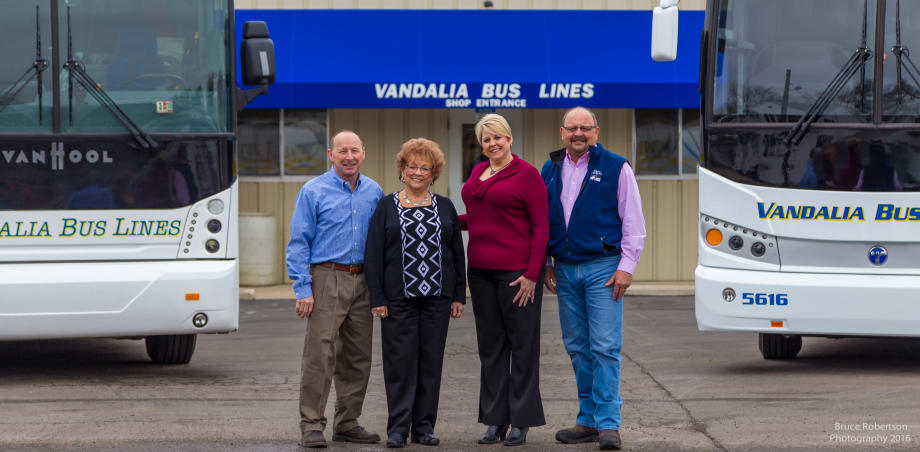
Since 1975, the Streif family (from left to right) Dennis, Judy, Melissa Kaemmerer and Dale have maintained a safe and well-respected operation.
Bruce Robertson Photography 2016
Since 1975, the Streif family (from left to right) Dennis, Judy, Melissa Kaemmerer and Dale have maintained a safe and well-respected operation.
Bruce Robertson Photography 2016
Since entering the motorcoach industry in 1975, Caseyville, Ill.-based Vandalia Bus Lines has thrived through growing its fleet, keeping utilization high and providing top-of-the-line service.
Vandalia was initially started in 1932 with a fleet of five buses and provided transportation between St. Louis and several southern Illinois communities.
Leon Streif, an owner of multiple businesses, owned and operated Streif Bus Service with his wife Judy, which had served the Lebanon (Ill.) School District since 1963. Leon had started a charter business with one school bus in 1959 and bought his first motorcoach in the late 1960s — a GMC 4104. Eventually, Leon acquired Vandalia Bus Lines, bringing with it six more General Motors coaches and four new MCI-8s. The Streif family — President Dale Streif, VP Dennis Streif and their sister and Treasurer Melissa — has since grown the fleet to a total of 60 local and over-the-road coaches and more than 100 staff members.
In the early years, Vandalia ran a charter service and a scheduled line-run from St. Louis to Effingham, Ill. and operated school buses for the local community, as well as the surrounding metro area. The carrier now not only offers charter service, but also provides convention and meeting services as well as university transportation services.
Boasting a modern fleet of motorcoaches with all the latest amenities, one key to Vandalia’s success is its location.
“We are centrally located right in the heart of the Midwest,” explains Dale Streif. “We’re not only close to St. Louis, but are basically in the center of several large cities, including Kansas City, Indianapolis and Chicago, that we can get to in four to five hours.”
Another key is the caliber of drivers Vandalia hires and the investment that is made to train and maintain those drivers.
The operator only hires drivers with previous passenger experience — primarily drawing from the school bus industry — offers a quarterly driver bonus, and medical insurance to full time staff and drivers. The company also provides a matching contribution on an IRA for each full-time employee and gives full time drivers one week of paid vacation after two years of service.
They also go through an extensive training program, including classroom and online training through resources including the International Motor Coach Group (IMG), as well as a minimum of 20 hours behind the wheel.
Dennis Streif believes that the investment in training and a good benefits package helps the operation stay on top of one of their biggest challenges — actually finding drivers.
“Filling our driver’s seats is a real challenge for us as well as the industry, in general,” says Dennis. “We hope by offering a good benefits package and great place to work, that it helps make us more appealing in attracting drivers and that the training and equipment we run helps us retain those drivers.”
While the drivers’ seats have been difficult to fill, Vandalia is effectively filling seats with passengers, with the operation boasting a high utilization rate.
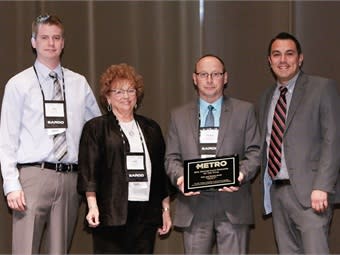
In February, Dennis Streif (second from left) accepted METRO Magazine's Motorcoach Operator of the Year Award from Managing Editor Alex Roman (far right) with his son Phillip and mother Judy (l to r).
Because of its driver safety and training practices, longevity in the industry and more, Vandalia Bus Lines was recently named METRO Magazine’s 2016 Motorcoach Operator of the Year. Dennis was on hand with his mother Judy and son Phillip to receive the award at the United Motorcoach Association’s (UMA) Expo 2016 in Atlanta in early February.
Sustainability, Outreach
In addition to providing safe, reliable services to its customers, Vandalia also places a premium on keeping its carbon footprint light.
One major way the operation does so is through the usage of an 11% mixture of biodiesel to power all of its vehicles, from late March through mid-November, before the cold weather sets in.
“We’ve been using biodiesel now for about 10 years and it works well for us,” says Dennis. “We found, though, that it was best for us to stop using it in early- to mid-November because of issues with coagulation. Biodiesel is eco-friendly, which is one of the main reasons we use it, along with the fact that it is produced in the Midwest.”
From the paper in the office to the aluminum and metal in the shop, Vandalia also has a comprehensive recycling program and strives to maintain a paperless workplace, by sending customers confirmations, statements and invoices electronically.
“Going paperless makes it simpler for the customer and saves us a lot on paper, copy machines and all the other expenses associated with using paper,” Dale explains.
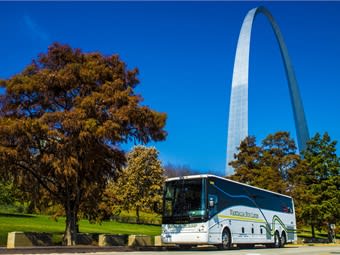
To keep its carbon footprint light, Vandalia uses an 11% mixture of biodiesel from late March to mid-November.
In addition to giving back to the community, Dennis also serves as Region I board member for the UMA and chairman of IMG’s board.
Dennis explains that Vandalia has been a member of IMG since 2001, with his two-year term as chairman set to come to an end in August of this year.
“IMG is a tight-knit group of people and other operators, that we get to know each other, closely and intimately; it’s a real brotherhood,” Dennis says.
Aside from networking and learning from other motorcoach operators, Dennis explains that his work with the UMA is more about giving back to the industry.
“Being part of the UMA’s board allows me to learn about things that impact our industry and our businesses. It allows me to represent other operators across the country in addition to lobbying at the state, local and national level,” he says.
Dennis’ lobbying efforts will continue with UMA’s Capitol Hill Days in April, which enables operators the opportunity to discuss important issues impacting the industry directly with their local representatives.
“Anytime you’re in this business, it’s important to do as much politicking as possible, whether it’s at the state, local or national level,” he says.
More Motorcoach

METRO Opens Submissions for 2026 Motorcoach Awards
Nominations are now being accepted for METRO Magazine’s Operator of the Year and Innovative Operator of the Year awards.
Read More →
Biz Briefs: Alstom Lands Canadian Contract, LYT to Supply California TSP, and More
In METRO's latest installment, we take a look at recent news from Complete Coach Works, Beep, FlixBus, and more partnerships making headlines across the transportation sector.
Read More →
Biz Briefs: RIPTA Unveils New Frontrunners, Clevland RTA Adds New Siemens, and More
In METRO's latest installment, we take a look at recent news from Siemens, Prevost, Dodge, and more partnerships making headlines across the transportation sector.
Read More →
People Movement: Holly Arnold Joins Transdev and More
In this edition, we also cover recent appointments and announcements at Pace, CamTran, MCI, and more, showcasing the individuals helping to shape the future of transportation.
Read More →
ABA Report: Motorcoach Travel Generates $161.6B Economic Impact
The 2025 analysis finds motorcoach travel supported nearly 900,000 jobs and generated $28 billion in federal, state, and local taxes.
Read More →
CharterUP’s Armir Harris on Technology, AI, and the Future of Group Mobility
In a recent episode of METROspectives, CharterUP Founder/CEO Armir Harris discussed the company’s evolution from an online charter bus marketplace into a technology platform supporting public- and private-sector mobility and much more.
Read More →
People Movement: ABC Names John Walsh as Chief Commercial Officer
In this edition, METRO also covers recent appointments and announcements at the DART, STV, and more, showcasing the individuals helping to shape the future of transportation.
Read More →
From Surviving to Thriving: Building Stronger Transportation Organizations
Bus Business Consultants founder Brian Dickson shares lessons on leadership, organizational health, and creating options for long-term success in a changing transportation industry.
Read More →
Biz Briefs: Luminator Marks Milestone and More
From manufacturers and suppliers to transit agencies and motorcoach operators, these updates offer a snapshot of the projects, partnerships and business moves driving the industry forward.
Read More →
ABAF Study Reveals Growing Insurance Crisis for Motorcoach Operators
Preliminary findings show 98% of operators faced premium increases over the past five years, while shrinking insurer participation is putting added pressure on businesses and customers.
Read More →