



RELATED: [Photos] Tour Dubai's groundbreaking catenary-free tram system
Dubai Tram System: Alstom's Innovative Rail Tech Takes Off
The six-mile tramway, featuring 11 vehicles and 11 air-conditioned stations, provides a key link to the fast-growing urban oasis in the United Arab Emirates.
by Janna Starcic, Executive Editor
June 17, 2015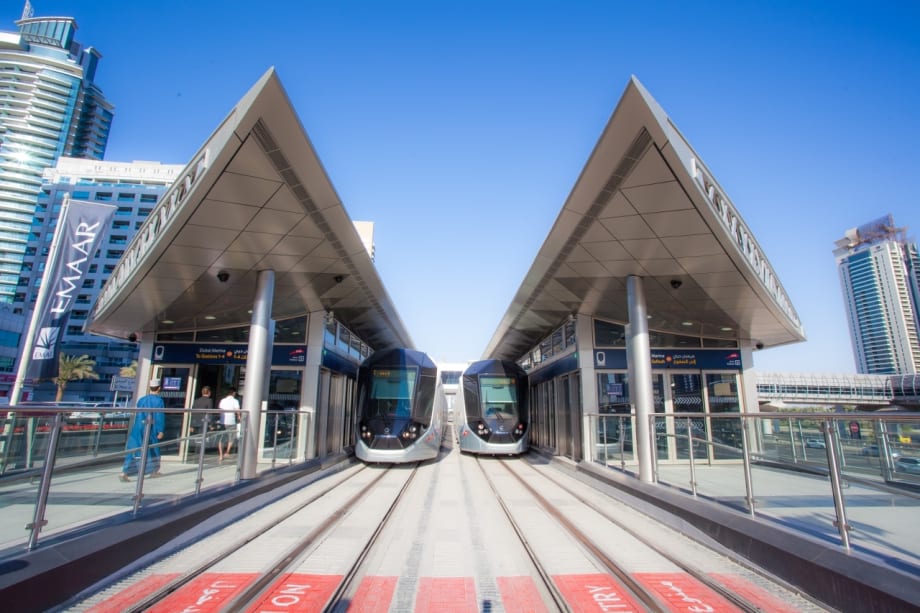
The tram system includes 11 air-conditioned stations along the six-mile line, which feature information kiosks, ticket validators and vending machines, public address systems, video monitors and CCTV systems.
6 min to read

For a city filled with superlatives, Dubai has added another impressive jewel to its lux landscape. The Middle Eastern city, home to the world’s tallest building, the Burj Khalifa (211 floors/2,177 feet tall), and future home of the world’s largest Ferris wheel (690 feet tall) and the world’s largest mall (28 square miles), has added the world’s first 100% catenary-free tram system — the Dubai Tram.
Project involvement
Alstom Transport was responsible for the design, integration and supply of this turnkey tramway project (the first for the Gulf region), which includes: the supply of Citadis trams, track laying, signaling — using Alstom’s Urbalis communications-based train control (CBTC) — communications systems, integrated operation control center, platform screen doors and ticketing system.
“The global value of the project is approximately $760 million, of which around 50% is Alstom’s share,” says Gian Luca Erbacci, sr. VP, Alstom Transport Middle-East & Africa Region. The electromechanical parts, including rolling stock, signaling and power supply is tabbed at an estimated $55 million, he adds. Additionally, Alstom signed a 13-year maintenance contract valued at $65 million.
The six-mile Dubai tramway, which debuted Nov. 11, 2014; features 11 Citadis trams, 11 air-conditioned stations; and connects destinations such as the Burj Al Arab Hotel area, Dubai Media City, the Marina and the metro system.
The tram is operated by Dubai’s Roads and Transport Authority (RTA), which was established in 2005. The RTA also oversees the metro, monorail, buses, taxis, intercity transport, marine transport, and roads and parking.
Regional growth

Since Dubai is one of the fastest growing cities in the world, providing an advanced transport network for its citizens has been high on the government’s agenda, according to Alstom’s Vincent Prou, managing director, Gulf Region.
“There is a strong desire from the Emirate to develop the infrastructure and provide an attractive business environment. The ambition is to bring the share of public transport from 13% to 30% by 2030,” Prou says.
Looking back to 1975, when there were 200,000 inhabitants in Dubai, can provide some context for the surge in growth the city is undergoing. Fast forward to 2003, the population reached one million. Today, the population has grown to 2.1 million people in a little more than 10 years. Dubai sees 10 million visitors a year via tourism and business.
“Obviously, in a city that has the world’s tallest building, they are looking for the best of the best,” Prou says of the tram system.
Citadis vehicle
Dubai’s low-floor Citadis tram is 140 feet long and can carry up to 408 passengers. The air-conditioned interior offers three classes differentiated by color and comfort level — “Gold” (featuring wider seats furnished in leather, with document holders and luggage racks), “Silver” and “Women & Children” classes. The interior offers high-end comfort, “infotainment” solutions, and enhanced communications and security systems both within the stations and on-board the tram, Prou explains.
The main features of the tram’s exterior design are its diamond-shaped front nose and its external livery, which evokes the sand dunes of the Emirate, according to Xavier Allard, sr. VP, design & styling, for Alstom. When developing design concepts for the tram’s overall aesthetic, Allard says he likes to integrate images suggestive of the city itself. Another example of this visual integration with the landscape is the vehicle Alstom designed for the tram system in Reims, France, which is reminiscent of a champagne glass, hence the idea of a luxurious jewel evocative of Dubai.

APS System, Stations
One of the cutting-edge technologies developed for the Dubai Citadis tramway is its APS ground-level power supply. This catenary-free system, which enables it to preserve the aesthetics of the city, reduces the rail system’s footprint by eliminating poles while optimizing safety and operational reliability.
Power is supplied to the tram via segmented street-level rail embedded between the running rails on the axis of the track, explains Prou. The conductive segments are switched off/on/off as the tram progresses.
“When the train is detected, the segment below the tram is automatically energized,” says Prou. “Conversely, when the tram leaves that section, the segment is de-energized and it is safe again for cars, pedestrians and bikes to cross the tram [path].”
Alstom first implemented the APS technology for the tram system in Bordeaux, France in 2003.
Other cutting-edge aspects of the tram system are the fully enclosed, air conditioned stations, featuring such amenities as touchscreen information kiosks, video broadcasting systems for passenger information and advertising, as well as contactless ticketing machines.
“A lot of attention was paid to designing bicycle paths, drop-off areas, bus stops and taxi stops,” Prou says. “So the tram interfaces nicely with other modes of transport.”
Intermodality is achieved at all stations via enhanced pedestrian access, connectivity to the metro system through two stations (3 and 5) as well as connection to the Palm Jumeriah monorail, which links the mainland to Palm Jumeriah island — a man-made island formed to look like a palm tree, which was built as a tourist destination.

Extreme climate
With summer temperatures in the United Arab Emirates reaching up to 122° F, the tram and its infrastructure needed to be fortified to withstand extreme weather conditions, including high humidity reaching 100% and the sandy, corrosive atmosphere.
The Citadis vehicle was redesigned, with a focus to make the electronic infrastructure more robust and air conditioning units were reinforced in the driver’s cabin and the passenger cars, Prou explains. Trams were also equipped with brushes to clear sand from the third rail and the switch boxes that power the live rail are air conditioned. Other adaptions made to the vehicle include the use of UV-resistant paint, glue, decals, cabling and electronics; and UV protection for windows.
The vehicle underwent testing in a climatic chamber at Alstom’s facilities in Vienna in addition to simulation of a mini version of the tram system at the company’s factory in LaRochelle, France.
“This allowed us to do a little bit of troubleshooting before the system was implemented in Dubai and this enabled us to drastically reduce the time for testing and commission.”
Signaling, supervision
Other elements of the tram system include Alstom’s CBTC signaling system, with provides speed control and also ensures precise alignment and safe interlocking with the station’s platform screen doors. The system’s control center, which receives feeds from more than 750 cameras along the line, is integrated with the depot, allowing for supervision, communication and control of the tram service. The cameras are installed along the line, which are directly monitored by the police in Dubai, Prou says.
Future plans
The Dubai tram is already a success, says Alstom’s Prou. RTA statistics indicate that 943,982 riders have used the tram in Dubai during the first three months of 2015. The RTA’s ridership expectation aims for 27,000 passengers per day, he adds, with the ambition to reach 60,000 per day by 2020.
Plans to extend the tramway line are underway, with Phase 2 set to extend the line two more miles, adding six new stops and 14 new trams. Work is expected to start in 2016. An additional segment (Phase 3) would extend the line an additional nine miles to 12 miles.
Subscribe to Our Newsletter
More Rail
DART Taps Nathaniel P. Ford Sr. as Next President/CEO
Since 2012, Ford has served as the CEO of the Jacksonville Transportation Authority
Read More →
California High-Speed Rail Authority Signs MOU to Advance High Desert Corridor
The agreement deepens collaboration between the California High-Speed Rail Authority and the High Desert Corridor Joint Powers Agency, supporting design integration, cost savings, and faster delivery of a key Southern California rail link.
Read More →
Building the Next Generation of Transit Technology
In this edition of METROspectives, Luminator CEO Magnus Friberg discusses the company's transformation, the growing role of AI and software, and what's next for transit technology.
Read More →
How Data, Strategy, and Community Engagement Are Reshaping Transit
In this edition of METROspectives, strada360 CEO Steve Lassey discusses how transit agencies can better align planning with operations, leverage data to improve decision-making, and build public trust as they prepare for the future of mobility.
Read More →
TTC Launches Camera Pilot to Curb Illegal Passing of Streetcars
During the pilot, the cameras will measure how often illegal streetcar passing occurs and test the technology's reliability for future automated enforcement.
Read More →
NJ TRANSIT Secures Capital Funding, Adopts FY2027 Budget
The budgets continue investments in infrastructure and equipment to maintain the system in a state of good repair and enhance the overall customer experience.
Read More →
Biz Briefs: Masabi Teams with St. Louis Metro and More
In METRO's latest installment, we take a look at recent news from Transdev, Hitachi, and more partnerships making headlines across the transportation sector.
Read More →
Metra Begins Drone Pilot Project to Boost Safety and Security
The project is funded through a $620,000 grant from FEMA’s Transit Security Grant Program, which provides transit agencies with funding for projects intended to protect critical transportation infrastructure and the traveling public.
Read More →
Austin Transit Partnership Selects Stadler to Manufacture Light Rail Vehicles
The award marks the conclusion of a series of major procurements over 18 months, as outlined in ATP’s delivery plan, and keeps Austin Light Rail on track.
Read More →
The Heart Behind Austin's Light Rail
Why Austin Transit Partnership's Operations and Maintenance Facility could become the most important building in the city's first light rail system.
Read More →