



DART airport station set to open 4 months early
The five-mile Orange Line extension from Belt Line Station to the newly rebuilt Terminal A at DFW will bring the longest light rail system in the U.S. to 90 miles.

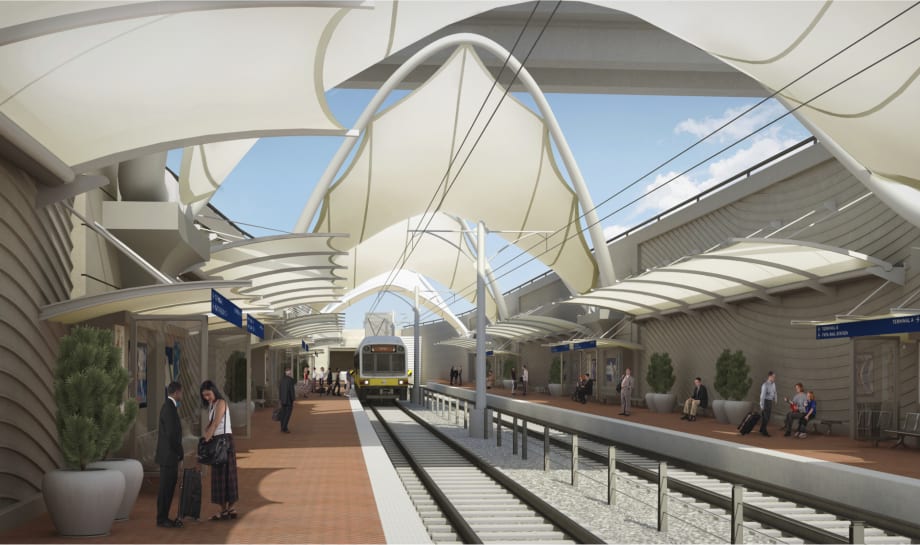
On Aug. 18, Dallas Area Rapid Transit Authority (DART) will join the ranks of transit systems with rail connections to major airports as it opens its Dallas/Fort Worth International Airport (DFW) station four months ahead of schedule and under budget.
The five-mile Orange Line extension from Belt Line Station to the newly rebuilt Terminal A at DFW will bring the longest light rail system in the U.S. to 90 miles.
RELATED:Report: Rail to airport connections a growing trend
When the DFW Airport Station opens, riders will only need to walk about 300 feet from the station to the terminal, making it convenient for people traveling to and from the Dallas/Fort Worth area as well as for people who work at or near the airport, DART President/Executive Director Gary Thomas said.
“Opening a project of this complexity early and under budget is a great testament to the work of our DART team and our colleagues at DFW Airport,” Thomas said. “Support from the Federal Transit Administration and Federal Aviation Administration (FAA) was also crucial to beating the targeted opening.”

When the DFW Airport Station opens, riders will only need to walk about 300 feet from the station to Terminal A, making it convenient for people traveling to and from the Dallas/Fort Worth area and those who work at or near the airport.
DART received a $5 million Transportation Investment Generating Economic Recovery grant as well as a $119 million Transportation Infrastructure Finance and Innovation Act loan for the rail extension to the station. The first section of the Orange Line received $61 million in American Recovery and Reinvestment Act funds.
DART initially planned to be finished with the station in December. However, as its project partner, DFW International Airport was building the station, and as the transit system handled the track work and catenary systems, they realized they were ahead of schedule. Together, they were able to pin down the opening date, allowing enough time to get all the required testing and integration completed in a timely manner and still have enough time for the training of DART’s operators.
Choosing an August opening date was particularly beneficial because that will make the station accessible before the State Fair of Texas, which starts in late September, and brings significantly high ridership, Thomas said. For example, over the last couple of years, the number of additional trips related to the fair was approximately 700,000 over a three-week period.
The project has also created about 60,000 jobs in and around DFW airport, from employees on airport property and businesses adjacent to it associated with hospitality, storage and logistics. The project created between 500 and 1,000 jobs not counting ancillary jobs, such as parts manufacturing, he added.
“All of those are solid employee bases, so I anticipate that this will be a well-used part of our system,” Thomas said. “I think that will only grow as time goes on.”
DART is currently projecting 1,200 trips per day going to the airport station, but Thomas said he can see that growing once more people become aware of the new station.
One challenge in completing the project was working with all the government entities that have control over the airport property.
“When you connect to the airport, you not only [work with] the FTA or Federal Railroad Administration, depending on your mode, you also have the FAA, and the U.S. Department of Homeland Security and the Transportation Security Administration,” Thomas explained.
However, he said the project has been a good team effort.
“It’s been fun to work on, and our partners at DFW have been great,” Thomas said.
More Rail

New York MTA Advances Final Contract for Second Avenue Subway Expansion
Contract Four is the largest in the Second Avenue Subway Phase 2 project and includes construction of station infrastructure, tracks, and signals for the subway expansion, MTA officials said. Work on Contract Four will begin in 2027.
Read More →
San Diego MTS Breaks Monthly Trolley Ridership Record
Agency officials said July’s ridership indicates MTS’s continued recovery from the pandemic.
Read More →
Report Examines NJ TRANSIT Reliability, Funding Challenges
The Garden State Initiative analysis examines the roles of Amtrak infrastructure, fleet management, and agency operations while recommending a more performance-based approach to improving reliability.
Read More →
Stadler, CapMetro Sign Long-Term Rail Fleet Support Agreement
Beginning in 2027, Stadler will provide on-site technical expertise, spare parts support, training, and obsolescence management to help extend the reliability and longevity of CapMetro’s GTW fleet.
Read More →
Biz Briefs: Alstom Lands Canadian Contract, LYT to Supply California TSP, and More
In METRO's latest installment, we take a look at recent news from Complete Coach Works, Beep, FlixBus, and more partnerships making headlines across the transportation sector.
Read More →
CATS Gold Line Marks 5 Years of Service, 2.8M Passenger Trips
With a six-mile expansion planned, the Charlotte streetcar is positioned to connect more neighborhoods and major transit hubs across the region.
Read More →
Why Simulating Pedestrian Movement Has Become Essential for Modern Rail Stations
Pedestrian microsimulation is helping rail planners identify bottlenecks, test station designs, and prepare complex transit hubs for growing passenger volumes.
Read More →
Amtrak Begins Major Construction at New York’s Sunnyside Yard
The new maintenance facility will support Amtrak’s Airo trainsets while improving maintenance efficiency and turnaround times in New York.
Read More →
Chicago Leaders Unveil Plans for O’Hare Airport Express Train
The privately developed project would offer a 15-minute trip between downtown and O’Hare’s Terminal 2, with trains operating every 15 minutes on a dedicated track. The service would use battery-electric trains and three existing freight rail rights-of-way.
Read More →
OCTA Maps Out 30-Year Strategy to Protect Coastal Rail Corridor
The draft feasibility report identifies strategies to protect the coastal rail line for decades as the agency continues near-term stabilization and sand placement efforts.
Read More →