Has cut its service by 37% over the past three years, but hopes to increase ridership by making its services more productive.
by Brittany-Marie Swanson, Associate Editor
February 14, 2013
3 min to read
Before the recession hit in 2009, Everett, Wash.-based Community Transit was well on its way to reaching its goal of 12 million annual boardings. Now, after being forced to cut 37% of its service over the past three years, the agency is ready to bounce back — by being more productive with its existing service.
“We can’t add service because we don’t have the money to do it,” said Martin Munguia, public information officer for Community Transit. “But at the same time, we know that there’s a lot of demand, so we’ve made a goal for ourselves to increase our ridership about 25% over the next five years.”
Ad Loading...
The agency is looking to scrap underutilized service and focus its efforts on providing more effective routes. With this approach, it hopes to increase the 9.2 million riders it saw in 2012 to 12 million by 2017.
“We want to find a way to shift some of our service around — maybe not run as many of the unproductive trips and add those trips to the highly productive routes, where we’re going to see a lot more ridership,” Munguia explained.
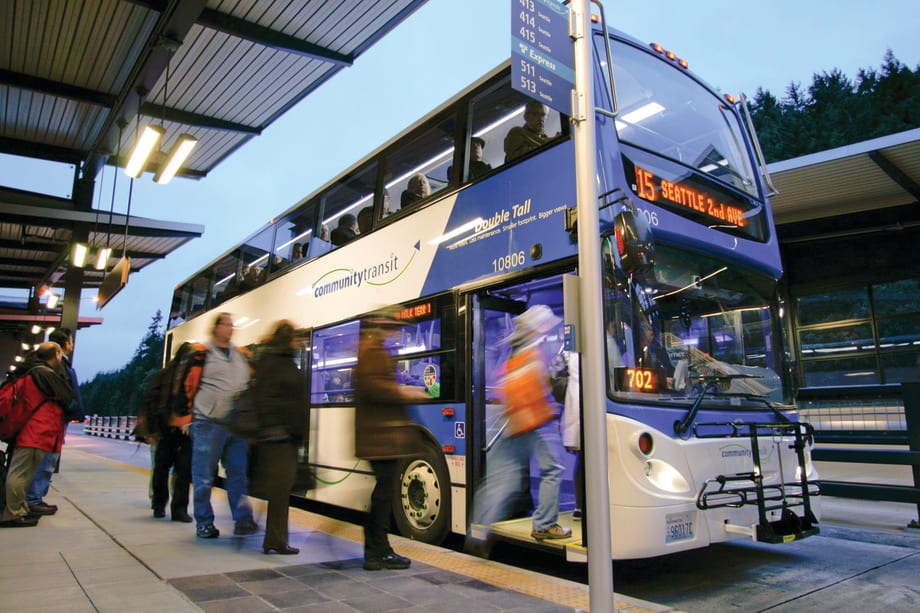
In 2011, the agency replaced some of its 60-foot articulated buses used for commuter service to Seattle with double-decker buses, called “Double Talls,” which added 30% passenger capacity without increasing operating costs. Despite this, one of the problems Community Transit has seen, according to Munguia, is excessive numbers of standees on these popular routes.
“We have some double-decker buses, and they have 77 seats. We see many trips with over 100 passengers on those buses,” he said.
To reduce the number of passengers without seating, the agency will now move buses from quiet routes to busier ones. Community Transit will also be able to add 30 trips a day to the Seattle commuter service starting next month, thanks to a grant from the Federal Transit Administration.
Ad Loading...
Moreover, to cultivate ridership during off hours, the agency is looking to use promotional advertising and social media campaigns to urge riders to use public transit during lunch time or to get to recreational activities.
“Through our peak times — the morning and afternoon rush hours — that’s when we have about 75% of all of our riders onboard. So that means, in the evening and in the middle of the day, the buses are less full,” Munguia said. “We are trying to get people excited about using the bus on those off periods.”
Munguia also pointed out that the best part of Community Transit’s new plan is that it focuses on data, rather than trial and error.
“Back [before the recession], a lot of transit agencies put bus service out in communities to see if people would come,” he explained. “And now, we’re taking much more of a data-driven, productivity-conscious approach. “Any new service we’re going to add, we’re really going to analyze the statistics,” he added. “We’re only going to put service where we know people are going to ride it.”
Complete Parts features new branding with a new logo, a new contact telephone number, a dedicated order desk, enhanced processes and inventory, all designed to provide the parts bus operations need.
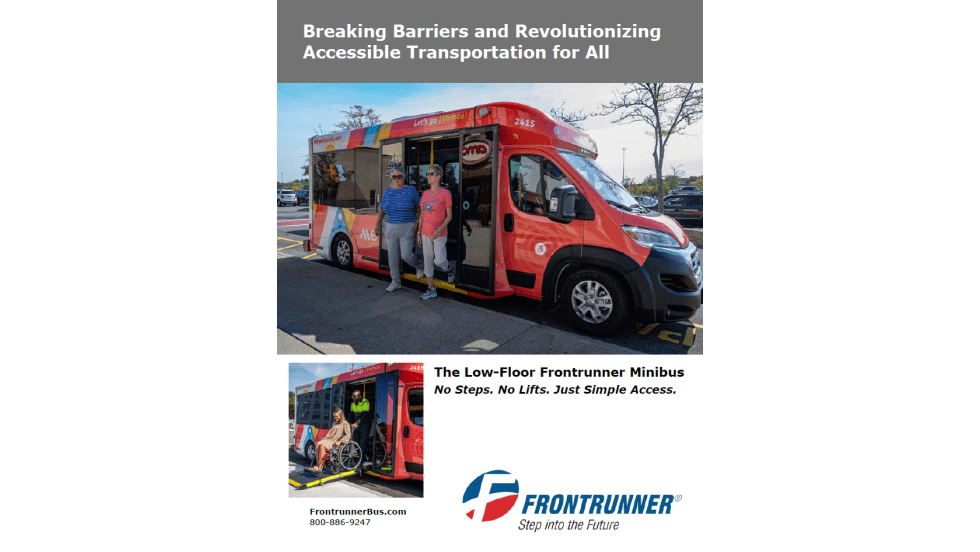
Accessible transit isn’t a feature—it’s a responsibility. This whitepaper explores how the Low-Floor Frontrunner is redefining mobility with a breakthrough design that removes barriers, empowers riders, and delivers measurable operational advantages for agencies. Discover why this next generation minibus is setting a new standard for inclusive transportation.
SEPTA was awarded $43 million in competitive grant funding from the FTA's FY25 Low and No Emission and Bus and Bus Facilities grant programs to support this procurement.
In part 1 of a two-part conversation, AC Transit’s director of maintenance joins co-hosts Alex Roman and Mark Hollenbeck to discuss his journey from the U.S. Marines to public transit and the role mentorship plays in developing the next generation of industry leaders.
When construction is complete, battery-electric buses will operate from the Arborway facility on Day One, providing cleaner, quieter, and more reliable service for riders, the MBTA said. After completion, the old facility will be demolished, and the land will be made available for redevelopment.
Nadine S. Lee, who has served as president/CEO since July 2021, said the decision comes after careful reflection on the agency’s progress and its path forward.
In this conversation, TBC’s Executive Director Ed Redfern, President Corey Aldridge, and Washington Representative Joel Rubin outline the coalition’s key policy priorities, the challenges facing transit agencies, and how industry stakeholders can work together to strengthen the voice of bus transit at the federal level.
What truly drives the cost of a paratransit fleet? Beyond the purchase price, seven operational factors quietly determine maintenance frequency, downtime, and long-term service reliability. This whitepaper explores how these factors shape lifecycle cost and what agencies should evaluate when selecting paratransit vehicles.