Transit agencies report that reviewing fare collection controls and system security is a continual process. Experts recommend appointing a revenue auditor to perform daily checks and reports, performing regular preventive maintenance on fareboxes and putting policies and procedures in writing.
by Claire Atkinson, Senior Editor
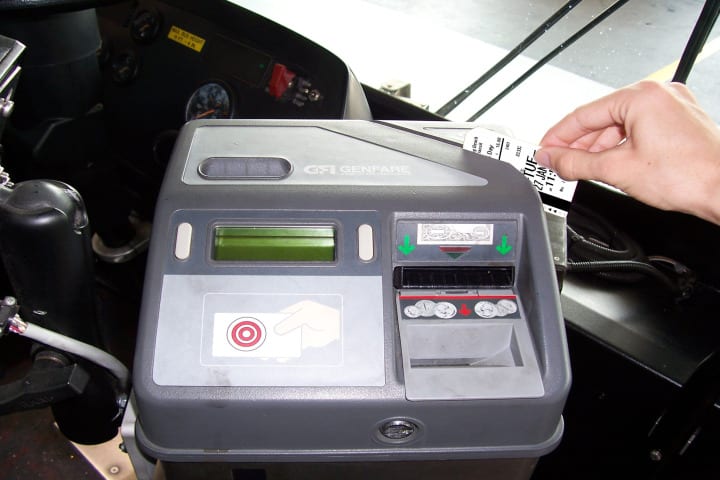
February 10, 2010[IMAGE]Fare.jpg[/IMAGE]The security of a transit agency's fare collection system is a topic many agency heads are reluctant to discuss. After all, revealing any weakness in a public agency's revenue handling could be a disastrous public relations move, as government entities are charged with the utmost care in dealing with funds.
Yet, some say the vast majority of "shrinkage" takes place internally, either through intentional employee theft or unintentional loss of revenue due to miscounts, equipment malfunction or other issues. Thus, creating an airtight revenue counting and reconciliation procedure is crucial.
"People do not want to talk about these things because in a governmental agency, you're not allowed to lose a penny," says Joe Simonetti, a consultant specializing in fare collection systems and procedures. "We've got an obligation to be accountable for knowing what we receive and deposit."
"Management sees fare and revenue collection as a key component to being good stewards of the taxpayers' money," says Rebecca Thornton, director of accounting at the Fort Worth (Texas) Transportation Authority (The T).
'Bus to bank'
Simonetti's career in public transit has its roots at the Chicago Transit Authority, where in the 1990s he headed the then newly established Revenue Equipment Technology and Maintenance division, which led the agency's transition to electronic fareboxes. He has been consulting since 2000 and works mainly with small and mid-size agencies, he says. "With regard to revenue controls and revenue processing and handling, it's difficult for them because they don't have large staffs to draw from to manage these systems," he explains. In some cases, smaller agencies can't afford to invest in the more expensive fareboxes that feature technologies that make reconciliation and data management more efficient, he adds.
Simonetti wrote an article on best practices in fare collection security that was later presented in a seminar at the California Transit Association's 2006 Annual Fall Conference. "Fare Collection Security: From Bus to Bank" provides recommendations for securing the money room, installing surveillance equipment, establishing written policies, revenue reconciliation, and staff positions and responsibilities.
Security of the money room is of paramount concern for transit agencies; it is essential to follow strict procedures concerning who is allowed in the money room, how money is counted, and reconciling collected cash versus the amounts deposited.
Simonetti recommends that keys for facilities associated with revenue processing be on a separate key control system from the rest of the facility keys. Alarms should be tripped and reports made when keys are not stored properly, and money room keys should never be taken home by staff.
In addition, the money room should be under video surveillance, he says. Electronic access control systems provide an additional layer of security. Simonetti also suggests that money room staff be issued long sleeved jumpsuits without pockets that must be worn until exiting the room.
At Long Beach (Calif.) Transit, keys to fare collection facilities are only accessed by authorized staff, who are verified using biometrics. Each employee's ID card is magnetically encoded and entrances into the money room are reviewed daily to ensure that times are entered. At least two employees must be in the money room at a time. "It's not just a key - you have to have a key and the right ID to get into the area," says Lisa Patton, manager, grants and revenue.
The agency has a money room supervisor and a staff of three dedicated to processing fare revenue. Both cash and magnetic fare cards are accepted on the bus. When buses return to the fuel island, a utility staff person transfers collected fares into through-the-wall vaults. After processing in the money room, cash is picked up by an armored car. "Then reconciliation is done by the revenue analysts in the finance department," Patton says.
To get an accurate revenue count, Simonetti urges agencies to do a blind count, where money room employees are not informed of the total recorded by the electronic farebox ahead of time. "If internal staff sees the reports and knows how much should be in there, that's generally how much they count," he explains.
He also recommends that one employee be assigned the role of revenue auditor, with the authority to investigate variances. This individual needs to be an expert on the agency's fare collection system, reports and alarms, and should perform a daily system audit with a report to management showing revenue variances, what checks were performed and what actions were taken.
"We do a daily audit by vault," Patton says. "The revenue analysts will ensure each vault has the amount of money it should have, and our variance is really low - it's less than one percent. Also, we make sure we have every large bill, making sure every $20 bill that was put in the cash box made it through the money room and then to the bank."
In addition, external auditors review fare collections and cash counting procedures annually as part of the financial audit and test of internal controls.
According to Thornton, the threats to security and loss of revenue include the separation of duties between staff that pulls and empties fareboxes and service attendants that clean buses. As a result, pulling of fare boxes is monitored by security cameras, she says, accounting staff counts the money daily and the physical count is reconciled to daily reports from the farebox and ticket vending machine systems. "We have surveillance cameras in the service station monitoring the revenue service agents as they pull the fare box, and on the depository vault and in the money room. Access to the money room is controlled by electronic ID cards and limited to accounting staff only," she explains.
In addition, 10 percent of the bus fareboxes are audited daily to ensure that the fareboxes are in good working order, and TVM cash is reconciled each time it's pulled from the machines.
[PAGEBREAK]
Get it in writing
In his article, Simonetti prescribes the establishment of written standard operating procedures regarding fare collection that detail the entire fare collection process, clearly explain what is expected of employees, and if not followed, what action the authority will take.
At The T, employees follow written revenue collection procedures for fareboxes, TVMs and the money room. Generally, new staff is trained by other staff members, and vendors also provide training when the agency acquires new equipment, Thornton says. "Training manuals are also part of the procurement requirements," she says. "These manuals will be issued to each employee involved with revenue collection and retained in our library for future employees. In addition, our staff handbook is very clear that theft by employees results in automatic termination."
Departmental cooperation
Several departments within a transit agency must form close working relationships for a successful fare collection program and for optimum security of the system. "The problem is if the fareboxes are being maintained by the maintenance division and the finance division is saying, 'this is how you've got to do things,'" Simonetti says. "Get that relationship going so that finance and maintenance can work together."
Not only is communication essential among departments for improved security and integrity of fare data, but maintenance staff can provide key insight into security improvements, as well as equipment malfunctions and other alarms that may indicate the source of a variance during reconciliation.
During Long Beach Transit's transition to an upgraded farebox system, Marketing Manager Marcelle Epley says a task force was formed and regular meetings were held. "As new information was coming in and as we were modifying our policies and procedures, we were checking in to make sure it was copacetic throughout the organization," she says. Representatives from the agency's maintenance, operations, customer service and finance departments were involved. "To Lisa's [Patton] credit, her team did an excellent job at facilitating what was an extreme change of culture internally and for our customers as well," Epley points out.
While developing fare collection procedures during the transition, Patton says that discussions with the maintenance department resulted in a practice of auditing cashboxes continually so that the entire fleet is covered twice a year. In addition, cashbox lockers were installed in the garage to avoid leaving full cashboxes out in the open unsecured. "They're through-the-wall lockers," she explains. "The maintenance supervisor will enter an access code and he'll be able to pull out an empty cashbox and put in a full one, so there's a one-for-one exchange and there's tracking of exactly what went in and what went out.
Preventive maintenance schedules for fareboxes are also necessary, according to Simonetti. At Long Beach Transit, farebox PMs are done every six months and maintenance employees completely change out all the components, Patton says. "That gives the shop time to go over all of the components and it essentially gives us a new farebox every time it gets PMed," she explains.
[PAGEBREAK]
Video surveillance
Digital video technology has made surveillance much more efficient and effective than recording on VHS tapes used to be, Simonetti says. "Now, you can record digitally in real time and save it forever." Modern cameras can also handle low-light environments and show color and movement in greater detail.
In his article, Simonetti lists several areas where video cameras should be installed:
Service lanes overlooking the cashbox vaulting at the receivers. Additionally, a camera should also be able to look through the front bus door and see the removal of the cashbox.
Money Room - Interior: The system should be able to view maintenance being performed on the receivers, the table where the bills are sorted and decked, the table where the bills are counted, the safe, coin counting area and entrance door.
Money Room - Exterior: The outside entry door to the Money Room should be under surveillance with lights to have a good view at night. Also, a monitor inside the money room could be used to identify people coming into the room.
Any room in the transit facility where safes are kept.
Farebox and cashbox storage room.
In addition, he specifies that employees should monitor cameras from one location controlled by security and not accessible in general. Remote joystick control should be provided for specific cameras in order to have tilt, pan and zoom capability. "We have six cameras and we use pan, tilt, zoom so we can actually zoom in and read the serial number on a bill," Long Beach's Patton says.
Training Resource
For agencies looking to instill hands-on operating knowledge in money room and finance department staff, Simonetti recommends the Fare Collection Workshop held each year by the American Public Transportation Association.
In 2001, The T centralized its revenue collection under the accounting department, Thornton says, and the agency's president suggested that she attend the workshop.
"Since attending my first Fare Collection Workshop in Denver, I have become very involved with the committee, serving as an officer and speaking at the workshops," she says. "Fort Worth hosted the Fare Collection Workshop in 2004, and I was able to have my entire staff attend the various training seminars, including Fare Collection 101."
The workshop this year is being held March 28 to 31 in San Diego. Check www.apta.com for more information.