



Brookville Equipment Corp. marks 100th anniversary
Originally founded as Brookville Truck and Tractor Co. in 1918 when local Ford-dealer installed flanged rail wheels on standard Ford Model-T.

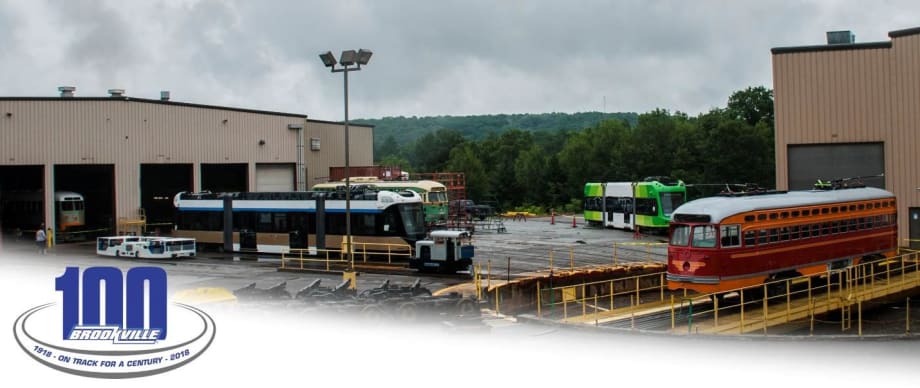
Brookville Equipment Corp. celebrated its 100th Anniversary, with nearly 800 guests, employees, families of employees, friends, suppliers, and industry members in attendance.
As part of the festivities, addresses were given by CEO and Chairman Dalph S. McNeil, who discussed the major role long-tenured employees played in the company’s success, and Brookville Equipment President Rick Graham, who focused on how the company is continuing to transform and evolve in the modern age.
Brookville Equipment volunteers provided in-depth tours of the manufacturing facility, which covered the company’s history and current product line. Visitors were able to see streetcars, locomotives, and mining equipment in various phases of manufacturing.
The company also displayed some of its rail equipment, including heritage streetcars bound for San Francisco and El Paso, modern streetcars destined for Milwaukee and Oklahoma City, mining equipment for customers in West Virginia, and a locomotive for Metro-North Railroad in New York City. Guests were able to board the Oklahoma City Streetcar.
Additionally, Brookville Equipment showcased a 1945 model BFA-5 gasoline-powered locomotive. The small locomotive, purchased, and refurbished by the company, includes a Ford Flathead V8 engine and runs on 21 1/2-inch rail gauge. American Industrial Mining Company Museum, a 501(c)(3) non-profit preservation society from Buckeye Lake, Ohio, also brought a 1930s-era three-ton Ford-powered locomotive, which was decaled to commemorate the 100th Anniversary of the company.
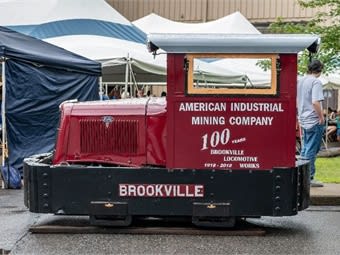
A 1930s-era Ford-powered V8 gasoline switching
locomotive restored by American Industrial Company
Museum. (Photo by Chris Lasher)
Originally founded as Brookville Truck and Tractor Co. in 1918 when local Ford-dealer L.A. Leathers installed flanged rail wheels on standard Ford Model-T, the company would soon be known as Brookville Locomotive Works and become a full-scale manufacturer of small-scale rail switchers for railroad and industrial applications. In the 1970s, the company was purchased by the McNeil family, who has now held the company for more than four decades. Under the vision of CEO Dalph S. McNeil, the company would be renamed Brookville Mining Equipment Corp. in the 1980s, emerging as a market leader in mining rail haulage and transport equipment, including locomotives and personnel carriers.
Today, now known as Brookville Equipment Corp., the company continues to be a market leader in rail-mounted mining equipment and has diversified into the production of full-scale surface locomotives for freight and passenger applications, and streetcars, having delivered new and rebuilt fleets to cities across the U.S., including Philadelphia, New Orleans, San Francisco, El Paso, Dallas, Detroit, Oklahoma City, Milwaukee, and soon to include, Tempe, Ariz.; Tacoma, Wash.; and Portland, Ore.
More Rail

New York MTA Advances Final Contract for Second Avenue Subway Expansion
Contract Four is the largest in the Second Avenue Subway Phase 2 project and includes construction of station infrastructure, tracks, and signals for the subway expansion, MTA officials said. Work on Contract Four will begin in 2027.
Read More →
San Diego MTS Breaks Monthly Trolley Ridership Record
Agency officials said July’s ridership indicates MTS’s continued recovery from the pandemic.
Read More →
Report Examines NJ TRANSIT Reliability, Funding Challenges
The Garden State Initiative analysis examines the roles of Amtrak infrastructure, fleet management, and agency operations while recommending a more performance-based approach to improving reliability.
Read More →
Stadler, CapMetro Sign Long-Term Rail Fleet Support Agreement
Beginning in 2027, Stadler will provide on-site technical expertise, spare parts support, training, and obsolescence management to help extend the reliability and longevity of CapMetro’s GTW fleet.
Read More →
Biz Briefs: Alstom Lands Canadian Contract, LYT to Supply California TSP, and More
In METRO's latest installment, we take a look at recent news from Complete Coach Works, Beep, FlixBus, and more partnerships making headlines across the transportation sector.
Read More →
CATS Gold Line Marks 5 Years of Service, 2.8M Passenger Trips
With a six-mile expansion planned, the Charlotte streetcar is positioned to connect more neighborhoods and major transit hubs across the region.
Read More →
Why Simulating Pedestrian Movement Has Become Essential for Modern Rail Stations
Pedestrian microsimulation is helping rail planners identify bottlenecks, test station designs, and prepare complex transit hubs for growing passenger volumes.
Read More →
Amtrak Begins Major Construction at New York’s Sunnyside Yard
The new maintenance facility will support Amtrak’s Airo trainsets while improving maintenance efficiency and turnaround times in New York.
Read More →
Chicago Leaders Unveil Plans for O’Hare Airport Express Train
The privately developed project would offer a 15-minute trip between downtown and O’Hare’s Terminal 2, with trains operating every 15 minutes on a dedicated track. The service would use battery-electric trains and three existing freight rail rights-of-way.
Read More →
OCTA Maps Out 30-Year Strategy to Protect Coastal Rail Corridor
The draft feasibility report identifies strategies to protect the coastal rail line for decades as the agency continues near-term stabilization and sand placement efforts.
Read More →