




RELATED: Senate leaders reject Gov. Baker's MBTA fiscal control plan
Gov. Baker unveils $83 million MBTA winter resiliency plan
Calls for investments this summer and over the next five years in snow removal equipment, infrastructure upgrades and operations during harsh weather to improve service reliability.
June 5, 2015
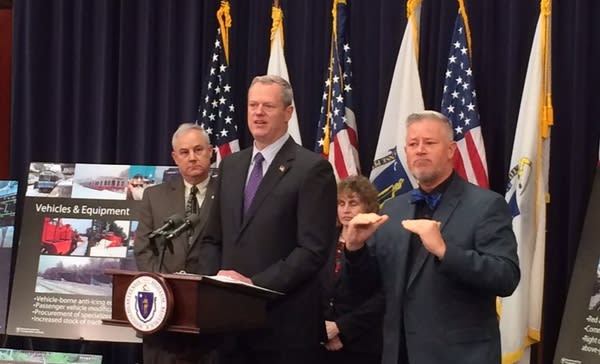
Massachusetts Governor Charlie Baker during press conference.
Courtesy MBTA
4 min to read

Governor Charlie Baker unveiled an $83 million plan to make Massachusetts Bay Transportation Authority (MBTA) buses and trains more resilient during extreme weather. The MBTA Winter Resiliency Plan calls for investments this summer and over the next five years in snow removal equipment, infrastructure upgrades and operations during harsh weather to improve service reliability. Governor Baker also stressed the need for legislative action on An Act for a Reliable, Sustainable MBTA to secure long term improvements at the T.
“In the event of another harsh winter, it is critical we are prepared. We also hope the legislature will act before the end of this session to deliver the reforms necessary to address the underlying financial and management challenges at the MBTA,” said Governor Baker. “These investments and contingency plans are important for day-to-day operations and emergency service. But, without the flexibility and dedicated oversight of a Fiscal Management and Control Board and the reforms we outlined, the T will continue to fail its stress tests for commuters and taxpayers who deserve a reliable world class transit system.”
The new resiliency plan was developed based on recommendations by an American Public Transportation Association (APTA) peer review of the MBTA’s winter operations in April, while a special panel appointed by the Governor reviewed and made recommendations to fix the MBTA’s deeper structural, financial and operational problems.
“We learned last winter that in addition to structural reforms, the MBTA needs meaningful improvements to its snow resiliency efforts, including upgrades to infrastructure, operations and equipment,” said Interim MBTA GM Frank DePaola. “As we continue to work with the administration and our peer agencies to improve service reliability, we look forward to implementing these plans that are essential to reducing the amount and length of service disruptions during severe weather.”
The $82.7 million plan will be funded through $62 million in federal formula funds for capital investments, $10 million in non-federal, MBTA capital funds, and $11.7 million in operating funds. The plan will be presented to the MassDOT Board for approval next week and focus on the following priorities to more effectively mitigate the frequency, length and magnitude of system disruptions to public transit during severe weather.
Infrastructure
Third rail replacements and heater upgrades on vulnerable outdoor sections of the Red and Orange Lines.
Snow fence installation along the Red and Orange Lines to mitigate snow drift accumulation.
Repairs to vehicle maintenance facilities and structures to further maximize recovery efforts.
Emergency power generators to supplement existing subway and facility power as needed.
Track access improvements for larger snow removal and track work equipment on the Red Line.
Equipment
New and rehabilitated specialized snow removal equipment to increase removal capacity and reduce use of passenger vehicles.
For passenger vehicles, vehicle-borne anti-icing equipment, modifications to air and propulsion system resiliency and an increased stock of traction motors to improve availability.
Operations
Additional snow removal contract services, as needed, to remove snow and ice at stations, facilities and other critical operations areas.
Training and staffing of a Field Inspection Team to be deployed during weather events to monitor staff and contractor field activities clearing snow and returning tracks to an operational status.
Adoption of incident management software in coordination with the MassDOT Highway Division to track deployment of snow removal operations across the system.
Formal establishment of an as needed inmate snow removal assistance program with the Department of Corrections to augment and streamline the services provided this winter.
Further coordination of interagency planning with the Massachusetts Emergency Management Agency, state agencies and local municipalities to identify efficiencies and synergies in snow removal.
Similar resiliency enhancements to the commuter rail network.
Revisions to the MBTA’s severe winter weather operations protocols and customer notification practices to ensure more information, customer safety and the protection of equipment and facilities.
The right-of-way improvements on the Orange and Red Lines will be scheduled to occur this summer and fall and the MBTA will notify customers of any service impacts required to enable the upgrades as these projects are implemented.
In April, Governor Baker filed legislation based on the special panel’s recommendations to establish a Fiscal Management and Control Board (FMCB) and Chief Administrator to oversee the MBTA’s operations and finances, create capital plans and expand the MassDOT Board. An Act for a Reliable, Sustainable MBTA also introduces reporting and audit requirements and lifts procurement restrictions on the MBTA.
More Management

California High-Speed Rail Authority Signs MOU to Advance High Desert Corridor
The agreement deepens collaboration between the California High-Speed Rail Authority and the High Desert Corridor Joint Powers Agency, supporting design integration, cost savings, and faster delivery of a key Southern California rail link.
Read More →
Building the Next Generation of Transit Technology
In this edition of METROspectives, Luminator CEO Magnus Friberg discusses the company's transformation, the growing role of AI and software, and what's next for transit technology.
Read More →
How Data, Strategy, and Community Engagement Are Reshaping Transit
In this edition of METROspectives, strada360 CEO Steve Lassey discusses how transit agencies can better align planning with operations, leverage data to improve decision-making, and build public trust as they prepare for the future of mobility.
Read More →
NJ TRANSIT Secures Capital Funding, Adopts FY2027 Budget
The budgets continue investments in infrastructure and equipment to maintain the system in a state of good repair and enhance the overall customer experience.
Read More →
Federal Railroad Administration Study Finds Upgrades Could Boost Penn Station Capacity by One-Third
The study outlines a roadmap for increasing train throughput while preparing Penn Station for future growth across the Northeast Corridor.
Read More →
Austin Transit Partnership Selects Stadler to Manufacture Light Rail Vehicles
The award marks the conclusion of a series of major procurements over 18 months, as outlined in ATP’s delivery plan, and keeps Austin Light Rail on track.
Read More →
June LA Metro Ridership Surges 2 Million Year Over Year
Total June ridership increased for both weekdays and weekends. Weekday ridership was 953,820, which grew 8.4% from June 2025; Saturdays increased nearly 13% year-over-year to 708,826; and Sundays increased 7.7% to 611,534 from June 2025, according to LA Metro.
Read More →
Washington's Pierce Transit Board Sends Transit Funding Measure to November Ballot
With the adoption of Resolution 2026-006, the measure moves to the Pierce County Auditor, giving voters in the Pierce Transit service area the decision on whether to fund an expansion of local transit service within the agency’s service area.
Read More →
Building the Next Generation of Transit Technology
In this edition of METROspectives, Luminator CEO Magnus Friberg discusses the company's transformation, the growing role of AI and software, and what's next for transit technology.
Read More →
EPA Proposal to Ease Diesel Emissions Compliance Could Improve Reliability for Motorcoach Operators
The EPA is proposing to remove DEF-related engine derates for new heavy-duty diesel vehicles, a change bus operators say would improve safety and reliability while sparking debate over the future of emissions enforcement.
Read More →