



NABI production now entirely in U.S.
Company’s previous two-step business approach, with heavy manufacturing relegated to its plants in Hungary, and with final assembly accomplished at its Anniston, Ala., has now been entirely discontinued.


NABI's bus body manufacturing in Anniston, Ala.
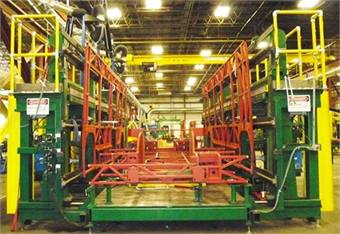
NABI's bus body manufacturing in Anniston, Ala.
NABI President/CEO Jim Marcotuli announced the shipment of the company’s final unfinished bus from Hungary, marking the shift of all NABI buses being produced entirely in the U.S.
Since its incorporation in Alabama in late 1992, NABI utilized a two-step production process with heavy manufacturing relegated to its plants in Hungary, and with final assembly accomplished at its Anniston, Ala., headquarters. However, Marcotuli confirms that the bus maker’s previous two-step business approach has now been entirely discontinued.
Marcotuli elaborated that this final unfinished bus marks the culmination of a progressive shift of manufacturing from Hungary to the U.S. that began with a single, multi-year order for 1,145 standard-floor buses by New Jersey Transit back in 2007.
“The size and multi-year stability of the New Jersey order provided the logical starting point for the progressive shifting of our manufacturing to the USA. We started the change by focusing only on standard-floor buses while leaving our normal low-floor production undisturbed in Hungary. Then in 2011, using lessons learned with the standard-floor production, we began shifting our metal-structured low-floor bus production from Hungary to Alabama. This began incrementally, beginning with structural sub-assemblies being shipped from Hungary rather than unfinished buses, and was completed late last year with all manufacturing now done entirely in Alabama on all new production tooling and with state-of-the-art laser-cutting equipment.”
With all of NABI’s standard-floor and low-floor metal-structured buses produced in Alabama since late last year, this left only the NABI’s composite-structured CompoBus still in production in Hungary. The last of these unique 45-foot buses was completed on April 30th and shipped to Alabama for final assembly. With production of over 700 CompoBuses now completed, and with no plans to resume production of this model, the final unfinished CompoBus that departed Hungary on April 30th marks the end of NABI bus manufacturing in Hungary. The last production CompoBus is expected to be shipped this month.
Bill Coryell who now works in NABI’s sales department was instrumental in the company’s startup in 1992. Coryell explains that the original two-step manufacturing arrangement was a logical approach for a start-up enterprise.
“At the time, Hungary’s bus manufacturing infrastructure was huge, capable and grossly underutilized due to political and economic conditions in Central Europe” notes Coryell. “Using it provided critical facilities, tooling, trained labor as well as deep engineering resources.”
Marcotuli and Coryell both concur that in today’s business climate, the progressive shift in manufacturing to the USA was not only logical, but is a powerful tool to improve business efficiencies and product quality. They echo that this change eliminates substantial transportation cost and simultaneously reduces inventory; reduces in-process time; and shortens delivery time. It also reduces the delivery time on replacement body parts that were previously produced abroad.
An additional and interesting aspect of this change is NABI’s compliance with industry Buy America requirements. Brian Dewsnup, NABI’s CFO, points out, “While the purpose of the shift in production was to secure the previously mentioned improvements in efficiency…as a positive side-effect of the change NABI’s typical U.S. component value has climbed from its previous 60 – 70 percent to typically over 90 percent under the new, all domestic manufacturing scenario.“
Marcotuli is justifiably proud of NABI’s current business operations, noting, “Given today’s concern over foreign goods and heightened consciousness regarding American jobs, we are indeed proud. NABI has simultaneously improved efficiencies, quality and increased American employment. Not only is NABI domestically owned and managed, but it currently produces its products entirely within the USA.”
More Bus

Scenes from APTA TRANSform & EXPO 2026
Transit leaders, manufacturers, and industry professionals gathered in Chicago to explore new technologies, share ideas, and discuss the future of public transportation.
Read More →
More Than a Summer Job: Building the Next Generation of Transit Talent
The Delaware River Port Authority and PATCO have transformed their internship program into a hands-on professional development experience that introduces students to the breadth of transportation careers — and creates a pipeline for future employees.
Read More →
LA Metro Board Awards 220 Battery-Electric Bus Contract to ENC
The contract, which is the largest base award of battery-electric buses by a U.S. transit agency, will be built in Southern California, sustaining good jobs as LA prepares to welcome the world in 2028
Read More →
Public Transit Conference Returning to GFX in 2027, Call for Papers Now Open
The Call for Papers is now open, allowing transit agency professionals and industry experts to help shape the PTC educational program by submitting session ideas for consideration.
Read More →
Indian River Transit’s Community-Focused Approach Earns National Recognition
Named APTA’s 2026 Outstanding Public Transportation System in its size category, Florida’s Indian River County transit system continues to grow ridership through fare-free service and a focus on evolving community needs.
Read More →
ENC Lands MATA Contract and More in Biz Briefs
In this edition of Biz Briefs, we spotlight the latest developments shaping the future of mobility.
Read More →
From Surviving to Thriving: Building Stronger Transportation Organizations
Bus Business Consultants founder Brian Dickson shares lessons on leadership, organizational health, and creating options for long-term success in a changing transportation industry.
Read More →
Everett Transit, Community Transit Outline Consolidation Agreement
The proposed agreement calls for a 50% increase in bus service in Everett, a new microtransit zone, continued paratransit service, and the transfer of Everett Transit operations to Community Transit.
Read More →
SEPTA Details Accelerate Vision for Transit System
The plan outlines investments in trolley modernization, new Metro and Regional Rail vehicles, accessible stations, and more frequent bus and rail service.
Read More →
Report: Transit Bus Manufacturing Supports 34,100 Jobs, $5.1B in GDP
The “Buses Mean Business” report examines the transit bus manufacturing industry’s economic footprint, supply chain, and rising demand for vehicle replacements.
Read More →