



OCTA Sees Growing Adoption of Wave Fare Payment System
Since launching in October 2025, the Wave system has steadily replaced previous fare media with faster, more flexible payment options designed to streamline boarding, improve reliability, and help riders more easily access fare discounts and cost-saving benefits, said OCTA

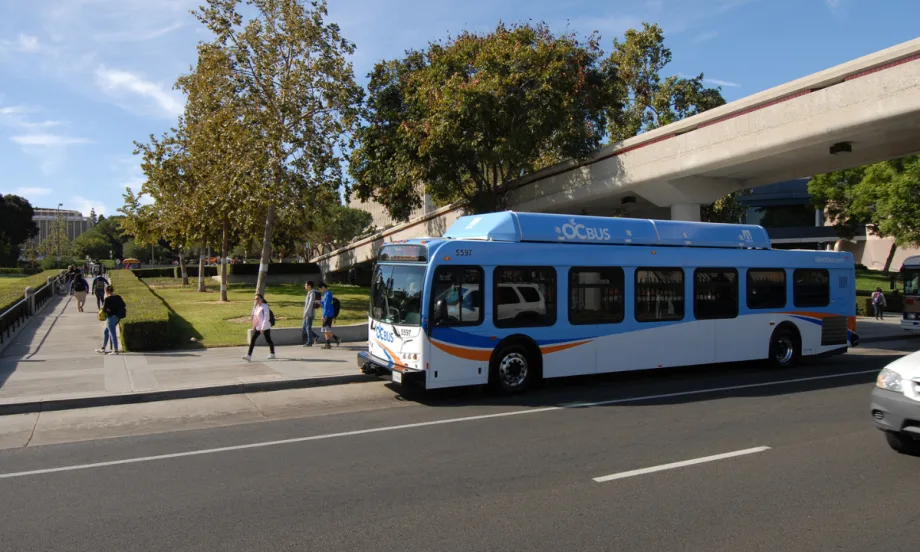
Wave and contactless payments accounted for approximately 31% of OC Bus boardings when the system launched in October 2025. By March 2026, adoption had nearly doubled to 60% and continued growing to approximately 61% in April.
Photo: Orange County Transportation Authority
- OCTA's Wave system, introduced in October 2025, is being increasingly adopted to replace older fare media.
- The new payment options improve boarding times and overall reliability for riders.
- Wave facilitates easier access to fare discounts and cost-saving benefits for users.
*Summarized by AI
California’s Orange County Transportation Authority (OCTA) officials report that adoption of its Wave fare payment system remains strong, with approximately 61% of OC Bus boardings now using Wave cards or contactless payment options as the agency advances efforts to modernize fare collection and improve the transit experience.
Since launching in October 2025, the Wave system has steadily replaced previous fare media with faster, more flexible payment options designed to streamline boarding, improve reliability, and help riders more easily access fare discounts and cost-saving benefits, said OCTA
Wave Adoption
Wave and contactless payments accounted for approximately 31% of OC Bus boardings when the system launched in October 2025. By March 2026, adoption had nearly doubled to 60% and continued growing to approximately 61% in April.
OCTA officials added that during the same period, farebox payments — including cash, magnetic stripe passes, and transfers — declined from 54% of boardings to 39%, reflecting the continued transition to contactless and account-based payment methods.
“The continued growth of the Wave system shows that riders are embracing a more convenient and modern way to pay for transit,” said OCTA Chair Jamey M. Federico. “Wave helps speed up boarding, simplifies fare payment, and ensures riders can more easily take advantage of discounts and features that automatically provide the best value for passengers.”
As of the end of last month, OCTA had more than 255,000 active transit accounts, including approximately 159,000 physical Wave card accounts and 97,000 virtual Wave mobile accounts. The system allows riders to pay using a physical Wave card, the mobile app, or contactless debit and credit cards, including Apple Pay and Google Pay.
Enhancing the Ridership Experience
Wave’s account-based system offers several features designed to enhance convenience for riders, including free two-hour transfers, balance protection, auto-load capabilities, and online account management. Fare capping also ensures riders never pay more than the equivalent daily or monthly fare without needing to pre-purchase passes.
To support accessibility and convenience throughout Orange County, OCTA has expanded the Wave retail network to more than 400 locations countywide — up from 113 retail outlets that previously sold paper passes.
As of April, retail partners processed more than 60,000 Wave card sales and reload transactions, totaling approximately $1.17 million, officials said.
OCTA is also continuing efforts to expand in-person retail access for customers who rely on cash-based transactions, including targeted outreach to additional retailers in the Little Saigon area and other communities throughout Orange County.
All nine Orange County community colleges and three universities now participate in the Wave program, along with 13 social service agencies and 10 employers that help connect riders with transit access and reduced-fare opportunities.
The successful transition follows OCTA’s completion of the phase-out of magnetic-stripe paper passes as of May 1, officials said.
Quick Answers
The Wave system is a fare payment solution launched by OCTA in October 2025, designed to replace previous fare media with faster and more flexible options.
*Summarized by AI
More Technology

Public Transit Conference Returning to GFX in 2027, Call for Papers Now Open
The Call for Papers is now open, allowing transit agency professionals and industry experts to help shape the PTC educational program by submitting session ideas for consideration.
Read More →
ENC Lands MATA Contract and More in Biz Briefs
In this edition of Biz Briefs, we spotlight the latest developments shaping the future of mobility.
Read More →
Strada360’s Steve Lassey on Turning Transit Data Into Better Decisions
From breaking down data silos to preparing for AI, Strada360 CEO Steve Lassey discusses how transit agencies can use technology to improve operations, customer information, and long-term decision-making.
Read More →
Almaviva Looks to Open Architecture to Advance Transit Technology
Eric Reese discusses how interoperability, open architecture, and modular design can help transit agencies control costs, reduce vendor lock-in, and upgrade technology without starting over.
Read More →
Driving Smarter Paratransit
John Hanlon shares how AlphaRoute is leveraging AI-powered technology to help paratransit providers optimize operations, support frontline staff, and enhance the rider experience.
Read More →
From Hardware to Digital Partner: Luminator Charts Its Next Chapter
CEO Magnus Friberg discusses Luminator’s shift toward becoming a digital partner, the growing importance of software and interoperability, and how AI can help agencies improve operations and passenger experience.
Read More →
Beyond the Checklist: A Structured Approach to Transit Maintenance
Reliability-Centered Maintenance helps transit agencies move beyond routine checklists to focus limited resources on the assets and failures that have the greatest impact on safety, reliability, and service.
Read More →
NJ TRANSIT Advances Bus Technology Upgrades Across Statewide Fleet
More than 1,500 buses now feature upgraded technology designed to improve arrival predictions and provide free Wi-Fi, with deployment expected to reach nearly 2,000 buses by the end of 2026.
Read More →
Building a Flexible Path to Transit Electrification
John Hroncich discusses BAE Systems’ modular and scalable approach, lessons learned from decades of real-world operations, and how agencies can identify electrification strategies that fit their fleets.
Read More →
Biz Briefs: Alstom Lands Canadian Contract, LYT to Supply California TSP, and More
In METRO's latest installment, we take a look at recent news from Complete Coach Works, Beep, FlixBus, and more partnerships making headlines across the transportation sector.
Read More →