



Task Force Approves Actions To Guide Post-Pandemic Future of Bay Area Transit Network
Approval of this set of actions marks the culmination of a 14-month effort that began in May 2020 when the Task Force accepted a three-stage mission to help the Bay Area transit network adjust to new conditions created by the COVID-19 pandemic.
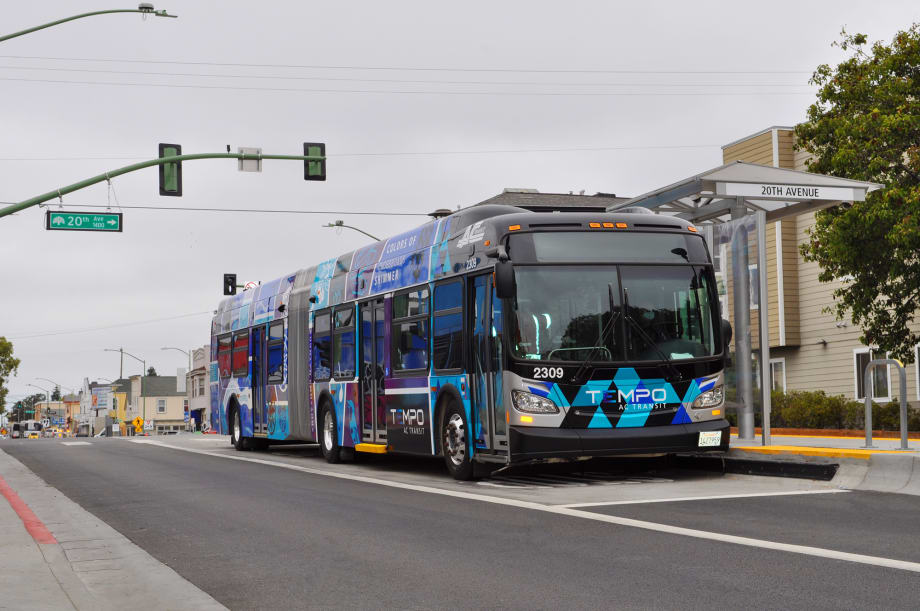
As part of the MTC's findings, the group will act on recommendations of the Fare Coordination and Integration Study, including selecting and funding pilot projects.
AC Transit
The Blue Ribbon Transit Recovery Task Force convened by Calif.’s Metropolitan Transportation Commission (MTC) wrapped up its work by approving 27 near-term actions to be taken by MTC, transit agencies, county transportation agencies, and others in the coming months to make the Bay Area's public transportation network more connected, more efficient, and more customer-focused. Approval of this set of actions marks the culmination of a 14-month effort that began in May 2020 when the Task Force accepted a three-stage mission to help the Bay Area transit network adjust to new conditions created by the COVID-19 pandemic. These stages included assisting in the distribution of federal coronavirus relief funds and guiding transit agencies' recovery planning as well as developing a “Transit Transformation” action plan.
The 32-member Task Force was chaired by MTC Commissioner and Solano County Supervisor Jim Spering and included several other local elected officials as well as advocates for people with disabilities; representatives from the state Senate, state Assembly and the California State Transportation Agency; transit agencies; business and labor groups; and transit and social justice advocates.
"We spent over a year deep in collaborative dialogue and a respectful search for consensus," said Spering. "All of the Task Force members deserve huge thanks for their time and commitment, with special appreciation for the nine transit-agency general managers who actively contributed while also tackling historically severe impacts on their organizations."
The specific actions unanimously approved by the Task Force are organized around the themes of fare-payment coordination and integration; customer information; transit priority on roadways to increase bus speeds and reliability; bus and rail network management reform; connected network planning; data collection and coordination; accessibility; and funding. These include:
Act on recommendations of the Fare Coordination and Integration Study, including selecting and funding pilot projects (completion target: December 2021).
Determine whether existing authority is sufficient to support uniform implementation of these recommendations (Dec. 2021).
If needed, seek state legislation for additional authority to ensure timely and uniform implementation of these recommendations (mid-2022).
Fund and finalize regional mapping and wayfinding standards for application throughout the region (mid-2023).
Fund and complete up to three consistently branded mapping and wayfinding pilot projects in the North Bay and East Bay (late 2024).
Fund and develop a data platform for regional mapping data services to enable standardization of digital and paper maps across all transit services (late 2023).
Request action by Caltrans to expedite design exceptions that will allow for bus priority on state highways (Dec. 2021).
Sponsor legislation to remove barriers to transit priority implementation (early 2022).
Fund the design and delivery of prioritized near-term transit corridor projects (mid-2022)
Define a cooperative agreement process to expedite travel-time improvements on arterial streets and bus rights-of-way (late 2022).
Fund, develop and adopt a transit-priority policy and corridor assessment for improving bus speeds and reliability (late 2023).
Fund and complete a business-case analysis of potential transit network management reforms (mid-2022).
Establish and support an MTC advisory group to guide this analysis (Oct. 2021).
Provide financial incentives for Solano and Sonoma counties to complete their transit integration initiatives (Dec. 2021).
Deliver grant for Phase 1 Rail Partnership and Governance Assessment (late 2021) and Final Assessment (mid-2023).
Adopt transit equity principles and a process for applying them (mid-2022).
Fund, develop and adopt a Bay Area Connected Network Plan (late 2023).
Adopt a transit hub toolkit to optimize station design and connectivity that includes coordination with local governments' access plans (late 2023).
Establish protocols and implement uniform real-time and transit pathway data collection to provide customers consistent and accurate information (mid-2023).
Designate a mobility manager to coordinate rides and serve as a liaison between transit agencies in each county (mid-2022).
Fund more pilot projects for one-seat paratransit rides and develop cost-sharing policies for paratransit trips that cross jurisdictions (late 2022).
Identify the next steps for full integration of ADA paratransit services with the Clipper fare-payment system (late 2022).
Identify key paratransit challenges and recommend reforms (early 2023).
Adopt standardized eligibility practices for programs that benefit people with disabilities, including paratransit and Clipper RTC cards (late 2022).
Identify cost-saving efficiencies and funding needs for regional transit network management as part of the Business Case analysis outlined in actions #13 and #14 above (early 2022).
Convene stakeholders to identify priorities and a funding framework for a future transportation ballot measure that would include new funding for transit (late 2023).
MTC is the transportation planning, financing, and coordinating agency for the nine-county San Francisco Bay Area.
More New Mobility

From Hardware to Digital Partner: Luminator Charts Its Next Chapter
CEO Magnus Friberg discusses Luminator’s shift toward becoming a digital partner, the growing importance of software and interoperability, and how AI can help agencies improve operations and passenger experience.
Read More →
Biz Briefs: Alstom Lands Canadian Contract, LYT to Supply California TSP, and More
In METRO's latest installment, we take a look at recent news from Complete Coach Works, Beep, FlixBus, and more partnerships making headlines across the transportation sector.
Read More →
CharterUP’s Armir Harris on Technology, AI, and the Future of Group Mobility
In a recent episode of METROspectives, CharterUP Founder/CEO Armir Harris discussed the company’s evolution from an online charter bus marketplace into a technology platform supporting public- and private-sector mobility and much more.
Read More →
Jacksonville’s NAVI Project Charts a New Course for Autonomous Public Transportation
Through its NAVI program, JTA is showing how autonomous vehicles, intelligent infrastructure, and coordinated operations can work together to deliver everyday public transportation.
Read More →
Biz Briefs: Luminator Marks Milestone and More
From manufacturers and suppliers to transit agencies and motorcoach operators, these updates offer a snapshot of the projects, partnerships and business moves driving the industry forward.
Read More →
New Tricks for Old Bureaucracies: Joshua Schank on Making Transit Innovation Stick
Former LA Metro Chief Innovation Officer Joshua Schank discusses why good ideas aren't enough, how transit agencies can overcome resistance to change, and why today's challenges demand more innovation.
Read More →
How DART's GoPass Is Redefining Regional Mobility
Serving 14 transit agencies, GoPass simplifies multimodal travel by allowing riders to plan, pay for, and manage an entire trip through one app.
Read More →
Biz Briefs: OCTA Taps Clean Energy for Hydrogen Station, Stadler to Supply Via Rail Vehicles, and More
From manufacturers and suppliers to transit agencies and motorcoach operators, these updates offer a snapshot of the projects, partnerships and business moves driving the industry forward.
Read More →CharterUP Expands Into New Mobility and Autonomous Transportation
Vice President of New Mobility Stephen Joos discusses how CharterUP is leveraging its nationwide transportation network, technology platform, and autonomous vehicle partnerships to expand into workforce mobility, campus shuttles, and transit solutions.
Read More →
METRO Magazine Announces 2026 Innovative Solutions Awards Winners
Projects Recognized for Advancing Mobility Through Technology, Accessibility, Workforce Innovation, and Operational Excellence
Read More →