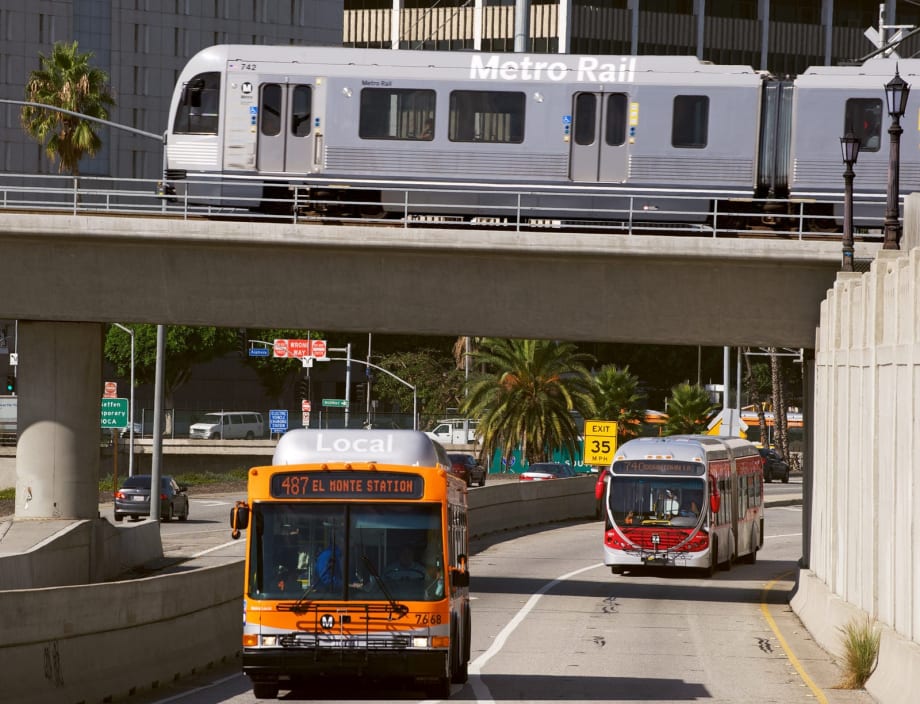
The agency saw a 15% year-over-year increase in ridership in July 2023 compared to July 2022 with more than 23.3 million boardings, marking the eighth consecutive month of year-over-year ridership growth.
In July, Metro had 23,337,404 boardings on its bus and rail services. An average of 843,459 rides were taken each weekday, with Saturday boardings averaging 643,234 and Sunday boardings averaging 542,009.
Credit:
L.A. Metro
3 min to read
The Los Angeles County Metropolitan Transportation Authority (Metro) saw a 15% year-over-year increase in ridership in July 2023 compared to July 2022 with more than 23.3 million boardings, marking the eighth consecutive month of year-over-year ridership growth.
Metro’s monthly bus and rail ridership is now at 76% of its 2019 pre-pandemic level. Average weekend ridership is now at 88% of pre-pandemic (July 2019) levels and 72% for average weekdays.
Ad Loading...
July Ridership Boom
In July, Metro had 23,337,404 boardings on its bus and rail services. An average of 843,459 rides were taken each weekday, with Saturday boardings averaging 643,234 and Sunday boardings averaging 542,009. Post-pandemic ridership recovery continues to be strongest on the weekends, with average boardings on Saturdays reaching more than 86% of (July 2019) pre-pandemic levels and average boardings on Sundays reaching almost 90% of (July 2019) pre-pandemic levels.
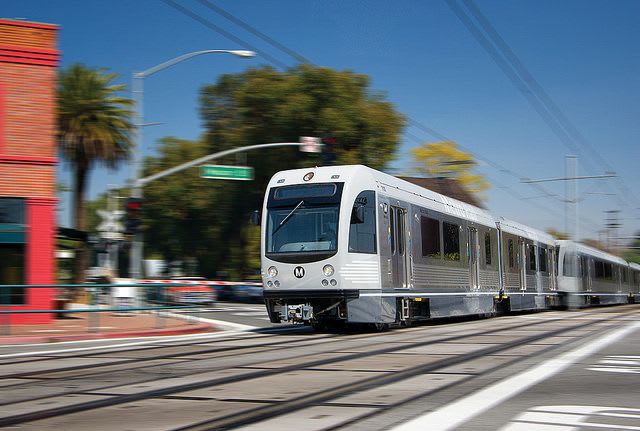
July 2023 marked the first full month of operation for the newly reconfigured A and E Lines, thanks to the opening of the Regional Connector project in June 2023. The Regional Connector project consolidated three of Metro’s legacy rail lines, the A (Blue), E (Expo), and L (Gold) Lines, into two: the A Line, serving customers from Azuza to Long Beach, and the E Line, serving customers from East L.A. to Santa Monica. The project also opened three new stations in downtown L.A.
During July 2023, ridership on the A and E Lines rose 26% on the weekdays compared to the combined ridership on the A (Blue), E (Expo), and L (Gold) Lines in July 2022. Ridership on the weekends in July 2023 rose nearly 42% compared to the combined ridership on the A (Blue), E (Expo), and L (Gold) Lines in July 2022.
Ridership also rose on other parts of the Metro rail system. On the B Line (Red)/D Line (Purple) subway, where there has been an increased focus on safety and a sharp decrease in crime, ridership in July 2023 rose on both the weekdays and the weekends (13% on the weekdays and 4% on the weekends) as compared to July 2022. Average Sunday ridership on the B Line and D Line is now 99% compared to July 2019, before the pandemic. On Sundays in July 2023, an average of 61,290 trips were taken on the B Line and D Lines, compared to 61,923 in July 2019 before the pandemic.
Ridership on the C Line rose 13% on the weekdays and 16% on the weekends year-over-year. K Line year-over-year information is not yet available as the line opened in October 2022.
Ad Loading...
Weekend ridership was driven in part by special events supported by Metro, the Anime Expo (A Line), NoHo Summer Nights (B Line), Riverfest (A Line), Rock the Block (K Line), and a soccer match-up between the LA Galaxy and LAFC at the Rose Bowl (A Line).
Credit:
L.A. Metro
Weekend Ridership Growing
Weekend ridership was driven in part by special events supported by Metro, the Anime Expo (A Line), NoHo Summer Nights (B Line), Riverfest (A Line), Rock the Block (K Line), and a soccer match-up between the LA Galaxy and LAFC at the Rose Bowl (A Line).
In July 2023, Metro bus ridership saw nearly a 12% year-over-year increase. Almost 18 million rides were taken on Metro’s buses, with total bus ridership in July 2023 at 75% of its level in July 2019, before the pandemic.
“We continue to be encouraged that more people are choosing to go Metro on both bus and rail,” said Metro CEO Stephanie Wiggins. “We believe these ridership gains can be directly tied to our proactive efforts to improve the customer experience over the past year, from restoring our pre-pandemic level of bus service to making big improvements related to safety, security, and cleanliness on our rail system.”
Executives from ABC Companies and MCI discuss how rising costs, changing market conditions, and post-pandemic challenges are prompting motorcoach operators to rethink financing strategies, fleet replacement cycles, and long-term planning.
Austin Transit Partnership CEO Greg Canally discusses the city's nearly 10-mile light rail project, its collaborative approach to project delivery, the importance of community engagement, and the milestones ahead as construction approaches in 2027.
ETA founder and CEO John Maglio explores the evolution of transit technology, the importance of reliable systems, and how stronger partnerships can help agencies improve operations and the passenger experience.
The Systemwide Network Plan identifies infrastructure needs and potential investments to expand all-day, bidirectional rail service across the Chicago region.
In this edition, we also spotlight recent personnel moves at HDR, PATH, STV, and more, highlighting the people taking on new roles across the transportation industry.
Transit agencies are using fare-free service, trip-planning tools, and targeted rides to improve voting access. See what other agencies can learn from these efforts.
The railroad’s shift to electric service has brought more frequent trains, stronger customer satisfaction, and increased ridership, earning it APTA’s Outstanding Public Transportation System award.
CTA launched crisis intervention teams as CATS prepares to deploy fare ambassadors, expanding customer assistance and security efforts across both systems.
Bus Business Consultants Founder Brian Dickson discusses the leadership principles, operational discipline, and strategic planning that separate transportation companies positioned for long-term success from those stuck in survival mode.