



New York Begins Issuing Violations for Blocking Bus Stops, Double Parking
The program is in addition to existing enforcement of cars blocking bus lanes on 14 bus routes equipped with Automated Camera Enforcement and double parking in real-time across four boroughs with Staten Island to be added later this year.

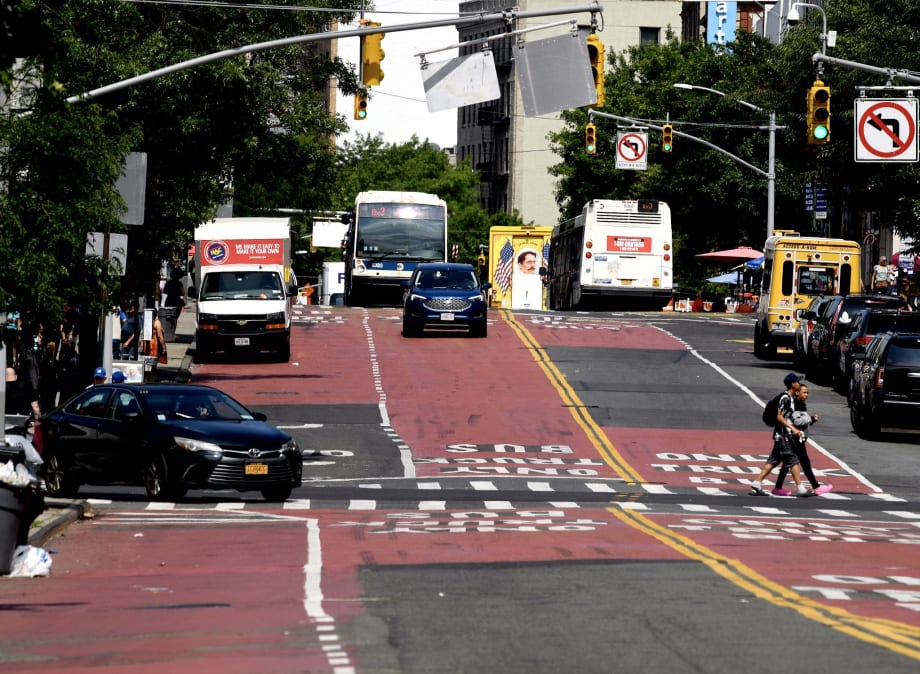
ACE builds on the many accessibility improvements New York City Transit has made to its bus fleet since 1993 when it became since the first large public transit agency to have a 100% wheelchair accessible fleet.
Photo: Marc A. Hermann
The New York Metropolitan Transportation Authority (MTA) began issuing summonses to vehicles blocking bus stops or double parking. Summonses start at $50 and scale up to $250 for repeat violators.
The program is in addition to existing enforcement of cars blocking bus lanes on 14 bus routes equipped with Automated Camera Enforcement (ACE), which captures vehicles violating bus lane and bus stop rules, and double parking in real-time across four boroughs with Staten Island to be added later this year.
Early Impact
New York City Transit Sr. VP, Buses, Frank Annicaro rode the M34 Select Bus Service (SBS), and in one case, got off the bus to personally tell a driver blocking the bus to move.
When enforcement cameras are activated, on average, routes see bus lane speeds increased by 5%, a 20% reduction in collisions, and a 5% to 10% estimated reduction in emissions. Only 9% of drivers commit another bus lane violation after being fined.
All 623 buses on the 14 routes that currently feature lane enforcement technology on bus lanes have now upgraded capability to enforce bus stops and double-parked locations.
Enforcing vehicles parked in bus stops helps ensure buses can pull to the curb, allowing all customers to safely exit and board the bus including those using wheelchairs or mobility devices and those pushing strollers or carts.
Benefits of ACE
ACE builds on the many accessibility improvements New York City Transit has made to its bus fleet since 1993 when it became since the first large public transit agency to have a 100% wheelchair accessible fleet.
The ACE program is administered in partnership with the New York City Department of Transportation (NYCDOT) and the New York City Department of Finance.
Once captured by the cameras, video, images, license plate, location, and time stamp information are then transmitted to NYCDOT for review and processing.
Since 2019, NYCDOT has issued 438,660 notices of violations. By the end of 2024, there will be 1,023 ACE equipped buses across 33 routes.
Each corridor with active ACE camera enforcement has signage indicating that those routes are camera-enforced.
More Security and Safety

Transit Agencies Highlight Safety Gains at National Summit
Leaders from 15 major transit systems shared crime-reduction results and safety initiatives while discussing the role of continued federal support.
Read More →
DART Launches Major Security, Fare Enforcement Initiative
The 90-day demonstration will deploy coordinated security teams at five light rail stations while testing controlled access and gathering data to guide future investments.
Read More →
RTD Launches NextRide App to Consolidate Trip Planning, Fares, Security Reporting
The app expands on RTD’s existing NextRide web application and allows customers to view real-time vehicle locations and service alerts, purchase and store digital fares, and access customer support.
Read More →

TAPTCO Updates OSHA Compliance Training for Transit Maintenance Operations
The revamped program addresses 26 OSHA standards for maintenance facilities, with TAPTCO pointing to training, documentation, and everyday shop hazards as continuing challenges for transit operations.
Read More →
How VaporVision Adds Value to Transit Door Systems
Wabtec engineers explain how the system improves doorway detection, strengthens diagnostics and gives transit agencies and OEMs greater operating flexibility.
Read More →
FRA Announces $5.3B in Rail Investments, Including $2B for Amtrak
Funding will support grade-crossing improvements, infrastructure upgrades, and new Amtrak equipment in 23 states.
Read More →
Chicago, Maryland Expand Non-Law-Enforcement Safety, Rider Support
The CTA and MTA are launching new programs aimed at de-escalation, crisis response, rider assistance, and greater transparency.
Read More →
LA Metro, City of West Hollywood, and Partners Advance Smarter Bus Lane Enforcement
The award-winning partnership combines AI-powered detection with human oversight to improve bus reliability, accessibility, and enforcement efficiency.
Read More →
LA Metro Reports 57% Decline in Homelessness on Transit System Since 2024
The agency's latest homelessness count offers new data on how care-based services and cross-sector partnerships can complement traditional transit security strategies.
Read More →
FTA Launches 'Transit Moves America' Dashboard to Highlight Agency Safety and Performance
The online dashboard transforms National Transit Database information into a public-facing resource that allows users to compare transit agencies on key operational and safety metrics.
Read More →