



California's OCTA Says Coastal Rail Stabilization Requires Emergency Action
OCTA’s first action was to issue a request for information for contractors to provide dredging and transport options to expedite the sand placement component of the projects. OCTA expects to place approximately 540,000 cubic yards of sand.

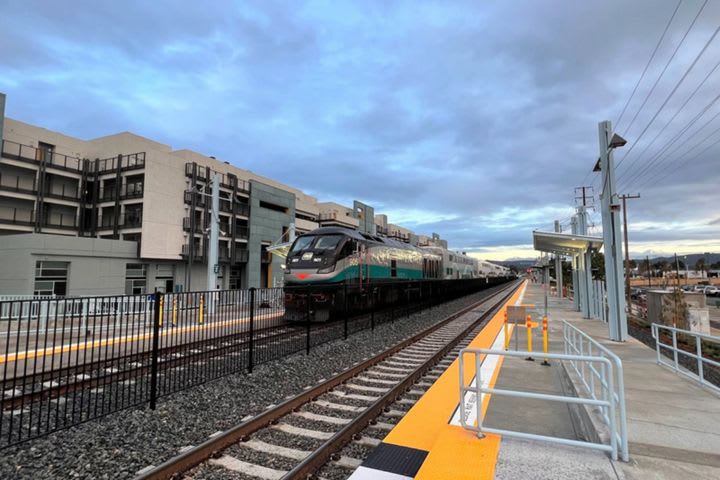
Emergency action is necessary to prevent additional disruption of vital rail service. In addition, continued erosion requires quick action to repair and replace existing riprap, and deliver enough sand to help protect the tracks.
Photo: OCTA
With ongoing threats to a critical link in Southern California’s rail network, the Orange County Transportation Authority (OCTA) submitted an Emergency Coastal Development Permit to the California Coastal Commission to expedite work to stabilize four areas most vulnerable to failure above the railroad track through San Clemente.
The effort allows OCTA to take immediate steps to protect a critical link in the state’s rail network. OCTA’s first action was to issue a request for information for contractors to provide dredging and transport options to expedite the sand placement component of the projects. OCTA expects to place approximately 540,000 cubic yards of sand.
The Need for Resiliency
Emergency action is necessary to prevent additional disruption of vital rail service. In addition, continued erosion requires quick action to repair and replace existing riprap, and deliver enough sand to help protect the tracks.
A series of landslides near Mariposa Point have occurred over the past year and debris and mud are nearing the top of the 12-foot-high temporary catchment wall constructed a year ago when a slope failure forced rail service to shut down.
OCTA has coordinated closely with the Coastal Commission and the California State Transportation Agency (CalSTA) and other stakeholders since 2021, when an unstable private slope in the Cyprus Shore community of San Clemente forced the first of several closures totaling more than a year along the rail line that has been in place since the 1880s.
OCTA has addressed ongoing emergencies as they have occurred, and through a comprehensive process, four additional areas were identified that require immediate action to prevent loss of property and essential public rail services, as well as for the protection of life and public safety to avoid a catastrophic bluff failure.
Emergency Actions Needed
On April 14, the OCTA board is expected to consider an action that will allow the CEO to enter into emergency contracting agreements to expedite work on the four Coastal Rail Stabilization Priority Projects that were identified in 2024 as most vulnerable.
The board action, if approved, would allow OCTA to:
Issue an emergency design-build procurement for construction of a catchment wall along Mariposa Point, which is planned to include restoration of San Clemente’s popular pedestrian trail, and to build a revetment, seawall, or functionally equivalent structure south of San Clemente State Beach.
Direct Metrolink to repair and replace existing riprap, limiting the amount to only what’s necessary to protect the track.
It’s estimated that 5,100 cubic yards of riprap is needed to protect the track near Mariposa Point and nearly 50 times that amount – 240,000 cubic yards – of sand will be placed.
At the southern end of the project, near San Clemente State Beach, 1,400 cubic yards of riprap repair, 22,000 cubic yards of engineered revetment, seawall or functionally equivalent structure, and 300,000 cubic yards of sand have been identified as necessary to protect the track.
In total, OCTA estimates 95% of the project will be sand placement and 5% will be riprap placement.
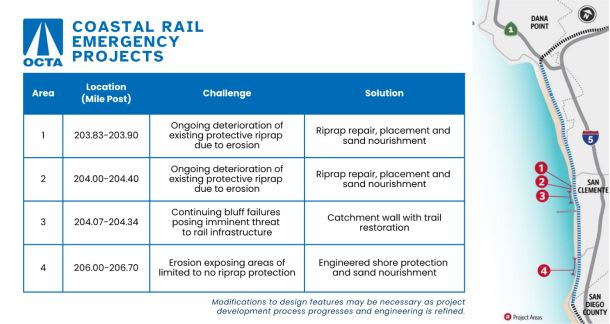
In total, OCTA estimates 95% of the project will be sand placement and 5% will be riprap placement.
Photo: OCTA
OCTA’s Path to Completion
While all of the activities are necessary to resolve the emergency, they are expected to occur on different timelines based on their complexity and availability of contractors and material.
Additionally, the design and amount of materials will be further refined and are subject to change as design is advanced. Most of the activities will occur within OCTA’s rail right-of-way.
Securing this permit does not relieve OCTA of its responsibility for environmental mitigations but it enables OCTA to expedite the design and construction processes. With the emergency process, it’s estimated the projects could be delivered one to two years sooner than the standard permit process would allow.
This emergency work is consistent with the $305 million in state and federal grant funds OCTA received in late 2024 for the effort. This financial commitment underscores the urgency and importance of protecting the region’s transportation infrastructure.
The closures since 2021, amounting to more than a year, have severed the only rail connection between San Diego County and the rest of the nation, affecting millions of annual passengers and impacting more than $1 billion in annual freight movement.
Additionally, the LOSSAN corridor plays a crucial role in the nation’s Strategic Rail Corridor Network by supporting military logistics, freight movement, and passenger transportation, ensuring connectivity between key military installations and commercial hubs along the West Coast.
As this emergency effort advances, OCTA will keep the public informed of progress, construction activities, and any impacts to rail service and beach access that may be necessary to ensure public safety.
More Rail

New York MTA Advances Final Contract for Second Avenue Subway Expansion
Contract Four is the largest in the Second Avenue Subway Phase 2 project and includes construction of station infrastructure, tracks, and signals for the subway expansion, MTA officials said. Work on Contract Four will begin in 2027.
Read More →
San Diego MTS Breaks Monthly Trolley Ridership Record
Agency officials said July’s ridership indicates MTS’s continued recovery from the pandemic.
Read More →
Report Examines NJ TRANSIT Reliability, Funding Challenges
The Garden State Initiative analysis examines the roles of Amtrak infrastructure, fleet management, and agency operations while recommending a more performance-based approach to improving reliability.
Read More →
Stadler, CapMetro Sign Long-Term Rail Fleet Support Agreement
Beginning in 2027, Stadler will provide on-site technical expertise, spare parts support, training, and obsolescence management to help extend the reliability and longevity of CapMetro’s GTW fleet.
Read More →
Biz Briefs: Alstom Lands Canadian Contract, LYT to Supply California TSP, and More
In METRO's latest installment, we take a look at recent news from Complete Coach Works, Beep, FlixBus, and more partnerships making headlines across the transportation sector.
Read More →
CATS Gold Line Marks 5 Years of Service, 2.8M Passenger Trips
With a six-mile expansion planned, the Charlotte streetcar is positioned to connect more neighborhoods and major transit hubs across the region.
Read More →
Why Simulating Pedestrian Movement Has Become Essential for Modern Rail Stations
Pedestrian microsimulation is helping rail planners identify bottlenecks, test station designs, and prepare complex transit hubs for growing passenger volumes.
Read More →
Amtrak Begins Major Construction at New York’s Sunnyside Yard
The new maintenance facility will support Amtrak’s Airo trainsets while improving maintenance efficiency and turnaround times in New York.
Read More →
Chicago Leaders Unveil Plans for O’Hare Airport Express Train
The privately developed project would offer a 15-minute trip between downtown and O’Hare’s Terminal 2, with trains operating every 15 minutes on a dedicated track. The service would use battery-electric trains and three existing freight rail rights-of-way.
Read More →
OCTA Maps Out 30-Year Strategy to Protect Coastal Rail Corridor
The draft feasibility report identifies strategies to protect the coastal rail line for decades as the agency continues near-term stabilization and sand placement efforts.
Read More →