120 Years of Transit Innovation: NYC’s Subway Pushes Transit Systems Forward
After 120 years of operation, the New York City subway system has made several innovations and continues to be at the forefront of finding ways to improve the rider and operator experience.
by Staff
January 29, 2025
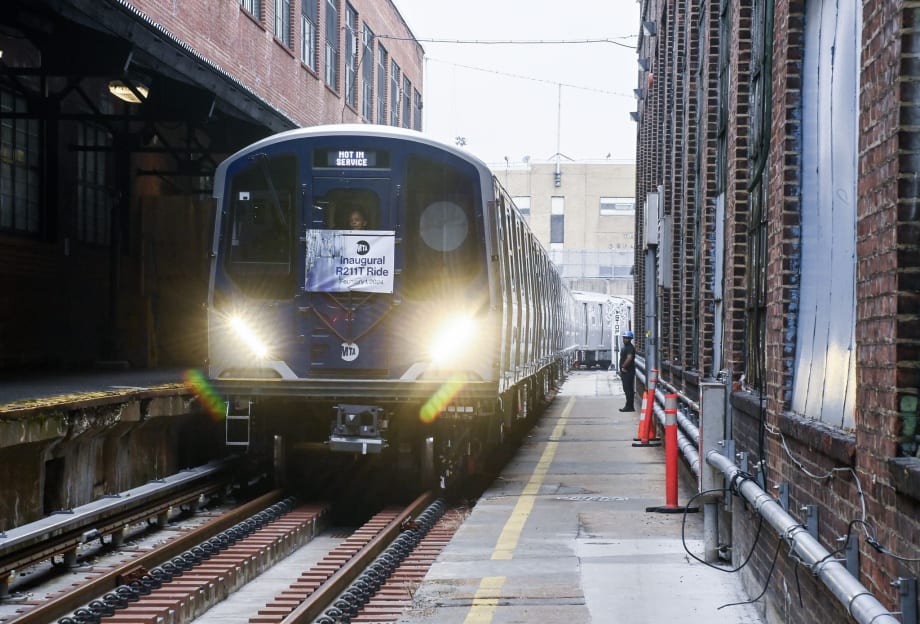
New York's new R211 subway cars are designed to be more accessible than their old cars, featuring wider doors for loading and unloading.
Photo: Marc A Hermann
5 min to read
The New York City subway system has been operational for 120 years.
It has introduced innovations to enhance both rider and operator experiences.
The system remains a leader in advancing transit solutions.
*Summarized by AI
The New York City subway system is known worldwide for several reasons. From innovations such as the third rail to air conditioning, the New York subway system has changed subway trains forever.
Opening on October 27, 1904, the world-famous subway system recently celebrated its 120th anniversary. As times have changed, the New York Metropolitan Transit Authority (MTA) and the New York Transit Museum continue to preserve the legacy of the subway while also innovating intercity transportation.
Ad Loading...
Keeping History Alive
The New York City Subway currently consists of 25 routes, including 472 stations and 800 track miles, but all that infrastructure was built over 120 years.
The original line of the subway, known as the Interborough Rapid Transit, opened on October 27, 1904, with 28 stations and stretched for 9.1 miles from City Hall to Harlem. Construction began roughly five years before opening, making the oldest parts of the subway system 125 years old.
“Maintaining the assets is the biggest challenge for sure,” said John Gasparine, WSP New York transportation lead. “That’s why MTA has such a big state of good repair budget.”
WSP has been involved with the New York City Subway from the beginning, as William Barclay Parsons served as the chief engineer for the Interborough Rapid Transit project. Parsons founded the New York-based Parsons Brinckerhoff, which is a forerunner of WSP.
Apart from WSP, which works on the subway system to this day, the New York Transit Museum helps preserve the history of the railway. Focusing on preserving the history of the subway, the Transit Museum maintains the original City Hall Station, an architectural icon.
Ad Loading...
As the city has grown and the subway system expanded, some of the original stations have been demolished to make way for new construction. When the original Penn Station was demolished, the importance of historic preservation became apparent.
“Historic preservation became a very big thing in New York and almost everywhere when the original Penn Station was demolished,” said Gasparine. “So now historic preservation permeates almost everything that we do, especially as it relates to the stations. MTA bakes historic preservation into all the original stations and the tunnels themselves as they’re a functional piece of infrastructure, and they’re constantly being maintained.”
While not open to the public, the New York Transit Museum offers rides on vintage train cars through City Hall Station for the 120th anniversary of the subway and every December.
Pushing Technology Forward
To build the Interborough Rapid Transit subway, several technological innovations were implemented, including one that would change the way electric trains work forever. One of WSP’s founders, Henry M. Brinckerhoff, helped invent the third rail in 1894, allowing trains to operate on electricity safely and eliminating any smoke or steam produced by steam engines.
“Henry M Brinckerhoff helped invent third rail electrification of passenger trains as we know them today,” said Gasparine. “He helped eliminate the smoke that would otherwise be coming from a locomotive in those enclosed spaces. He also helped General Parsons create the first steel subway cars, a move away from wooden chassis. It resulted in longer-lasting, safer vehicles.”
Ad Loading...
The construction of the tunnels also utilized new technology that enabled engineers to build the City Hall station without disrupting the building above. The various blasting techniques used in tunnel construction revolutionized underground work in urban areas.
As the subway system grew, safety systems that allowed operators to track the location of all subway trains became necessary.
Following the trend of pioneering new technologies, such as an interlocking block system with automatic trippers overlapping track circuits, the trains themselves were among the first to feature a train stop in the cab that automatically stopped the train if an operator removed their hand from the control panel.
With the cold winters and hot summers, the New York Subway was among the first to install air conditioning.
“Over the years, going back to 1955, I think one of the biggest milestones was air conditioning,” said Gasparine. “Making people cool in the summer and warm in the winter. That was a big deal.”
Ad Loading...
Adapting to Modern Times
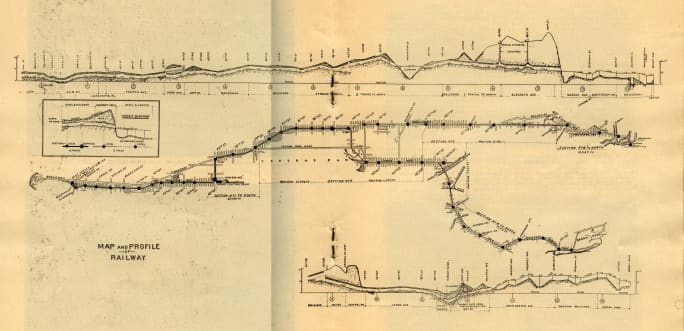
This map shows the original layout of the IRT subway system. Much of the infrastructure depicted on this map is still in place today and is maintained by the state of New York.
Photo: WSP
The New York Subway is still pushing innovation forward, as they are currently putting a focus on American Disability Act accessibility. Work to make the subway accessible to all is ongoing, with accessibility improvements at stations and on trains often underway.
Recently, New York City has been purchasing new R211 subway cars to address accessibility issues. These cars feature more accessible seating and wider doorways to improve the boarding process.
Updating the subway trains can be a challenge, however, as the 120-year-old infrastructure was designed for older, smaller cars; modern cars and engines have to be considered with these restrictions in mind.
“When you look at the size of the tunnels from the original IRT lines and the radius of the turns, it actually limits how long a train car or the train itself could be, as well as how wide a train can be,” said Gasparine. “So some of the tunnel structure and geometry present constraints on options for how to modernize the subway. Another big challenge is that the original system was built with natural ventilation. This was designed so that when trains are moving through the tube, they push the air ahead of the train, creating a vacuum behind the train that draws in fresh air from at-grade vents. This makes it hard to heat and cool stations mechanically.”
Other Innovations on the Tracks
Keeping riders comfortable and on the move is a big part of any transit system, and one innovation many transit systems still use today did not require any technological advancements.
Ad Loading...
With a large population wanting to get from one side of New York City to the other, the designers of the New York City subway decided to implement express tracks with fewer stops and less time spent waiting for passengers to get on and off the train. The New York subway system was the first subway to implement an express line.
The Next Big Thing
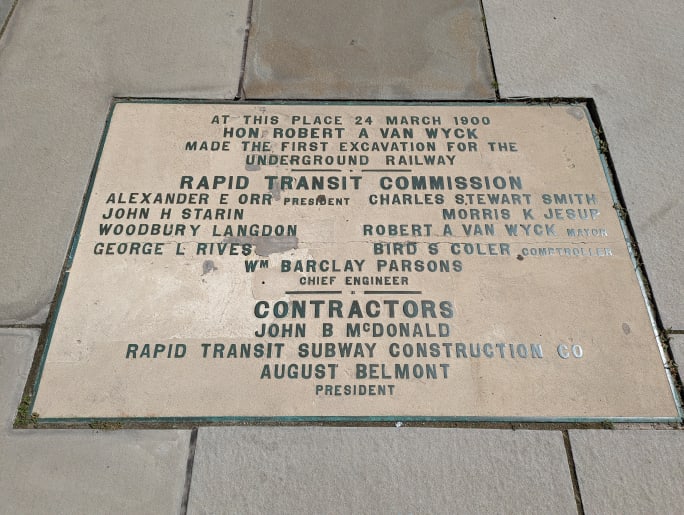
The location of the groundbreaking for the New York City Subway is marked by a plaque commemorating those who worked on building the initial IRT railway system, which expanded into the current subway system.
Photo: WSP
As technology continues to improve, the New York City subway continues to be at the forefront of implementing new technologies.
By migrating to digital systems, the subway is making real-time passenger information available to everyone, regardless of where they are. Even the train control system is seeing the benefits of going digital with the advent of communication-based train control and laser-based track intrusion detection systems.
The MTA is investing heavily in technology as it becomes more refined, keeping the New York City subway system at the forefront of the industry and innovating wherever it can.
The NYC subway system's 120 years of operation signify its longstanding service and its role in pioneering transit innovations that improve both rider and operator experiences.
The NYC subway system has contributed to transit innovation by implementing technologies and strategies that enhance efficiency, safety, and comfort for both riders and operators.
The NYC subway system focuses on improving rider experience through the adoption of advanced technologies, better infrastructure, and service enhancements aimed at providing a more reliable and comfortable journey.
Innovations in the NYC subway system help operators by streamlining operations, improving safety protocols, and providing better tools and resources for efficient transit management.
Continuous innovation in transit systems is crucial to meet evolving urban demands, enhance service quality, reduce operational costs, and ensure sustainability in an increasingly interconnected world.
Contract Four is the largest in the Second Avenue Subway Phase 2 project and includes construction of station infrastructure, tracks, and signals for the subway expansion, MTA officials said. Work on Contract Four will begin in 2027.
The Garden State Initiative analysis examines the roles of Amtrak infrastructure, fleet management, and agency operations while recommending a more performance-based approach to improving reliability.
Beginning in 2027, Stadler will provide on-site technical expertise, spare parts support, training, and obsolescence management to help extend the reliability and longevity of CapMetro’s GTW fleet.
In METRO's latest installment, we take a look at recent news from Complete Coach Works, Beep, FlixBus, and more partnerships making headlines across the transportation sector.
Pedestrian microsimulation is helping rail planners identify bottlenecks, test station designs, and prepare complex transit hubs for growing passenger volumes.
The privately developed project would offer a 15-minute trip between downtown and O’Hare’s Terminal 2, with trains operating every 15 minutes on a dedicated track. The service would use battery-electric trains and three existing freight rail rights-of-way.
The draft feasibility report identifies strategies to protect the coastal rail line for decades as the agency continues near-term stabilization and sand placement efforts.